Showing posts with label Paul Schurke. Show all posts

Sunday, 12 March 2017

Dog sledding in the Arctic and Antarctic

Every spare day I can find, I spend at least an hour sorting out photographs and slides taken over 60 years. Today I am working on the various trips I have done in Antarctica and the Arctic with dogs and sledges. When I reflect, my trips with dogs are the most memorable of all my expeditions, and this is due to the relationships that are built up between you and the dogs. Here are a few of my shots.
For more on Scott Base, Antarctica huskies, see this link.

Travelling by plane with 50 huskies from Igaluit (formerly Frobisher Bay) to Eureka (79.9889° N, 85.9408° W) on Ellesmere Island. Then we flew in Twin Otters to Ward Hunt Island, our starting point for the North Pole.


                                   My two strong lead dogs at Scott Base, Rangi (l) and Oscar.


In 1985, we did a 1500-mile dog sledge trip from Arctic Red River on the Mackenzie River, Canada, to Point Barrow, Alaska. A lot of the time was spent travelling on the Arctic Ocean. Paul Schurke (left) puts our gear in the tent while I check the condition of the dogs. (right)


         "Let me sleep another hour.' Odin, a Scott Base husky in 1969. (Antarctica)


The last of the Scott Base huskies, I shipped them from Antarctica to Lyttelton, NZ in 1987, and then to the US via Hawaii, to join Will Steger's kennel in Ely Minnesota. Here they are at Christchurch ready to be flown to the US.


 Following behind Chris Knott with his dog team near Scott base, Antarctica. 1970.


 Training for the North Pole on Baffin Island where we tested dogs, equipment and team members down to minus 45 oC.


                        A master of Antarctic dog sledging, Chris Knott. 1969 at Scott Base. 

                               Setting out on a trip from Scott Base with a team of huskies.

 Lead dogs, Mike and Kulak. Stronger than oxen and set good work ethics for the other dogs. Scott Base 1969-70


                                 Settling in for the night as the sun dips. Arctic Ocean 1986.


Brent Boddy was one of our North Pole team members who lived in Iqaluit, Baffin Island. Here is Brent with his dogs, his house behind and his wife and son Nigel. Brent always carried a harpoon with him to test the thickness of the ice. A highly experienced Arctic traveller.

On our trip to point Barrow Alaska, we often skiied out front to coax the dogs along when they got bored. 1985


Friday, 8 June 2012

An encounter with white wolves and musk oxen on the way to the North Pole.


In 1986 I was a member of the Steger International Polar Expedition. While at a remote weather station called Eureka located  at around 80 degrees north in latitude, on Ellesmere Island in Arctic Canada, I had one of the most amazing encounters with musk oxen and white wolves. I was with Jim Brandenberg, the National Geographic photographer and writer who tells the story. . 

From Ellesmere's tip to the North Pole measures some 500 miles across the Arctic Ocean. During the winter, and for the first 50 or so days of "spring", such as it is, the water is frozen six to eight feet thick most of the way to the Pole. Unfortunately, even during the best of conditions, this ice has little in common with the glassy ice familiar to figure skaters and cocktail enthusiasts.

Across its craggy, snow-blown surface, the ice cap is wrinkled with pressure ridges. These erupt in endless labyrinthine walls that can make forward progress an agonizing, "leads" yawning cracks in the ice that reveal open sea water. When a team of mushers encounters a lead, they have no choice but to circumnavigate it or wait for the minus 70degree air to refreeze the brine and create the several inches of rubbery ice needed to support a sled loaded with supplies.

In 1909, the legendary Peary with his men and dogs braved this unforgiving habitat, aided by an army of Inuit assistants. But ever since Peary's North Pole adventure, which took place without external resupply, there has been rampant speculation as to whether he really reached the Pole. The reason for the controversy is largely climatological. Peary's expedition began in early March, when the sun momentarily rises above the Arctic horizon for the first time in four months. Peary had only about seven weeks to make it to the Pole and back to land before the ice cap break-up, a period many scholars consider impossibly short.


                                                             Photo: Jim Bradenberg


Steger and co-leader Paul Schurke were determined to try a second, unsupported trip to the Pole, putting the debate to rest, one way or the other. Before the Steger team could even begin, however, they had to get their expedition to the departure point, no small ordeal. Sleds, dogs, crew members and tons of supplies all had to be carried, by a succession of ever smaller aircraft, to the tip of Ellesmere Island in time for an Ides-of-arch send off.

The traditional first stop for all expeditioners is Resolute Bay in the Northwest Territories, the most northerly spot serviced by commercial airlines. From there, Arctic dreamers must cart their supplies several hours further north to Eureka Sound, where a permanent weather station is manned by a dozen men. To reach Eureka, it's necessary to charter 748s, DC-3s, or Twin Otters, the smallish, highly maneuverable aircraft with skis for wheels, "the workhorses of the Arctic." Finally, to traverse the approximately 300 miles from Eureka to northern Ellesmere, expeditioners and their gear are ferried by Twin Otters.


 The weather station at Eureka, surrounded by what is in essence a frozen desert, made me think of what life must be like on a space station. My fellow inhabitants were all technicians whose fives revolved around the collecting of data and the combating of boredom. They drank, ate, slept, thought about meteorology, played cards, watched satellite TV and looked forward to an occasional risque video cassette. Depression was a problem, especially during the long months without sunshine.

The Eureka personnel rarely took advantage of the natural world outside. To be sure, the winter environment is about as hospitable to human flesh as outer space: a half-hour without your proper "space suit" and you will almost certainly expire. Still, after a few days at the station waiting out expeditionary snafus, I felt myself getting extremely jumpy from boredom and claustrophobia. For three days in a row, I had whiled away the hours by aiming my binoculars through the murky blue twilight at a distant herd of musk oxen, which looked like raisins in the snow. I thought it might be fun to take a closer look.


                                        Musk Oxen, NWT Canada. Photo: Bob McKerrow


Bob McKerrow, a Steger team member from New Zealand, agreed to go along. We assumed the herd was very close, but after a half-hour of steady hiking we realized that they were at least four miles away from the station. Lacking any experience with the animals, we approached with great caution. There are no trees to climb in the high Arctic, and we felt quite certain that the horns and hooves of an adult musk ox could make short work of us. As we came closer, the magnificent ancient beasts, living remnants from the Stone Age, came into sharper focus.

Having grown up on the prairie, I had expected musk oxen to be similar in size to buffalo. In reality, they are much smaller - about the size of cows, though they are more closely related to goats than to cattle. With their sure-footed hooves, they have little trouble scrambling along rocky precipices.

I could see the animals' extremely long guard hairs, almost a yard in length. Thanks to these hairs, which are prized for yarn, as well as their highly insulated undercoats, musk oxen are never affected by the cold, no matter how low the temperature drops. Noting their indifference to the climate, it occurred to me for the first of many times in the Arctic how nice it would be to have a little more hair myself.

At one point, we evidently got a little too close to the herd, because they quickly assumed their classic protective circle: a phalanx of horns and front hooves radiating at every point on the circumference, flanks shoved together at the center. This strategy, evolved over eons of living in a treeless environment, is a very effective way to protect the young against Arctic wolves, the major predator of musk oxen. It is not so effective against human predators like the Inuits who found the musk oxen relatively easy to kill.

McKerrow and I backed off and the musk oxen resumed their grazing, pawing holes in the snow to get at the frozen grass and sedge below. We studied them for hours, until finally cold and fatigue got the better of us and we decided to begin the long hike back to the station. The sun at this time of year lurks just below the horizon for most of the day, creating a kind of permanent blue dusk. On the way back, I trailed behind, taking photographs of the landscape. McKerrow was about a quarter-mile ahead when it happened.


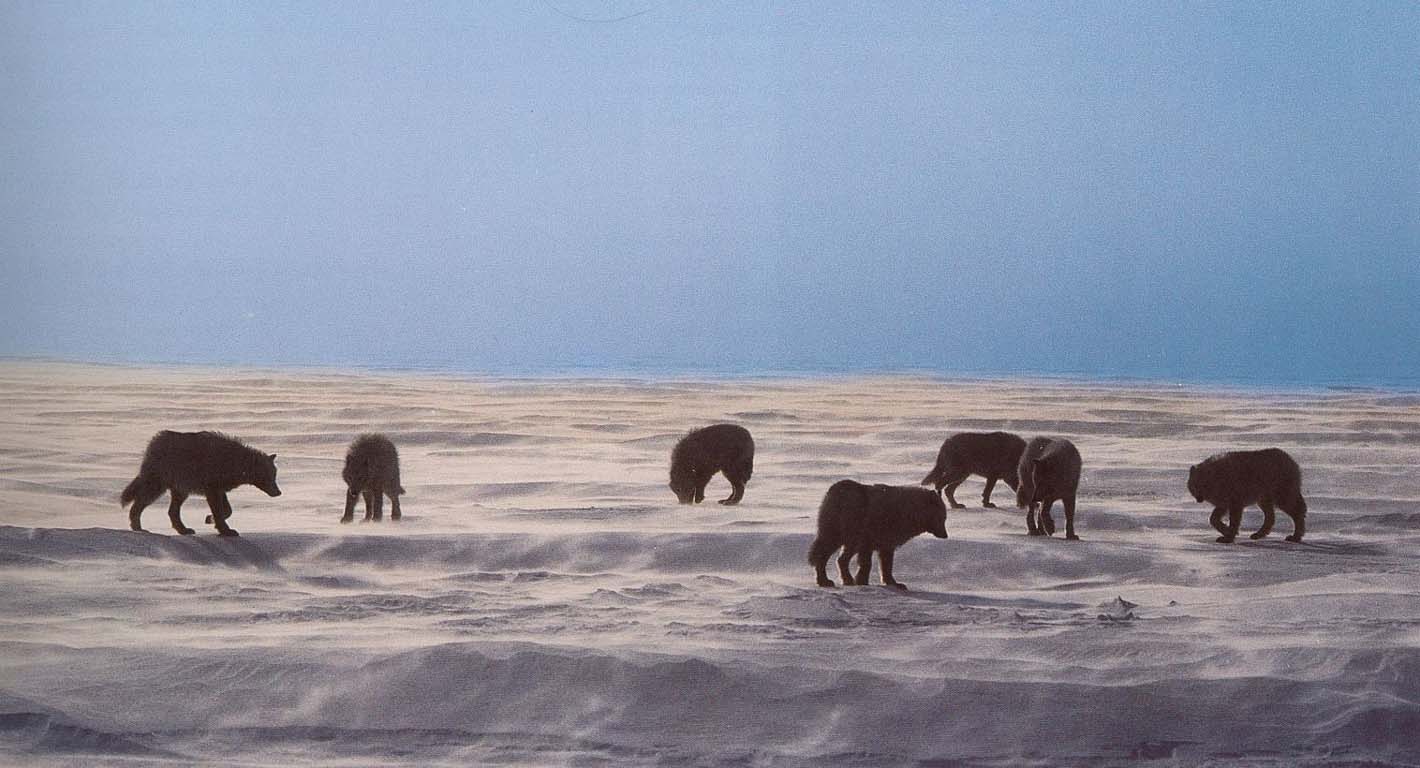
Ellesmere Island is a vast, lonely land
whose inhabitants must struggle to make out a living.
Wolves are tireless travelers who roam the thousands
of square miles of their territory in search of prey.
Photo: Jim Bradenberg

A pack of six Arctic wolves, trotting in a direct line of march over a nearby rise, appeared like ghosts materializing from the blue ether. At first, I thought I must have been hallucinating from cold, hunger and fatigue. Three of them split to my left. Three others swung around to a steep embankment that flanked a nearby frozen creek. They trotted to the top and sat there, eyeing me, their bodies silhouetted against the murky horizon. One wolf, which I thought might be the leader of the pack, sat on the ridge and inspected me with a kind of fearless, bemused curiosity. Much later, when I returned to search for a pack to live with and photograph, I would remember this individual wolf and be convinced he was the same alpha male I would come to know as Buster.

At that moment, however, I was not thinking about the future. I was, to say the least, flabbergasted. Reflexively, I pulled out my camera and began shooting photograph after photograph. It was at this moment that I first learned the difficulties of shooting in the Arctic when you are excited. The combination of exhaustion and exhilaration makes huffing and puffing inevitable, and one breath on the viewfinder enamels the glass with an I/ 16th-inch coating of ice. This must be scraped off with your fingernail, which means removing your two sets of gloves, which means freezing your fingers.

After scrutinizing me for several minutes, the wolves stood up and resumed their pursuit of the musk oxen. Suddenly realizing that I might be able to capture wolves and their natural prey in the same photographic frame, I turned around and raced after them as best I could. A weary biped is no match for a species superbly adapted to the Arctic.


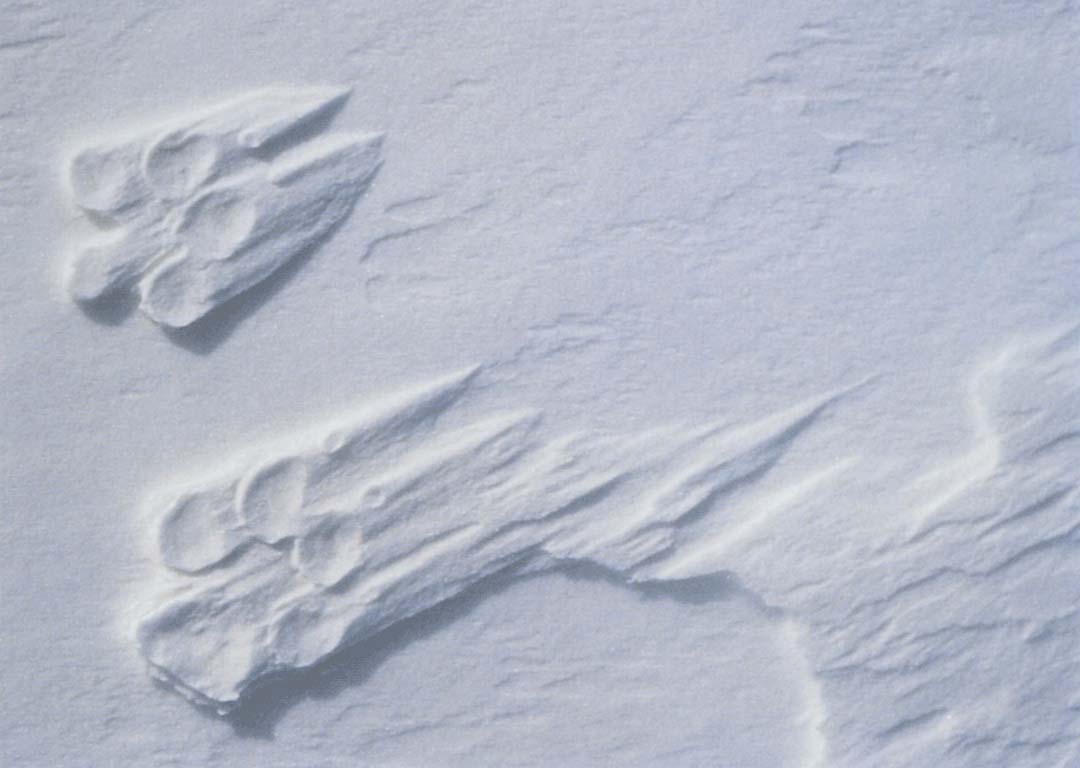
trace.jpg
a windblown signature in the snow. Photo: Jim Bradenberg

The paws of a wolf are large, and they can splay their toes so wide that their tracks in the snow almost resemble human handprints. Their weight is distributed evenly across the snow, so they can walk on top of the crust. In my mukluks, was breaking through on every other step. After 20 minutes, I was exhausted. As the dusk deepened, I snapped a few last shots of the distant wolves approaching the even more distant musk oxen. Then, with muscles aching, I turned back to catch up with McKerrow. When we were a half-hour away from the weather station, a Twin Otter flew overhead and dipped its wings a not so subtle sign of concern and a reminder it was time to come in from the cold.

Back at the station, my mind reeled with wolf images. I'd been wrong in my interpretation of Will Steger's Ellesmere anecdote: sled dogs would not be necessary to lure wolves. Evidently the wolves' own curiosity, fueled by the absence of unpleasant experiences with humans in this remote comer of the world, was enough to allow some close encounters with the pack.

A few days later, we flew to Ward Hunt Island and waited for the first glimmer of sun to inaugurate Will's trek. On March 5, the sun appeared for a few moments on the horizon and winked at us before dipping down again below the earth's rim. This was the signal to begin, and off Steger and company went, in a cacophony of canine barks and human cheers that would soon turn to grunts. I was on hand to photograph the departure, and then flew back south by Twin Otter to Eureka.

At three points during the expedition, a Twin Otter was scheduled to fly in and airlift out sled dogs, a humanitarian alternative to Peary's policy of eating any dog no longer needed to pull supplies. The plane, of course, would not bring any supplies to the expedition. The Geographic had arranged for me to fly on these trips to photograph the team's progress.

In between shoots, I found myself with time on my hands and thoughts of wolves on my mind. I flew from Eurel to Resolute Bay and from there to Washington, D.C., where National Geographic has its editorial offices. For years I had been discussing with various editors the possibility of shoo shooting a wolf story if ever a suitable opportunity arose. Ellesmere seemed ideal. But I had scarcely started in with my propose when I was told that the Geographic had already commissioned a wolf story.

So I suggested instead a story I had proposed ten year earlier. The idea was to photograph the white animals of Ellesmere Arctic fox, Peary caribou, hares, weasels, snowy owl ptarmigan, polar bears, beluga whales and wolves. When I first suggested this story, I'd been turned down because of the expense of sending a rookie to such a remote place. Now, wit time on my hands and the expenses already incurred whether I did extra work or not, Geographic editor, Bin Garret decided that it only made sense to go for a "two-fer." The white wolves, I figured, might be an interesting sidelight to this larger story.
 larger story.


                                                            Photo: Jim Bradenberg

In the end, Steger and his team would make it to the Pole in triumph, and their exploits would be celebrated in Geographic cover story. The Ellesmere piece, with its well-detailed depiction of an exotic habitat, would also prove quite popular. But the wolf story, which evolved into a several year obsession, would prove the most significant work of my career. For more on Jim's fascinating story click here. Thanks to Jim Bradenberg for permission to run this article. All photos are Jim's except for the one of mine of the Musk Oxen.
 

Tuesday, 17 April 2012

Eyewitness Voices: North Pole Expedition Team on Climate Change Impacts ...


In 1986 I was a member of an 8-person expedition to the North Pole using 49 dogs and sledges and we became the first confirmed unsupported expedition to reach the geographic North Pole.

Last year we met in Minnesota to celebrate the 25th anniversary of the event, and also to draw the world's attention to climate change.

Here is what the Will Steger Foundation website had to say about what each of us has observed in terms of climate change in our respective professions.
"We were impressed by the wealth of knowledge team members shared and their own eyewitness stories: Canadians Richard Weber and Brent Boddy talked about a loss of thick, old, multi-year ice, shortened dogsledding seasons and the loss of the summer sea ice in the Arctic Ocean; wildlife biologist, Geoff Carroll provided his insight into impacts to Alaska's large land mammals he studies, like caribou and musk ox; New Zealand team member Bob McKerrow, who now works for the International Red Cross in Sri Lanka, talked about communities in the Bay of Bengal being squeezed out by rising water levels; and Bob Mantell talked about the impact of the BP oil spill on communities in New Orleans, where he lives. Paul Schurke joined Will with a call to action to address climate change; and Ann Bancroft acknowledged the impact the expedition had on her career and thanked the team and all of Minnesota for the gifts afforded her and the entire team."
 Visit   the Will Steger Foundation for more information.


Monday, 30 May 2011

Twenty five years later: Photographic comparisons.

This is the first reunion I have participated in my life. I have avoided them like the plague. However, haven come together as a team in 1985 and again in 1986, we bonded together through minus 70 degree temperatures and incredible hardship. So for me, going to Minnesota, USA for the 25th anniversay of our 1986 North Pole expedition, starting on 15 May, was a real joy. . Here are classic before and after photos; 1986 and 2011.


Back row: Bob McKerrow,Will Steger, Paul Schurke, Richard Weber
Front row: Geoff Carroll, Brent Boddy, Ann Bancroft, Bob Mantell
.

Note that in both photos we are in identicle positions, and the hair a little greyer.

Monday, 23 May 2011

Pictographs, people and canoes in Ely Minnesota

Our last day canoeing on various lakes in the Boundary Waters north of Ely Minnesota was magnificent, and it drew to a close nine days of the 1986 North Pole expedition reunion which included getting together informally and canoeing and partying, four days of which were public exhibitions, displays and lectures.


L to R: Geof Carroll, Ablai McKerrow and Jeff Blumenfeld on the lake where we found pictographs. Photo: Bob McKerrow

In the morning we headed into Ely to pick a second canoe and this turned into a trip down memory lane as we went to Jim Brandenberg's studio white wolf, Patty Steger's mukluk store,  and to Jason Zabokrtsky who owns Boundary Waters Guide service and The Ely Outfitting Company. We also egged Geoff on to buy a pair of men's underwear with a rather provocative slogan on them.  I am sure Maria, his lovely Innuit wife be in for a surprise when he returns to Point Barrow Alaska.

On the town with Jeff Blumenfeld, Paul Schurke, talking to  Jason Zabokrtsky, the leading outfitter in Ely. Photo: Bob McKerrow 

Paul Schurke knows all the lakes, rivers, camping sites and places of historical and spiritual interest. On Friday he took us to one lake north of Ely, where we paddled to an amazing campsite with a spectacular view over the lake. There he told us of the political history of the region. In 1926, the Superior Roadless Area was designated by the U.S. Forest Service, offering some protection from mining, logging, and hydroelectric projects, although logging would not cease completely until 1979. The Wilderness Act of 1964 made the BWCAW legal wilderness as a unit of the National Wilderness Preservation System, while the 1978 Boundary Waters Canoe Area Wilderness Act established the Boundary Waters regulations much as they are today with motors allowed only on a few large entry point lakes.


Because this area was set aside to preserve its primitive character and made a part of the National Wilderness Preservation System, it allows visitors to canoe, portage and camp in the spirit of the French Voyageurs of 200 years ago.


Left: Here Geoff, Jeff and Paul showed their skills by making a fire ready on a large flat rock they had placed on the ground, and gave Ablai the honour by lighting it.

Within the BWCAW are hundreds of prehistoric pictographs and petroglyphs on rock ledges and cliffs. The BWCAW is part of the historic homeland of the Ojibwe people, who traveled the waterways in canoes made of birch bark. Prior to Ojibwe settlement, the area was sparsely populated by the Sioux who dispersed westward following the arrival of the Ojibwe.

French explorers were first known to travel through the Boundary Waters area in the late 1600s. Later, during the 1730s, the region was opened to trade, mainly in beaver pelts. By the end of the 18th century, the fur trade had been organized into groups of canoe-paddling Voyageurs working for the competing North West and Hudson’s Bay Companies, with a North West Company fort located at Grand Portage on Lake Superior. The US-Canadian border, the northern border of most of the BWCAW follows one of the primary voyageur route

Ablai, Jeff Blumenfeld, Geoff Carroll and Paul Schurke reflect on life around the fire, as they cook lunch. Photo: Bob McKerrow

We canoed from our lunch site down to the end of the lake, and portaged our canoes onto Hegman Lake, I was paddling in the front of our canoe, and Paul, said, " Bob, paddle over to those rock walls to the side of the lake." As we got closer, I spied some paintings of the rock wall. I was entranced.


We were all stunned by the pictographs, the spirituality it generated, the sense of history and for me, trying to sense who these people were and how they lived. Paul, with over 40 years of local knowledge told us the history of an Indian chief who lived in the south, whose tribe was starving. He had a dream of a land with plenty of lakes full of fish, and forests where many types of animals lived. Like Mosses, he led his tribe to this part of the land.

Jeff Blumenfeld gazes at the Pictographs on Hegman Lake. Jeff Blumenfeld


Paul (l) and Sue Schurke (r) sitting on a rocky promontory near White Iron Lake where they have their home, dogsledding lodge and 70 plus Greenland huskies. I first met Sue and Paul when they visited me at Anakiwa in NZ in 1983 and did two arctic expedition with Paul in 85 and 86. They opened their marvellous home and Wintergreen Dogsled Lodge to us and provided wonderful hospitality and nmemorable canoe trips.

The last night at Paul and Sue Schurke's home on the Boundary waters, was a memorable one where the remnants of our North Pole Expedition, together with Jeff Blumenfeld and Ablai, had the last supper for a while. The sunset from the balcony farwelled us.


I left Minnesota yesterday with such feelings of camaraderie and amazed by the individual acheivements since our expedition in 1986, and with many new friends.  This group of eight explorers have neen to the North Pole over 30 times, to the South Pole four, and numerous trips to Greenland, Arctic Canada, he Russian Arctic and Himalayas. In their own way, and own time, they have become advocates for climate change, vulnerable peoples, promoting peace between nations and  in the words of Ann Bancroft "I believe that in honoring our women leaders, and by supporting a girl's ambition and hope, we are validating ourselves. "  Others are doing important wildlife biology and conservation in the Arctic regions, but above all, they are curious explorers of the remote regions of the world and preserving them.

Special thanks to Bill and Duffy Sauer, their daughter Lisa, for taking charge of airport pick-ups and accomodation.
To Will Steger's sisters and Ann Bancroft's family who were so kind and helpful, and to the Mother of them all, Lois Schurke at 90 years of age, who gave us laughter and inspiration. With deep appreciation to Gail & Marlin Olson for putting up Brent, to Bob & Lana Doolan for looking after Bob Mantell, and Wendy & Seth Webster for accomodating Geoff and Quinn. Thanks to Greg and the team at Wilderness Inquiry for the canoe trip down the Mississippi ad the BBQ.

And of course, to all the Minnesotans that backed our 1986 North Pole Expedition, and who are still backing us now, such as Tom, who gave us all a ride from Ely to St. Paul/Minneapolis airport. Thanks to you all.


Tom (far right) and his amazing  twin cab pick up that took took five of us, and our gear to the airport. Thanks Tom. Thank you Minnesota. !

This photograph will be a lasting memory for me sitting round the table at Wintergreen on White Iron Lake: Left to right: Paul and Sue Schurke, Geoff Carrol, Jeff Blumenfeld, Ann Bancroft, Will Steger, Bob McKerrow and Richard Weber. Photo: Ablai McKerrow

Saturday, 16 April 2011

"NORTH TO THE POLE!" 25 YEARS LATER

Polar Time Capsule to be Unveiled

I am off to Minnesota next month to meet after 25 years with members of our 1986 North Pole expedition.
I just received this press release describing the expedition and the reunion.

Twenty five years ago this May, a team including Minnesotans Will Steger, Paul Schurke & Ann Bancroft, reached the North Pole after enduring 56 days and a thousand zig-zag miles across fractured, shifting sea ice in temps that dipped below -70 F. Their epic ski &; dogsled trek with an 8-member, 49-dog crew was a deliberate throwback to the days of the early explorers that captured the imagination and riveted the attention of people around the world. Their accomplishment, the first confirmed trek to reach the Pole without resupply, was deemed by National Geographic "a landmark in polar exploration."

To commemorate this achievement during this anniversary year, the Minnesota History Center and Will Steger Foundation in St. Paul are hosting two public events. These include an "Expedition Family Day" 12-4 pm, Sunday, May 15 with team members, a sled dog and arctic clothing & equipment (open to the public with museum admission), and at 7 pm Tuesday May 17, a "Team Member Reunion" slide/film presentation (reservations required 651-259-3015 or www.tickets.mnhs.org). Most of the expedition members have been involved in climate change and environmental projects during their different lives since the expedition and this will be promoted. In addition to Will, Paul & Ann, team members attending the reunion include Richard Weber and Brent Boddy from Canada, Geoff Carroll from Alaska and Bob McKerrow from New Zealand.

THEIR CANINE COMPANIONS

LEFT: Forty-nine of our huskies piled into a plane that took us from Baffin Island to Eureka, a weather station on Ellesmere Island.


Many of their other stories involve their sled dogs on whose herculean efforts the expedition depended. Their team mascot Zap, distinctive with one blue eye and one black, was remarkably personable and worked the crowds at pre-trip fundraising events. As Paul recalled, "Folks would chant 'Zap to the Pole!' as he made his way up and down the aisles greeting everyone and as I attempted to give my speech. But I could just as well have been reading from the dictionary. No one would have noticed since Zap kept them completely engaged."

On one of the teams' fundraising trips to New York, US Air gave Zap his own first class airplane seat and hotel room. When the media spotted Will and Paul walking him in Times Square, a photo of Zap made the wire services titled "Publicity Hound Hits Broadway." On the way to the Pole, Zap sported a red velvet cape emblazoned with a big gold "Z" that team members draped over him on cold nights to supplement his thin coat.


LEFT: Paul Schurke feeding Sam, the first dog to reach both the north and south poles.


Another favorite was a dog named "Sam." A wild dog who'd taken up residence at a radar station in the Canadian Arctic, he followed along with the team when they sledded past there on a 1985 training trip. Team member Richard made it his mission to befriend the timid animal and when, just for fun, he slipped him in harness, he found to the team's amazement that Sam was a voice-command lead dog, probably a long-lost member of a Yukon trapper's team.


LEFT: Sam and the team at the North Pole

A year later Sam was on his way to the North Pole with the team and, in 1989, he was part of Will's South Pole expedition as well, thus making canine history as the one and only dog on expeditions to both ends of the earth.  See link to The Most Amazing Sled Dog in Polar History   http://www.inuitsleddoginternational.com/featuredarticle.html
Sadly, another one of the team's lead dogs, Critter, did not make it the Pole. He was the loyal companion of team member Bob Mantell and led Bob's team with power & precision. But Bob was one of two team member who sustained serious injury --frostbitten feet-- and was evacuated by airlift. (The other was Bob McKerrow whose ribs were broken when he got caught under a run-away sled.) Upon departing, Mantell opted to leave behind his dogteam in hopes they would help the team, and a part of him, reach the Pole. But in Bob's absence, Critter immediately went into a slump and soon was so despondent that team members cradled him in a dogsled as his rigor faded. His death, the team surmised, resulted from a broken heart.

THE TOP OF THE WORLD

Burying Critter behind an ice block seemed the darkest moment of the journey, but more difficulties followed. After a month on the trail, an inventory revealed the team had used up well over half their supplies but had covered only a third of the distance. "Desperation Camp," as the scene was referred to in their diaries, brought some tears, some prayers and some heated arguments about their options. In the end, they opted to lighten their loads by jettisoning every ounce of gear not necessary for survival. Out went extra jackets, camera tripods, covers off diaries, handles off tooth brushes and several of their sleeping bags which now weighed over 50 pounds with accumulated ice and frost. For the remainder of the trip some slept snuggled two or three together in the remaining drier bags.

In the early '80s during the team's training and preparation, public intrigue mounted rapidly for this home-spun project which was based from a sod-roofed log "homestead" near Ely and supported initially by sales of buttons & T-shirts. Then, during their two-month traverse of the Arctic Ocean in spring 1986, television and newspaper updates from sketchy radio communiqués kept Minnesotans appraised of their progress -- as well as their many setbacks which included Ann's plunge through thin ice, a tent fire triggered by a faulty stove, the devastating loss of a lead dog, a team breakdown over diminishing supplies and a malfunction of their sole navigation device just days from their goal.

Their ultimate success triggered a collective cheer across the state and resulted in a National Geographic cover story, a best-selling book and film both titled "North to the Pole," and commendations from President Reagan and the World Center for Exploration. Thousands greeted the team upon their return to Minnesota on a sunny spring day when the temperature was over 150 degrees warmer than most of their days spent on the Arctic Ocean. Hailed as a "triumph of the human spirit," their success reflected the conviction of Will's diary entry the day the journey began, "The faith that moves mountains would take us to the Pole."

The accolades were deeply gratifying for the team members. Now 25 years later, stories from this trip continues to be remembered and will be shared by team members at the upcoming Minnesota History Center anniversary events. They will also be unveiling the "Polar Time Capsule," a sealed container they'd left at the North Pole with mementos of their trip. They never expected to see it again, But against all odds it was found years later washed up on a beach in County Donegal by an Irish carpenter and is now on its way to Minnesota to be displayed at the May events (see story below


The lightened loads helped. Their pace quickened. They soon topped 20 miles a day and one day, traveling 'round the clock to make the most of clear weather, topped 40 miles. Momentum built so rapidly that they almost felt unstoppable. But just a few days from their destination their sextant, their only navigational device, malfunctioned and they were essentially lost at sea among millions of miles of drifting ice. With nerves frayed to near breaking point, team members disassembled the delicate scientific instrument with their only tool, a Swiss Army knife, and with incredible good fortune were able to get the sextant and their trip back on track.

Having departed Canada's northernmost shore on March 7 with 3 tons of supplies and equipment, they arrived at the Pole on May 1 with just a few pounds of food left. There they were rewarded with clear, calm weather and their one and only day above zero -- a balmy 8 degrees. A happy crew of 6 and happy, howling dogs posed for a team photo with the American flag, an iconic picture that later became a popular poster.


THE TIME CAPSULE

Their celebrations while awaiting the arrival of ski planes to airlift them home included the ceremonial tossing of a special plastic tube off into the sea ice. Dubbed the "Polar Time Capsule," it was a piece of plumbing pipe capped on both ends in which team members whimsically placed keepsakes including a Boy Scout scarf, a beaded Indian belt, a letter to Santa Claus from a school child and a small lace prayer circle. After the trip executives with DuPont Corporation, the expedition's main sponsor, hatched a plan to enhance international media coverage of the expedition. They announced a $5,000 reward for recovery of the time capsule. It was all meant 'tongue in cheek" and the media loved it. The story ran worldwide although no one expected anything to come of it.

But 3 years later a carpenter named Peader Gallagher was walking a beach near Dublin when he spotted an odd bit of flotsam. He took it home, cracked it open and found one identifiable item inside: a Polaroid picture the team had taken of themselves at the Pole that referenced "National Geographic." Perplexed but assuming his discovery might have some significance, he sent the photo to National Geographic in Washington D.C. Editors there were astonished to realize that, a year and a half after being deposited at the North Pole, the time capsule had been found. They alerted DuPont executives who in turn made plans to alert the man to the reward and surprise him with an all-expense-paid vacation to New York where they'd issue him his check on live network vacation. But the surprise was theirs because when they called him with the big news, he refused the invitation to New York, insisting that a trip to the "Big Apple" wasn't his 'cup of tea.' He never did come but they sent him his check and the time capsule captured worldwide media attention again with the story of its unlikely recovery. The capsule, which survived a 2,100-mile ocean journey to reach Ireland, now resides at the Explorers Club in New York City and will be displayed at the May 15 & 17 Minnesota History Center events.


LEFT: Will Steger, the expedition leader


MAY REUNION EVENTS AT MNHS

The Sunday afternoon May 15 events at MNHS (open to the public with museum admission) include family activities, games, films and resource tables on the Arctic and team members will be present with a sled dog as well as an actual sled, camp gear, clothing from the expedition and the "Polar Time Capsule." At the Tuesday evening May 17 program (reservations required), team members will share stories, slides and film footage from the expedition. Will will share also the latest updates on climate change. Ironically, the Arctic Ocean is being impacted by global warming more dramatically than any other region of the globe and, as he will explain, this has huge implications for the entire planet. On Wednesday, May 18, team members will attend a public luncheon reception in Ely, Minnesota, where the trek was based.

The team members who are reuniting from around the world for the May events and whom the public will have a chance to meet at the Minnesota History Center include:


Will Steger, Ely & St. Paul, Minnesota. In 1989-90, he led the first dogsled traverse of Antarctica with a team of 7 from 7 countries, another milestone in his 45-year career of leading some of the most significant polar expeditions in history. He has become a formidable voice on arctic climate change and a global environmental leader through his "Global Warming 101" website and Will Steger Foundation. will steger


Paul Schurke, Ely, Minnesota. In 1989 he co-led the Bering Bridge Expedition from Siberia to Alaska, a journey that Presidents Bush and Gorbachev credited with hastening the opening of the US-Soviet border following the 40-year Cold War. He and his wife Sue operate Wintergreen Dogsled Lodge and founded Wintergreen Northern Wear, an outdoor apparel business based upon designs Sue developed for the 1986 North Pole trek. http://www.dogsledding.com/ 


Ann Bancroft, Scandia, Minnesota. In 2001 she (with colleague Liv Arnesen) skied to the South Pole, securing Ann's place in history as the first woman to trek to both ends of the earth. Her Ann Bancroft Foundation promotes the potential and achievements of women and girls. Ann is planning another expedition to Antarctica in 2012. http://www.annbancroftfoundation.org/

Geoff Carroll, Pt. Barrow, Alaska. A wildlife biologist living in the northernmost community of the US, Geoff is an expert on arctic ecosystems and sea ice and maintains a dog team to enjoy life on the land.

Richard Weber, (photo right) Alcove, Quebec. Canada's top polar explorer, he has lead over 50 arctic expeditions, in 1995, he completed the first and only trek from Canada to the North Pole and back with no outside assistance, and with his wife, Josee operates an eco-lodge on Lancaster Sound in the Canadian High Arctic. weber

Brent Boddy, Cambridge Bay, Nunavut. Granted the Order of Canada award for his polar endeavors, Brent continues his love of arctic adventuring in his retirement from overseeing public works for a native village in Canada's western arctic.

Bob McKerrow, New Zealand. A mountain climber and polar explorer who was a member of one of his country's first teams to winter in Antarctica, he works with the International Red Cross. Since the 2004 Indian Ocean Tsunami, Bob has been coordinating relief efforts and public health projects in India, Sri Lanka, Maldives and Indonesia. http://bobmckerrow.blogspot.com/

Bob Mantell, ? "Ironman Bob," as he was called for his dogged perseverance and legendary stamina on the 1986 expedition, is the one crew member among the eight who the team has not been able to locate to invite to the May reunion events.

Saturday, 11 April 2009

POLAR EXPLORERS TO TREK 500 MILES BY DOG SLED

A few people have asked me about our 1986 North pole expedition. Here is an article from the New York Times.

POLAR EXPLORERS TO TREK 500 MILES BY DOG SLED
By CHRISTOPHER WREN, SPECIAL TO THE NEW YORK TIMES
Published: February 25, 1986


One of five teams of dogs that started out for the North Pole. Photo: Bob McKerrow

In early March 1986 when the dormant winter sun first glimmers on the horizon, 58 hardy travelers will set out from the northernmost point in North America for the North Pole.

The grueling 500-mile trek from Ward Hunt Island in subzero cold will take seven men, one woman and 50 sled dogs through a maze of ice ridges and across channels of open water that appear and vanish as the ocean currents shift the polar ice.

In a throwback to the early years of Arctic exploration, the expedition is making the trip without outside support along the way, except for emergency two-way radio contact.

The American explorer Adm. Robert E. Peary reported that he discovered the North Pole on April 6, 1909. His claim was challenged by a rival, Frederick A. Cook, who said he reached the North Pole nearly a year earlier on April 21, 1908. Inconsistencies cloud both accounts, though Admiral Peary's is more generally accepted.

The North Pole has now been visited by airplane, snowmobile and even submarine. While the newest explorers would be the first confirmed travelers to arrive at the Pole on their own without mechanical means, the trek is as much a test of science as it is a test of their courage.

Each of the explorers will live for two months on a daily diet of 7,000 calories, three times the intake of a regular adult. The diet is deliberately high in fat as part of an experiment on the health effects of cholesterol.

''This pole trip is probably the ultimate in self-reliance,'' said Will Steger, the leader of the Steger International North Pole Expedition. Mr. Steger, a 41-year-old former science teacher who lives in a log cabin near Ely, Minn., has logged 12,000 miles of Arctic travel. He said the trip to the North Pole left little margin for error.

''The average person who'd go up there probably wouldn't last a day,'' Mr. Steger said at his base camp on Baffin Island in Canada's Eastern Arctic. ''The eight of us doing it are specialists. We've looked at the obstacles and we've developed systems to overcome those obstacles safely.''

The five Americans, two Canadians and one New Zealander have a 60-day ''window'' to reach the North Pole before the ice starts breaking up, meaning that they have to average about 15 miles a day. While the distance is 500 miles on the map, detours could double it. For that reason, Mr. Steger said, ''I wouldn't want it any warmer than 40 below.''

The expedition spent two months training on Baffin Island before setting off to the North Pole. Photo: Bob McKerrow


Three Major Obstacles

Mr. Steger foresees three obstacles. The first are the ''pressure ridges'' formed of ice thrust upward as plates of pack ice collide and buckle. He expects to confront ridges as high as 30 to 40 feet. His team must hack trails over them that five dog teams hauling two tons of supplies can follow. ''We look at this in a way as a road construction project,'' Mr. Steger said.

Another obstacle will be ''leads,'' or patches, of open water formed in ''shear zones'' where ocean currents crack and separate the ice. The leads can range from a few feet to several miles wide. The expedition is carrying a small boat to scout a way around the water, but may have to wait overnight for it to freeze. There is another risk that unstable ice could break up under the travelers, even while they sleep.

The last difficulty is finding the northernmost point on earth, which lies beneath a layer of moving ice. A point marked as the North Pole one day could be 10 miles away the next, putting an exhausted team in danger of missing its objective. The magnetic North Pole on which compasses rely lies south, and limited visibility or a storm would obscure a sextant reading from the sun.

Paul Schurke (l) and Bob McKerrow (r) taking a noon sunshot with a sextant on the training trip. Photo: Bob McKerrow


A reporter who traveled with the team for two days on a rehearsal run across the ice of Baffin Island's Frobisher Bay confronted more basic problems. In extreme cold the simplest tasks, from boiling water to erecting a tent, become clumsy, even painful. The enemy is not so much the cold as the bitter wind, which deadens exposed flesh like an overdose of Novocain.

The previous year, five of the expedition did a 1500 km training trip from the MacKenzie River delta in Canada to Point Barrow Alaska. Taken on that trip. Photo: Bob McKerrow

Carelessness Can Be Disastrous
Carelessness can prove disastrous. On one training trip, matches used to light the stoves that cook food and melt ice for drinking water were mislaid briefly.

''Moving along on a day when it's 40 or 50 below, your attention funnels down to a fingertip or an earlobe that's been bitten by the wind,'' said Paul Schurke, another Minnesotan who is a coleader of the expedition with Mr. Steger. ''We're working on taking an inventory of each other throughout the day, tuning in to each other's level of alertness.''

Even in rough pack ice only a few feet high, sleds career, snag and tip, making them hazardous to ride. The dog handlers run or ski alongside to keep the weight to a minimum. ''If you're not alert or agile, it's easy to get your leg pulverized under the sled,'' Mr. Steger warned.

But such travel can also be exhilarating because of the dogs, which, once harnessed to a sled, pull so relentlessly in the white Arctic silence that a metal anchor must be thrown overboard to bring them to a halt. Left to themselves the dogs will trot for hours without coaxing. At night they sleep contentedly in the snowdrifts.

''The worst punishment you could do to our dogs is to leave them behind,'' Mr. Steger said. ''They live to pull. They live to travel on expeditions.'' The howls emitted by several dogs who were left behind on the practice trip proved his point.

Mr. Steger bred some of the the expedition's dogs in Minnesota. ''I took the size of the Eskimo and the spirit of the Alaskan dogs and mixed in a little wolf for endurance, intelligence and spirit,'' he said.
Another 35 dogs have been leased from two Arctic communities. The Eskimo dogs, at about 80 pounds, are a little heavier, shaggier and wilder than the American dogs. All those making the long trip are male - to minimize distractions.

Mr. Schurke, who has worked with dogs for eight years, called the relationship between man and dog synergistic. ''You draw a lot of energy from your dogs beyond the pulling power on your sled,'' he said. Dogs to Be Airlifted Out

Each dog team will haul a 16-foot wooden sled with 800 pounds of provisions and gear, most of it food. Once a sled-load of food is consumed, the sled will be left behind. The Peary expedition killed and ate its spare dogs, but Mr. Steger said he would not consider doing that. So, in the only departure from the self-reliance of the expedition, a plane will fly in after three weeks to carry out half of the dogs.

Dogs in the Arctic are usually fed frozen seal and other game, but on this expedition they will eat a special diet of dry meat rations developed for military dogs performing under great stress.

The humans will also be on a special diet of 7,000 calories a day, prepared in two bland meals a day of butter and peanut butter, cheese, fatty meat pemmican, noodles and oatmeal.

''Seven thousand calories is marginal, just enough to get you through,'' said Mr. Steger, who consumed 10,000 calories a day on a solo trip through the Western Arctic last year. ''We have no outside source of heat, so we're depending on our body heat to keep us warm.''

Fat accounts for 70 percent of the diet, and Mr. Schurke said the serum cholesterol level of team members was being monitored as an experiment. He and Mr. Steger have been on high-fat diets before, and when they underwent medical tests at the University of Minnesota before leaving on this trip, Mr. Schurke said, their cholesterol levels were found below the minimum for their age groups, suggesting that they had burned the excess cholesterol.


World class skier Richard Weber cooking pemmican in the tent. Photo: Bob McKerrow


Bob McKerrow, the New Zealander, pointed out that other medical tests had focused on the negative aspects of fat and cholesterol. ''I believe that we'll be better off with a high-fat diet,'' he said. ''Sugar carbohydrates are very fast release, but we want the slow-release effect that can keep us going for 24 hours.''


Bob McKerrow checking emergency radio equipment on a training expedition. Note his seal skin boots ( Mukluks) made by Inuit women at Frobisher Bay. Photo: Bob McKerrow


The team is leaving salt and sugar behind. ''Extra salt means drinking extra water. Extra water means extra fuel, and we can't carry it,'' Mr. Schurke said. The disciplined Mr. Steger also ruled out candy bars, over the protests of some members, arguing that the prospect of such a treat ahead might distract team members and contribute to an accident.

The sleeping bags, parkas and long underwear of the dogsledders are insulated with synthetic fibers developed by Du Pont, which is an expedition sponsor. But team members are sticking with beaver-skin mittens and floppy sealskin or caribou-hide mukluks. ''My alertness resides in my fingers,'' said Mr. Schurke said. ''If my fingers are warm, my head is where it should be.'' First Woman to Pole

Ann Bancroft, a 30-year-old physical education teacher from Minnesota, could become the first woman to reach the North Pole unaided, but the prospect, she said, ''is not something I dwell on a lot.'' On the recent trip she kept up with the men in moving her dogs and sled through the rough ice. ''I think if I pace myself and go steady, I can chop all today,'' she said.

The team members play down the notion that they may become the first people to prove that they got to the North Pole. Some scholars question whether Admiral Peary could have covered more than 30 miles a day in his final dash as he claimed, or whether he found the North Pole using limited navigational readings. Others have wondered why Dr. Cook referred to islands and other landmarks that do not exist.

Mr. Steger, who has studied the journals of the early Arctic explorers, avoided speculation about who reached the North Pole first. ''The main thing is that we do the trip unsupported,'' he said. ''This controversy will never be solved.''

The expedition at the North Pole, 1 May 1986.