Showing posts with label Red Cross housing in Sri Lanka. Show all posts

Saturday, 2 February 2013

A dream. Housing in northern Sri Lanka.

I spent four days in the north of Sri Lanka this week with Azmat Ulla, monitoring the work of our Red Cross team that are supervising the construction of 16,800 owner-driven houses which are funded by the Indian Government. In total, the Indian Government is funding 43,000 owner-driven houses. The project that started at the beginning of September last year, is going well. Here are a few photos provided by Mukesh Singh.
All smiles at Rasool Puthuveli from a family whose Indian Government funded house is at roof level.

A young girl in Palinagar, Manthai East Mullaitevu, waiting for her house to be completed.

To my right, a woman who lost her husband during the war, and her 3 sons are all disabled due to various shell fragments embedded in their heads. To my left, her 21 year son with part of a bullet still in his head. His two other brothers are in similar situations. In the course of our work we come across a lot of people needing specialist medical treatment and we do everything we can to find appropriate treatment.
                                                      A completed owner-driven house.

A dream
A New Zealand journalist interviewed me on the 2nd anniversary of the Indian Ocean Tsunami, and the title of the article was “Bob the Rebuilder.’ I thought it amusing at the time, (2006) but seven years down the track such an absurdity has turned into truisms. When I left Indonesia in June 2010 after four years, I had a monitoring/implementation role with 20,000 transitional shelters and 20,000 permanent houses. Arriving in Sri Lanka in June 2010, we had a dream to start a programme to provide funds and technical expertise to build 300 houses for families displaced by war. That vision increased to1000, then to 3000 in an integrated Red Cross programme providing houses, water and sanitation, livelihoods and other community risk reduction measures.


In July last year we signed an agreement with the Government of India to be the implementing agency for 16,800 houses funded by them. So from a dream of building 300 houses in 2010, the target is now reaching 20,000. Thank God, sometimes absurdities turn into truisms.

Saturday, 27 October 2012

A day in the life of Red Cross housing project staff.

Yesterday was the final day of a five day monitoring trip I did to the north of Sri Lanka to measure progress on the role IFRC/SLRCS is playing as implementing with the Indian housing project. (IHP) and to identify ways we can accelerate the recovery operation. I have recorded a typical day on a trip like this.
On Thursday 26 October we visited the Project Office located at the G N Office, at Thananthaiselvapuram, Tellippai DS in Jaffna district where we met the IFRC Project Engineer and the Technical Officers and had a discussion with them.

I visited more than 20 sites in the village nearby where the 1st installment payment had been  sent to beneficiary bank accounts some days earlier by the Indian High Commission in Colombo and had discussion with the beneficiaries. 

I was accompanied Ms. Dushiyanthi David, Mr. Wahala  Bandara, DPO SLRCS  and K. Thiruthanigasalam, (Thiru)  Monitoring Officer, IFRC. Dushy is head of support services for IFRC is Colombo and I wanted her to become more familiar with the methodology as she has a liaison function with the IHP payment office in Colombo.

At the offce Thiru (centre) and I met Mrs. Shanmugam Pakkiyaledcumy (left),  a  very poor widow,  living alone at Market road. She had not met the beneficiary criteria but was hoping she would qualify in the second round. We took her name and explained what options are open to her.

Next we drove to the village close by at Thananthaiselvapuram and the first beneficiary we visited was Mr. Balasubramanium Mahendran, a person suffering from arthritis and struggling to walk. He had completed the foundation laying ceremony and the workers were very busy on excavation work for the construction of foundations. After the discussion Mr. Balasubramanium (right in the photo) told us that he will complete the construction works within 4 to 5 months. The necessary building materials for the foundation work has been transported to the site.


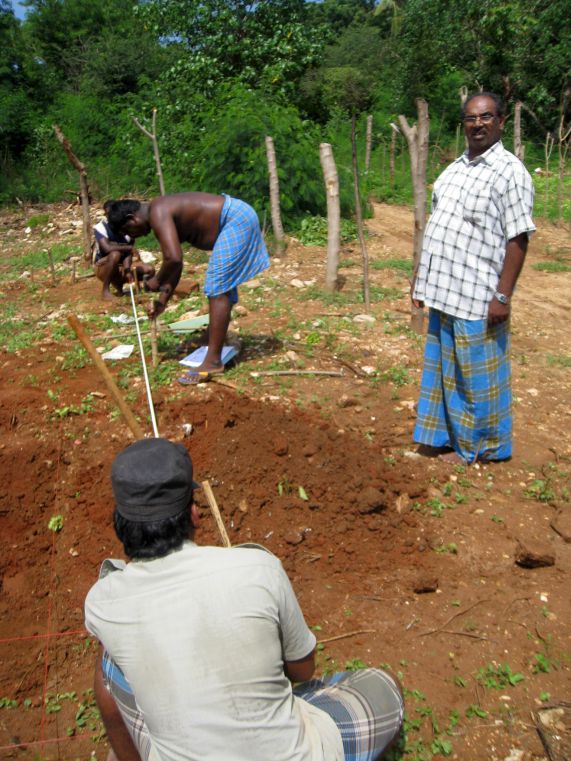
With the wind rustling the leaves on a Mahogany tree, we walked down a lane to the next housing site, visiting Mr. Nagendran Lagunathan's  place. Like many other beneficiaries, the heavy rocks had been dropped 40 metres or so from the house due to muddy roads, so we helped the family to transport some of the rocks from the heap to the site  Every little bit helps in these situations. Excavation for foundation has commenced in this site. Below Thiru and I talk to the family.


Here Thiru explains the finer points of the IHP to Mr and Mrs.Nagendran Lagunathan.


Closeby we met another  beneficiary  Mr. Kanagasabai Murugaiyah, a 76 year old man in poor health living with his wife alone and had a discussion with him about his situation and the construction works of his house. After the discussion he said they felt they could finish it is 5 - 6 months.. 
We called on Mr. Balasuntharam Sivakumar site  and found workers, including the the owner, very busy removing the stump of a big tree from the site enable construction work to start. The beneficiary has told us that due to the heavy rain experienced in the area, he could not start the foundation work. We visited many other sites and were heartened to see such industrious and committed people.
Also visited to Mr.and Mrs. Ponnuthurai Sriskandarajahs (photo above) place and had a chat with them about the problems they face and advised on  the construction of his house. He was reasonably confident he would finish the houses in 5 months.

As we were walking back to the road we met two elderly  women who were returning from putting their case across to grievance committee meeting. We stopped and talked about the situation and why they had not been  selected them for the housing project. As with all people we met on our two hour walk through this village, whether they had been selected or not, there was a quiet dignity and acceptance in their manner. 

What is depressing is the remnants of houses, places of worship and factories destroyed in the 30 year long conflict. Such wanton destruction casts a pall over reconstruction efforts.

During this visit I called Anurag Srivastava at the Indian High Commission to give him feedback on progress and discussed a few issues that I needed advice on. As  Vasanta Kumar Government Agent in Jaffna told us later in the day, we have to work continuously to improce coordination and cooperation.

Some of the pathways between houses are pleasant under the mid-day sun and you see many trees providing shade, fruits and timber. In a year these villages will be back to normal.

As we passed through Jaffna about 1.30 pm, we couldn't resist a stop at Rio icecream parlour and here Thiru (l) and Wahala enjoy a well deserved ice cream.

At 2.30pm we participated in an IHP meeting chaired by the Government Agent with all Jaffna DS in attendance, the UN Habitat, IFRC and SLRCS to discuss progress and methodology.

On the way back to Vavuniya we stopped at the A9 junction with Thenmarachchi to pick up new files from one of our Red Cross Engineers. I say each file is like a "Ratnapura Sapphire' as it brings a jewel to every selected family, that gift called 'a house.' At the junction is a sign giving detail of the Indian housing project. Below.


                                                              A close up of our sign boards.


Wednesday, 9 May 2012

Thavarani one year later. Poorest of the poor.


Thirteen and a half months ago I visited Thavarani a disabled widow with 3 children, in the village of Krishnapuram, in Kilinochchi district. She was in a very desperate situation and I was worried about her health, the health of her children, and was deeply concerned as to whether she would be able to build a house with the funds allocated by the Red Cross for her to build an owner-driven house. Today, her house is almost finished, just the floor to cement, and then she and her children move in. This is nothing short of a miracle.  I am so grateful to Red Cross volunteers who helped her. She looked so much healthier, and the children too. This is one of 3000 success stories, based on the 3000 houses Red Cross has built to date.

I was with Michael Annear, Head of the IFRC Disaster Management Unit for our Asia and Pacific zone.
Tonight I will sleep well knowing that Thavarani has a three roomed house with kitchen, water and sanitation, and a large vegetable garden that feeds her family, and surplus to sell.

This is the story I wrote 13 months ago.
 
Some nights I struggle to sleep wondering how a disabled widow like Thavarani survives with three children in a very basic make-shift shelter, while I am in a sound hotel or apartment. We work in some villages where people are in desperate situations, but it takes time to get communities functioning normally after such a long and brutal conflict in the north of Sri Lanka, which has grossly affected so many people, and ruined infrastructure, livelihoods, dreams and minds. Getting funds for this life-saving programme has been so difficult and we have had to graft all the way.

In my blog posting one before last. I wrote about Vimala Rani ( SEE LINK:vimala) who has rebuilt her life after a long and cruel war in the north of Sri Lanka.  She lost her husband, her house and nearly all possessions. Now she has a Red Cross house, a small income through our livelihood programme, a toilet and running water, and her five children are doing well, one training to be a nurse, and the rest at school. It takes time, patience and dogged perserverance to fund raise for such projects.

Last Thursday after visiting Vimala Rani in the village of Vivekanandanagar in Kilinochchi I went to visit the village of Krishnapuram where we are building another 100 houses for people who lost theirs. Some houses are completed but the majority are in various stages of construction. I asked Dr Mahesh, who runs our IDP programme to show me some of the poorest people in Krishnapuram. He said, the initial survey conducted by Red Cross shows that a 33 year old woman, Thavrani, as one of the poorest.


Thavarani, and her youngest child.


Thavrani is a widow, and has three young children. She lives in a very basic temporary shelter, while her Red Cross funded house is being built. During the conflict she got hit by a shell or mortar and her left leg is withered and left her with a bad limp. Her left arm was damaged and twisted so the palm of her hand is always in a face up position. The reason Thavrani is in a worse situation than most other widows as being disabled limits her in what she can do, her extended family is minimal, and support group limited.
Thavrani with her basic shelter on the left and her Red Cross funded house going up in the background.

A closer look at her very basic home where she lives with her three children
Red Cross has workers like Surethi and Nithya (pictured on the extreme right above)  ride on a small motor cycle, supervising this owner-driven housing programme, visiting all people in the community and when they find someone las destituteThavrani, they have the skills to discuss and advise her on problems, and also able to provide counselling and material support. Thavani, like many others, is suffering from Post-Traumatic Stress Disorder and needs regular visits and support. She also need Red Cross to provide her a voice for the future, and 'protection.'
Three of our staff supervising the housing programme Surethi and Nithya at the left and Chamini right, visit Thavarani and many others on a regular basis and do an amazing work helping them become self sustaining.


Thavrani's house will look like this within two months, and she will be able to move into it.


With the Sri Lanka Red Cross programme targetting 5000 familiers, it is frustraing seeing people suffering as they work even harder to get their houses completed before the next rainy season.

Thavrani maanges a broad smile as Dr. Mahesh asks her what additional help she needs. " I need a little extra help with laying the blocks, so I can finish it as soon as possible," she says.

As I walked away from her house I glanced back and saw her talking to  Surethi and Nithya and I know these two dedicated Red Cross workers  will watch over and care for Thavrani and her children, and ensure her house and other facilities are completed quickly.

It doesn't make me sleep easier as there are thousands of people like Thavani in Sri Lanka affccted by the aftermath of tsunami, recent floods and landslides and by a long and brutal war. But the hope comes from people like Nadeeka and Melinda from the Australian Red Cross who visited Jaffna, Kilinochchi and Vavuniya last week, and have given funding for over 300 houses, plus livelihoods, water and sanitation, and a little extra to support very vulnerables women like Vumala and Thavani.

We need continuing support from our partners and the general public out there to ensure people affected by war and natural disasters can live with dignity and hope.