Showing posts with label Shelter. Show all posts

Friday, 8 August 2014

Red Cross builds typhoon resistant homes in the Philippines

A step by step photographic guide to building typhoon resistant houses/shelters or homes as I prefer to call them, in the Philippines by the Philippine Red Cross Society for those who lost houses during Typhoon Haiyan (Yolande).  Photographs provided by Heike Kemper Shelter delegate Swiss Red Cross who is working with German Red Cross and PRC in Capiz.


                                                         Laying out the ground plan.


                                                             Shelter from the storm.


 Below, a critical design feature, affixing the typhoon strap which holds the roof structure to beams which are strongly cemented in the ground.


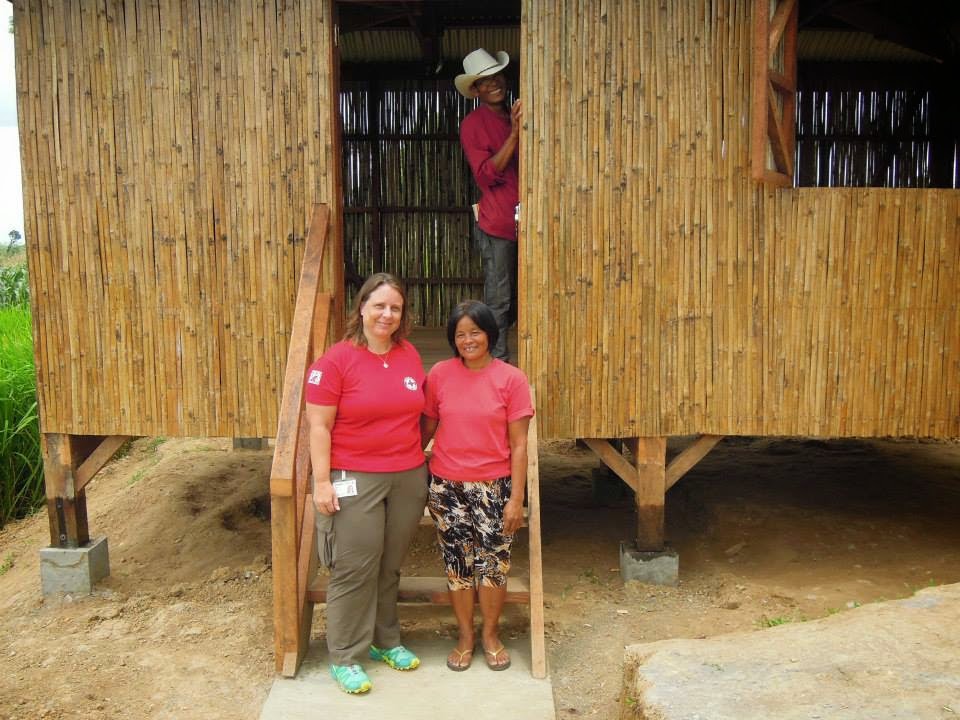
Heike Kemper above (left)
Heike Kemper from the Swiss Red Cross  (2nd from R) with the Philippine Red Cross construction team in Capiz. This is what she said, "You are wonderful people who in just 2 weeks learned how to manage a construction site on your own. I could not be more proud. :):):)" Great to see so many females in the team.

Monday, 28 July 2014

Story of a typhoon Haiyan survivor.


Her name is Anatalia M. Cabrera, 68 years old, singled-female household who was born on December 1, 1945 in Brgy. Poblacion, Tolosa, Leyte. She is popularly known as “Mana Tayang” in the locals and has been a resident of Tolosa for most of her existence. She is the 3rd child amongst 4 children of a farmer, Mr. Eleuterio and housewife, Mrs. Angela Cabrera.  Growing up to them was not that much easy, Anatalia was not born with a silver platter or a golden spoon instead came from humble beginnings and had her fair share with hurdles in life. She came from a poor family, “there are days that we are broke and something to eat was scarce”, as she recalls.
Anatalia had troubles in schooling. She admits she was not on top of the class and don’t have much interest in getting an education which entirely affected by financial capability of her family.
At the age of 18, her mother got sick and was diagnosed with tuberculosis which needs a continuous medication for 6 months. It was one of the turning point where they had to work extra hard to earn for a living. As to his father, he tries to make both ends meet. By the age of 24 which Anatalia was still on her secondary education, her mother died. Three years later, her father died because of beriberi disease which left them as orphans. Anatalia had gone through everyday struggles to survive since all her siblings have built their own families thereafter. 
At the age of 27, she was forced to work away from Tolosa to look for a better source of living. She worked in Manila as a residential cook for 3 years and at the same time sends herself to College. Portion of her salary goes for expenses of schooling and some became her savings. She was a self supporting student but was not able to finish College due to financial constraints.
After working in Manila, she went back to Tolosa to settle. All her savings was spent for the improvement of the house left by her parents which she happily accomplished the construction of her latrine and kitchen. She started to put up a small variety store which sells cooked and raw vegetables. Sometimes she also sells candies and other goodies outside a primary school. It was her typical activities of everyday living. On the year 2012, Anatalia joined an organization called Bayanihan which was composed of 12 members and their main objective was to generate livelihood for their members through buy and sell of rice grains.
Anatalia is also a devout and been active in Church activities such as Catechism, in fact she is part of a Church group called Catechumenate which conducts religious and values education in some schools. 
To date, she is now an elderly living alone and her neighbors became the major support systems in times of hardships or needing help like during disasters.

TYPHOON HAIYAN:
                                                                                                    Few days prior to the disaster, news started to emerge regarding the birth of Typhoon Haiyan or locally named as Typhoon Yolanda. At first, Anatalia did not felt any urgency and threat to the typhoon because Philippines had been through such a lot though can’t help to sense a containable mild level of anxiety. Additionally, she recalled, “There was still a fine weather, mostly sunny and seldom raindrops. No hints the typhoon can be bad as it was”
                                                                                                                                                                                                                                                              On November 6, 2013, news started to be more serious and persistent in advisory for the forecast strength and foreseeable devastation that the typhoon can bring. At this point, Anatalia has thought of the potential grievous effect of the upcoming typhoon.
             On November 7, 2013, Anatalia visited the Church, asked for guidance and protection from the Typhoon Haiyan. Did confession and prayed the rosary fervently. She also prepared clothes, foods and other necessary things she might need during any emergency situations.
                                                                                                                                             On November 8, 2013, at around 1am in the morning, strong winds start to blow in until 5am and Anatalia had still prepared to go to Church. By 6am, winds became stronger and zero visibility on the area. She knew that the worse has now started, thus she was helpless and all she did was pray. At the height of typhoon, Anatalia was asked to evacuate her house and went to her distant neighbor’s house. She went out of the house with a blanket overhead and carrying the emergency bag that she prepared. Unfortunately, the house also was wrecked by the typhoon. Anatalia was even hit by a stone on the head from the raging wrath of the typhoon. They had to hide underneath the sink until the typhoon pass. Afterwards, they transferred to another house. Anatalia was not able to take breakfast and lunch but was not also feeling any gist of hunger. By noon, she went to see her house and found that it was severely destroyed. All she could find was torn parts of her house and broken bricks. It was a heartbreaking moment for her, she was left with nothing. Nevertheless, she never loses hopes. She prayed for wisdom that she may be able to accept the aftermath situation.
                                                              She stayed in her distant relative for a week. At that time, no electricity, no source of communication and no open stores to buy for foods. They were all dependent to given reliefs from different organizations for her to survive everyday. Fortunately, there was assistance provided to her like tarpaulin and construction materials that helped in building a makeshift room for her to stay. A week after, she started cleaning her area.
              She joined a cash-for-work program, where they had to clean particular areas of the town. Activities include sweeping roads and disposing garbage. Her earnings were spent in the labor cost of making a better room for living. The room built was not enough to protect her from the cold weather and heavy rains.
                             By the month of April 2014, the Red Cross started its shelter project intervention in the Municipality of Tolosa. She underwent the process of house assessment, interviews, revalidation and others. Fortunately, she was picked to be the very first core shelter beneficiary of the shelter project. For her, it is a huge blessing and an ultimate gift that she couldn’t ask for more. It has far exceeded her expectations on the help she could get. Provided by Spanish Red Cross who worked with the Philippine Red Cross in building this home.

Wednesday, 23 April 2014

Six months since Typhoon Haiyan struck the Philippines

As the Philippine Red Cross, supported by its movement partners,  begins to steadily roll out is massive recovery operation the Chairman Richard Gordon reminded us this week of  the upcoming  6 months anniversary since Typhoon Haiyan (Yolanda) made land fall and World Red Cross Day, which both fall on 8th May.
The Red Cross Red Crescent Movement event is planned for the 5th May in Manila and a joint event humanitarian partners event hosted by the UN, in Tacloban, is scheduled for 7th May.
Chapters will also host events according to local preferences, based on the package of material provided from headquarters and customised to represent local activities and partners present in that location.
One of many thousands of houses that have been built by families who have received CGI sheeting, shelter kits and cash from the Philippine Red Cross. This was a house we visited last week in Malawig, Busuanga, Palawan. Photo: Bob McKerrow Swiss Red Cross

Chairman Gordon encouraged his Red Cross partners to ”mesh science with results, giving the example of fish depopulation in Leyte meaning some livelihood options for coastal people are not immediately viable.”
Chairman Gordon (pictured below) also commented positively in regard to Movement Coordination to date, stating that it had been perfect, with theatres of operation for the different Movement components being established right away.
His key messages were self help, self reliance and cooperating with each other as essential attributes of the operation and noted that for the Haiyan operation lessons have been learned from Haiti, leading to a smoother and faster operation in the Philippines.    It was also noted that the Haiyan Operation was faster than the Pablo or Bopha responses in the Philippines. 

Tuesday, 22 April 2014

Observations on early shelter in Typhoon Haiyan, Philippines.

Shelter repairs, emergency shelter, temporary shelter and transitional shelter are some of many terms we have heard frequently in the early days of relief operations over the years, and more recently in Typhoon Haiyan, locally known as Yolande, shelter needs have been enormous and we are seeing many variations of the traditional Nipa shelters made out of Sawali, woven split bamboo huts. Many of us foreigners working here are seeing  the importance of providing shelter kits, corrugated iron sheeting and cash early in the relief phase, with the goal of  shelter assistance to be life-saving and to set the path for sustainable reconstruction. The emergency or relief phase should be instrumental to orient the recovery phase, and integrate risk reduction as a key aspect of reducing housing vulnerabilities   Last week I traveled to Busuanga in the Calamian Island group of northern Palawan with the Chairman, Secretary General of the Philippine Red Cross, and my own DG from Swiss Red Cross Markus Mader. At Balasungan in Tagumpay Barangay we had a chance to look at affected households who had received shelter materials from Philippine/Swiss Red Cross some months ago. 2000 families received 10 sheets of corrugated iron, a comprehensive shelter repair kit, and a cash grant of US$ 50. What they have achieved is simply remarkable and each is tailor-made to their needs and resources that they have available.


At Balasungan in Tagumpay Barangay, we spoke to a husband and wife, with six young children. The shelter above and below looking from different angles, is what they lived in for four and a half months,


Now they have  new house with the walls made from Sawali, which are woven into split bamboo mats  It is a commonly used material in the construction of the ubiquitous Nipa hut. The Bahay Kubo, Balay, or Nipa Hut, is a type of stilt house indigenous to most of the lowland cultures of the Philippines.

The woman of the house proudly showing her new Red Cross funded house to DG of the Swiss Red Cross Markus Mader and Arsenia Tabique from the Philippine RC.
Another example of the benefit of early shelter distribution was on the morning of 26 November, just over two weeks after the typhoon struck, the Philippine Red Cross and Swiss Red Cross began distributing shelter repair kits, and CGI sheeting on the island of Bantayan. Later that afternoon, I visited one of the beneficiaries who was well on the sway to finishing the framework for his house, (photo above)  and the next day was going to fix the CGI sheeting, and Sawali walls a few days later.
 Distribution of corrugated iron sheeting to 3000 families in Bantayan of 26 November, just over two weeks after the typhoon struck .  Each family received 12 sheets. We also distributed comprehensive shelter repair kits, below.
 Distributing shelter repair kits to typhoon affected families on Bantayan on 26 November 2013.
 On 14 April I visited the village of Malawig at the northern end of Busuanga where recipients of Red Cross CGI sheeting, shelter repair kits and cash, had done an excellent job in building homes from old and new materials,
 One of the main locally made components of housing is Sawali  where woven split bamboo mats are  used to construct walls.

 One housing sector approach
The Red Cross Movement has been involved for decades in providing shelter to the disaster affected. These assistance methods vary greatly depending on the contexts, type of disaster, local capacities, scale and resources. The goal of humanitarian shelter solutions provided in the aftermath of a disaster, are to be life-saving but also to set the path for sustainable reconstruction. The emergency or relief phase, as outlined below, should be instrumental to orient the recovery phase, and integrate risk reduction as a key aspect of reducing housing vulnerabilities – the one housing sector approach. To achieve this, people’s needs and preferences are driving the process, as the main objective is to build safer and more resilient communities.


 Shelter relief
Following a disaster, shelter activities immediately focuses on saving lives. This is particularly urgent where the affected people are exposed to harsh climatic conditions such as extreme cold or heat.
Rapid shelter solutions include tents and shelter kits, or materials to build or repair homes. Alternatively, temporary accommodation in public buildings or with host families will be supported.
Beyond survival, the key considerations are:
  • providing protection from the climate
  • ensuring privacy and dignity
  • providing personal safety and security
Shelter assistance needs to be flexible and appropriate to the context, it needs to take the type of damage caused by the disaster into account and consider what is required to complement existing or damaged homes and structures. Additional important factors are social and climatic conditions and the scale of the disaster.

Focus on local solutions
Assistance can range from tents, tools and materials to financial support for either the affected people or their host families. In many situations the construction of transitional shelters made out of locally available materials using familiar building techniques is the best option since these can be improved by the disaster survivors themselves over time or be re-used in the construction of permanent homes. The funds invested in reconstruction programmes need to result in new income generating activities, which favours the local economy and development. The overarching goal is to promote local building cultures to improve the impact and efficiency of housing programmes.

These are the core or permanent shelters the Philippine Red Cross are building throughout the typhoon affected area abd plan to build more than 50,000. Photo: German Red Cross

Shelter recovery and settlement planning
Most people who have lost their homes through a disaster want to repair or rebuilt their homes as soon as possible. Many start the reconstruction process immediately after a disaster, whenever circumstances and resources permit. Shelter assistance provided by the International Federation of Red Cross and Red Crescent Societies (IFRC) and its members recognizances this, and where appropriate prioritises the provision of materials, tools, cash and technical assistance to support the process. This is also known as the people-driven or owner-driven approach to housing and settlements reconstruction.
Successful shelter repair and construction has to go hand in hand with finding solutions for a number of other issues such as water and sanitation, fuel for cooking and heating, waste management and settlement planning. At the same time communal facilities such as schools, play areas and health clinics have to be available to affected people.
Post disaster reconstruction activities provide opportunities for men and women to learn new skills related to construction, planning and related issues such as managing natural environmental resources and local project management.

Richard Gordon, Chairman Philippine Red Cross shows a traditional shelter with corrugated iron sheeting for a roof.

Shelter disaster preparedness and risk reduction
For many people living along riverbanks or the sea, on mountain slopes or in poorly built neighbourhoods, the risk of flooding, earthquakes and other hazards constantly threaten their lives. In disaster prone areas, the Red Cross Red Crescent works with communities and authorities to identify shelter and settlement risks and vulnerabilities with the goal of preparing for and minimising the potential impact of disasters. The ability of vulnerable households to build safer homes can be improved by introducing disaster resistant technologies, raising awareness of the local risks and hazards explaining to vulnerable communities how they can manage these risks better. In order to achieve this the IFRC has developed and promoted a tool named PASSA (Participatory Approach for Safe Shelter Awareness).
A special focus and interest, over the past few years, has been on Urban Risk and improving our approach to responding to disasters in urban areas. This aspect is complemented by advocacy work to ensure equitable reconstruction policies, that include addressing regulatory barriers, land and property aspects and the right to adequate housing.

All photographs taken by Bob McKerrow Swiss Red Cross