Saturday, 27 October 2012

A day in the life of Red Cross housing project staff.

Yesterday was the final day of a five day monitoring trip I did to the north of Sri Lanka to measure progress on the role IFRC/SLRCS is playing as implementing with the Indian housing project. (IHP) and to identify ways we can accelerate the recovery operation. I have recorded a typical day on a trip like this.
On Thursday 26 October we visited the Project Office located at the G N Office, at Thananthaiselvapuram, Tellippai DS in Jaffna district where we met the IFRC Project Engineer and the Technical Officers and had a discussion with them.

I visited more than 20 sites in the village nearby where the 1st installment payment had been  sent to beneficiary bank accounts some days earlier by the Indian High Commission in Colombo and had discussion with the beneficiaries. 

I was accompanied Ms. Dushiyanthi David, Mr. Wahala  Bandara, DPO SLRCS  and K. Thiruthanigasalam, (Thiru)  Monitoring Officer, IFRC. Dushy is head of support services for IFRC is Colombo and I wanted her to become more familiar with the methodology as she has a liaison function with the IHP payment office in Colombo.

At the offce Thiru (centre) and I met Mrs. Shanmugam Pakkiyaledcumy (left),  a  very poor widow,  living alone at Market road. She had not met the beneficiary criteria but was hoping she would qualify in the second round. We took her name and explained what options are open to her.
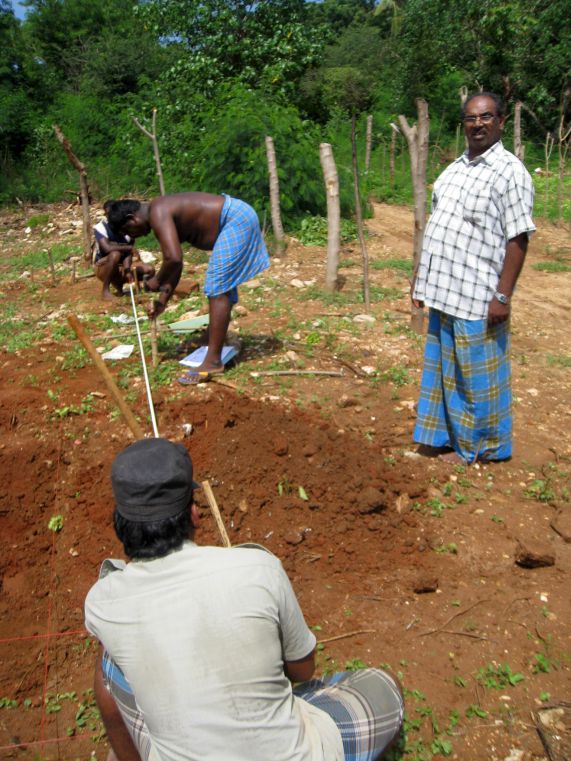
Next we drove to the village close by at Thananthaiselvapuram and the first beneficiary we visited was Mr. Balasubramanium Mahendran, a person suffering from arthritis and struggling to walk. He had completed the foundation laying ceremony and the workers were very busy on excavation work for the construction of foundations. After the discussion Mr. Balasubramanium (right in the photo) told us that he will complete the construction works within 4 to 5 months. The necessary building materials for the foundation work has been transported to the site.


With the wind rustling the leaves on a Mahogany tree, we walked down a lane to the next housing site, visiting Mr. Nagendran Lagunathan's  place. Like many other beneficiaries, the heavy rocks had been dropped 40 metres or so from the house due to muddy roads, so we helped the family to transport some of the rocks from the heap to the site  Every little bit helps in these situations. Excavation for foundation has commenced in this site. Below Thiru and I talk to the family.


Here Thiru explains the finer points of the IHP to Mr and Mrs.Nagendran Lagunathan.


Closeby we met another  beneficiary  Mr. Kanagasabai Murugaiyah, a 76 year old man in poor health living with his wife alone and had a discussion with him about his situation and the construction works of his house. After the discussion he said they felt they could finish it is 5 - 6 months.
We called on Mr. Balasuntharam Sivakumar site  and found workers, including the the owner, very busy removing the stump of a big tree from the site enable construction work to start. The beneficiary has told us that due to the heavy rain experienced in the area, he could not start the foundation work. We visited many other sites and were heartened to see such industrious and committed people.
Also visited to Mr.and Mrs. Ponnuthurai Sriskandarajahs (photo above) place and had a chat with them about the problems they face and advised on  the construction of his house. He was reasonably confident he would finish the houses in 5 months.

As we were walking back to the road we met two elderly  women who were returning from putting their case across to grievance committee meeting. We stopped and talked about the situation and why they had not been  selected them for the housing project. As with all people we met on our two hour walk through this village, whether they had been selected or not, there was a quiet dignity and acceptance in their manner. 

What is depressing is the remnants of houses, places of worship and factories destroyed in the 30 year long conflict. Such wanton destruction casts a pall over reconstruction efforts.

During this visit I called Anurag Srivastava at the Indian High Commission to give him feedback on progress and discussed a few issues that I needed advice on. As  Vasanta Kumar Government Agent in Jaffna told us later in the day, we have to work continuously to improce coordination and cooperation.

Some of the pathways between houses are pleasant under the mid-day sun and you see many trees providing shade, fruits and timber. In a year these villages will be back to normal.

As we passed through Jaffna about 1.30 pm, we couldn't resist a stop at Rio icecream parlour and here Thiru (l) and Wahala enjoy a well deserved ice cream.

At 2.30pm we participated in an IHP meeting chaired by the Government Agent with all Jaffna DS in attendance, the UN Habitat, IFRC and SLRCS to discuss progress and methodology.

On the way back to Vavuniya we stopped at the A9 junction with Thenmarachchi to pick up new files from one of our Red Cross Engineers. I say each file is like a "Ratnapura Sapphire' as it brings a jewel to every selected family, that gift called 'a house.' At the junction is a sign giving detail of the Indian housing project. Below.


                                                              A close up of our sign boards.


Wednesday, 24 October 2012

Indian Housing project Sri Lanka

It was so good yesterday to see the foundation outlines of the first Indian Government funded houses being implemented by the Red Cross in Eluthmuddval GN, Thenmarachchi Jaffna, and rocks, sand, gravel and cement on site. I even spied a stack of timber weathering. Below a young girl plays on the site that will be her new home in 8 months or so.The first payment for the Subramanyam family arrived in their bank account 10 days ago, and they started on the 18th of October, an auspicious day, and 6 days later this is the progress. Today I am visiting Thanthaiselvapuram and Karampaham GN divisions where families are working on houses foundations. through IHP

Having worked in post conflict recovery operations for 40 years or so, this one is unique. in the way the IFRC was selected as one of four Implementing Agencies (IAs) for the Indian Housing Project. (IHP) and the way all IAs have worked so cooperatively with the Indian High Commission and Presidential Task Force. Together we have come up with a very functional operations manual and beneficiary selection process. On  13 July 2012 the IFRC/SLRCS  entered a new partnership with the Government of India receiving funding for the repair of 2,800 and construction 14,000 new houses. This funding enables us to add to the 3000 houses Red Cross has built in the north in the past two years, which have livelihoods and water and sanitation as an integrated package.

Four Implementing Agencies (IAs), viz., UN-HABITAT, International Federation of Red Cross & Red Crescent Societies (IFRC) in partnership with Sri Lanka Red Cross, National Housing Development Agency (NHDA) of the Government of Sri Lanka and Habitat for Humanity, Sri Lanka, were selected for the next phase of the Indian Housing Project for 43,000 housing units in Northern and Eastern Provinces.


This phase of the IHP, which is being implemented under the owner-driven model, beneficiaries have been  selected through a transparent and norm-based process on the basis of clearly defined and objective criteria. These beneficiaries have just started undertaking the construction/repair of their houses with necessary technical assistance and support provided by the IAs. Funds will be released directly by the High Commission of India into bank accounts of beneficiaries based on certification of progress of work. An owner-driven approach has been followed on the basis of preferences of the Government of Sri Lanka, people on the ground as well as project objectives of contributing to livelihood activities.


Look to the upper centre of the photograph to the shack this family is currently living in. Within 8 months or so the house should look like this one below.


Mrs. Subramanyam and daughter Meneka were delighted about their house being underway Eluthumuddval GN. Her husband, a struggling day laborer, has to juggle work which is crucial to keep the family alive, and building the house.

The Red Cross engineers with technical officers and community mobilisers have specific roles in training, supervising and monitoring. Using hand drawn charts on techniques required to construct each stage of a house are carefully explained and followed up on. Progress is recorder in the family housing book and each stage signed off.

Communicating with the IHP beneficiaries is crucial, and also plays a key role in the on going reconcilliation process where communities are further empowered, appreciated and provided skills which can lead to employment in the future.

The High Commission of India signed agreements on 13 July 2012 to award work to four Implementing Agencies (IAs), viz., UN-HABITAT, International Federation of Red Cross & Red Crescent Societies (IFRC) in partnership with Sri Lanka Red Cross, National Housing Development Agency (NHDA) of the Government of Sri Lanka and Habitat for Humanity, Sri Lanka signaling the launch of the next phase of the Indian Housing Project for 43,000 housing units in Northern and Eastern Provinces. The signing ceremony was witnessed by Hon. Basil Rajapaksa, Minister of Economic Development and H.E. Ashok K. Kantha, High Commissioner of India.


Anurag Srivastava (r) and Bob McKerrow IFRC (l) signing the Indian Housing Project agreement with Hon. Basil Rajapaksa, Minister of Economic Development and H.E. Ashok K. Kantha, High Commissioner of India and Shri P. Kumaran Deputy High Commissioner, witnessing the signing.(photo courtesy Min. of Economic Development)


The four IAs were selected on the basis of their experience and expertise in implementing similar projects in Sri Lanka, through a competitive process following the Expression of Interest route. The signing of these agreements paves the way to commence immediate implementation of this Project on the ground.
     
This phase is expected to meet bulk of the housing needs in these areas. In the last phase of the project, which is also expected to commence soon, about 6,000 houses will be directly built by construction agencies for people from most vulnerable sections of IDPs in the Northern and Eastern provinces and for estate sector in the Central and Uva Provinces

Had an excellent one hour Red Cross radio programme with last night in Jaffna on YARL FM Jaffna with Thiru who works for the IFRC on the IHP  programme based in Vavuniya, and two volunteers from the Sri Lanka Red Cross branch in Vavuniya who volunteers their time on IHP too. The programme is a weekly one in Tamil for 6 months getting across messages about housing, both the IHP and our other parallel SLRCS one, water and sanitation, livelihoods, NCDs and other important information that empowers communities. We had half an hour of explaining our work then a further half hour where listeners can call in for discussion.