Showing posts with label Eric Shipton. Show all posts

Saturday, 28 January 2012

Ang Tharkay - the Father of all Sherpa guides and mountaineers


Ang Tharkay (right) with Bob McKerrow (left) taken at Ang Tharkay's farm at Simbhanjayang, South of Kathmandu in 1975. Photo: Bob McKerrow

Being woken up on a frosty morning at first light by Ang Tharkay with a mug of hot tea at his farm, south of Kathmandu, on 23 April 1975, is a memory that remains vivid in my mind. With a broad smile he handed me the tea, made in the Sherpa manner with sugar and milk boiled together. He greeted me in English and Tibetan.

I somehow had a flashback to photos of Eric Shipton in the 1930s and this is how he must have been woken up on his expeditions by the very same man. We had a breakfast of chapati and eggs from his farm. He had risen before day break and had milked cows and goats. Ang Tharkay was about 69 and I twenty seven.

We talked of the great climbers he went on expeditions with: Eric Shipton, Sir Edmund Hillary, Maurice Herzog, Gaston Rebuffat, Lionel Lachnel, Lionel Terray, Cmdr.Kohli and others. You could see he had a soft spot for Shiption and the French expeditions he had been on.

“ I left Kathmandu by car about 1230 for Ang Tharkay’s farm with his son Dawa who I had met in Kathmandu some weeks earlier. The first 10 km out of Kathmandu is over a good road then a short climb up to a pass, then the road plunges down into a very fertile valley. About two and a half hours up to Daman which is at about 8,000 feet, and then up to a pass some 200 feet higher, then the road descents to the Terai. It is a 15 minute walk from the road to his farm through beautiful bush. All the way you are kept under survelence of his trusty Tibetan dogs. His farm is surrounded by steep country on three sides, the lower side drops away steeply.


This distinquished mountain guide came out to greet me with a huge smile and gave me a shy hug. He showed me round the farm where potatoes are his main crop and a variety of vegetables and has many fruit trees. A herd of 30 cows graze on the hillsides. I noticed his English was quite broken and preferred to speak in Tibetan to his son Dawa who translated much of the time. He explained how he grows a special millet for making a favouritre Nepali drink, Rakshi and Chang. His house is sturdy and simple, very much in the Sherpa style.


After watching the cows being milked, I pitched my tent and I retired inside with Dawa and his famous Father.


We talked of the great climbers he went on expeditions with: Eric Shipton, Sir Edmund Hillary, Maurice Herzog, Gaston Rebuffat, Lionel Lachnel, Lionel Terray, Cmdr. Kohli and others. You could see he had a soft spot for Shipton and the French expeditions he had been on. He spoke with great pride of the 11 years he spent with Eric Shipton who he described as a very tough man, who ate little and was very strong, starting in 1931.


He spoke of his most famous expedition, the French Expedition in 1950 led by Maurice Herzog to Annapurna. Ang Tharkay spent much of his time carrying off Herzog who contracted severe frostbite. He said that in 1931 they were paid one quarter of an Indian Rupeee a day. They were paid five rupees per joint lost by frostbite and between 500 and 1000 rupees to your family if you lost your life. Then in 1975, he said “ now the family gets paid 100,000 Indian Rupees if a Sherpa loses his life.”


We drank his quality chang late into the nnight talking of all the great climbers, expeditions and significant people he met.

Born and raised in Khumbu, later migrating to Darjeeling, Ang Tharkay’s first expedition was to Kangchenjunga in 1931. He was on Everest in 1933, 1935, and 1938, when he was cook and Sirdar, having been formally made Sirdar for the first time on Nanda Devi in 1934. He was exceptional as both climber and sirdar, and his character won high praise from all who knew him.


I spent the morning with Ang Tharkay helping him with chores around the farm and I left about midday for Biratnagar, where I had work to do.


Photo left: Ang Tharkay at the age of 20 in Darjeeling. Photo. RGSS

Ang Tharkay, who died in Kathmandu on July 28th 1981, belonged to the first generation of elite climbing Sherpas. Born in 1908 in Khunde in the Year of the Monkey (according to the Tibetan calendar) Ang Tharkay went to Darjeeling at the age of twelve in search of work with expeditions

He accompanied Eric Shipton on eight of his pre-war expeditions in the Himalaya, including four on the northern route to Everest. Ang Tharkay had seen the days when high altitude porters were paid six annas compensation for each finger they lost by frost bite. And if the injury was really bad, and a porter could not walk back to Darjeeling, he was entitled by contract to receive a pony and one rupee compensation. Sherpas received blankets for high altitude camps, and sleeping bags were issued only during emergencies.


Mt. Everest and the west ridge, taken from Kallar Pattar 1975. Photo: Bob McKerrow


When Nepal was opened to expeditions, and the first reconnaissance groups traveled up the Dudh Kosi to Solu Khumbu, Ang Tharkay was with them. He had shed his traditional Sherpa pigtail, and dressed in smart woolen breeches, "but had same, shy reticence and quite humour", that Shipton remembered. He joined Eric Shipton, and Edmund Hillary on their 1951 expedition in which they tackled the treacherous Khumbu ice fall, the gateway to the southern route to Everest, and paved the way for the first successful ascent two years later. The expedition then went on to explore the upper reaches of the Imja Valley, the Hongu Basin, and then crossed the Tesi Tapcha into Rolwa Jing. Shipton was impressed by Ang Tharkay, and was moved to remark that he regarded his chief Sherpa as "a man of outstanding character and ability".

Ang Tharkay also took part in another epoch making Himalaya climb, the French Expedition to Annapurna in 1950, lead by Maurice Herzog. He reached the top camp above the "Sickle" on the north face of the first eight-thousander to be climbed.

After this, he was sent for training in technical climbing in Switzerland by the Himalayan Mountaineering Institute in Darjeeling. Although he was invited by Herzog to bring his wife along to France, it is indication of Ang Tharkey's forthrightness that he refused to take his wife to save his "Bara Sahib" extra expense.


Ama Dablam, taken on the march in to Everest base camp. 1975. Photo: Bob McKerrow


In 1954, Ang Tharkay resigned from the HMI and set up his own business taking trekkers up to Kangchenjunga. In 1962, he became the oldest man to have climbed up to eight thousand meters, when he made it to the South Col with the Indian Everest Expedition. Although he then retired from active mountaineering,

The year I first met him. 1975, Ang Tharkay took a party up to the Annapurna Sanctuary , and sirdared the French Expedition to Dhaulagiri in 1978, at the age of 70.

I remember how active he was,  virtually running round his farm to do his daily work, always with a smile on his face.As a young mountaineer sitting at the foot of a Guru in every sense of the word, I learnt so much from him. Simplicity, mental toughness, simple diet, hard work, humour, family, friendship, and above all, humility.

At seventy three years young, Ang was still extremely fit, and many remember the cheerful waves he gave from his bicycle on Durbar Marg. (He never rode in cars if he could help it). Ang Tharkay was looking forward to a quiet retirement in his orchard and farm in Simbhanjayang, when he was suddenly hospitalized and died of cancer.

In Eric Shipton's classice, A Blank On the Map Shipton describes his exploration of the Karakoram's Shaksgam and  N side area of K2 in 1937. This was a very small expedition that consisted only of Shipton, H. W. Tilman, M. A. Spender, J. B. Auden, seven Sherpas (under Sirdar Ang Tharkay), and four Balti porters. This five-month expedition mapped 1,800 square miles of rugged, glaciated, uninhabited country containing many of the world's most spectacular mountains


Ang Tharkay and a young brother. Tilman commented that his stews and curries were masterpieces, but that cooking was only one of his abilities, as he was responsible for porters, gave advice and invariably carried the biggest loads highest. RGS , 1938.

In a 1954 autobiography of Ang Thrace, Mémoires d'un Sherpa , it says that Ang Tharkay was Tenzing’s landlord in Darjeeling and also his mentor. Ang Tharkay accompanied Shipton on eight expeditions and was also a sirdar [leader] on the 1950 French expedition to Annapurna, led

He went to Annapurna with the French in 1950, to Everest in 1951, to Cho Oyu in 1952, to both Dhaulagiri and Nun in 1953, to Makalu in 1954, and finally to Everest with the Indians in 1962.

In 1955:he joined an  an Indian expedition from the Himalayan Mountaineering Institute in Darjeeling makes the second ascent of Kamet on July 6. Major Narendra D. Jayal led the party; Jayal, Ang Tharkay, Da Namgyal, Ang Temba, and Hlakpa Dorje comprised the summit team. Their route followed the ridge linking Abi Gamin and Kamet.


Crossing the Lumding La  (4520 m) with Neema Sherpa. This was a journey I did with Murray Jones and a Sherpani called Domalay in 1975, when we had an unsuccessful attempt on Kwangde. Photo: Bob McKerrow


I was first drawn to Ang Tharkay in my early teens when I saw a photo of diminutive Ang Tharkay, carrying a large, frost bitten French climber, Gaston Rebuffat, on his back down the mountainside from a high camp on Mt. Annapurna.

When I lived in Kathmandu for nine months in 1975, I visited Ang Tharkay on his farm a number of times, and it was always a joy to meet this modest mountain man.

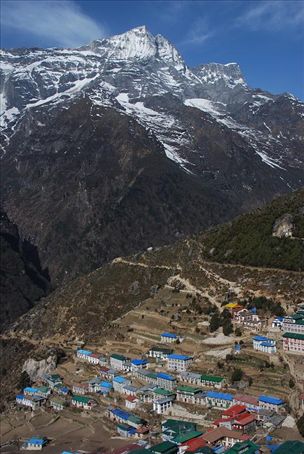
Having been born in the barren Solo Khumbu, (photo below) the lush green grass and trees of his farm in Simbhanjayang, south of Kathmandu, was an oasis. He was close enough to meet old climbing friends from abroad,  fellow Sherpa's from earlier climbs, yet being able to go to his farm when he wanted peace, quiet and self sufficviency.

The first time I visited Ang Tharkay was with his son Pemba who I had met in Kathmandu.

Later that year before I returned to Switzerland, Ang Tharkay was very distraught. The wife and daughter of his old climbing partner Ed Hillary, had died in a terrible plane crash in Kathmandu. He had made a special and swift visit into Kathmandu to comfort Sir Ed, Peter and Sarah. I remember that tragic day well as I was in Kathmandu and heard the plane crash and got the news an hour later. I joined a group of friends to give what support we could to a grieving Hillary family.

As a young man I had the privilige of meeting the two greatest early-era Sherpas,  Ang Tharkay and Tenzing Norgay. I met Tenzing in 1972 in The Mall in Darjeeling and we sat on a wall talking about his climbing career. Tenzing seemed a much more complex man than Ang Tharkay. At the risk of sounding disrespectful, I felt Tenzing had problems handling fame and status, whereas Ang Tharkay seemed totally unaffected by it, and found simple things like farming, cycling and being with family, more than satisfied his small needs. In my youthful mind, Ang Tharkay was the Father of the modern day climbing Sherpa

Two of my favourite Sherpa guides. Domalay (l) and Neema (r) who accompanied Murray Jones and I on a trip in 1975. They both worked for the Ed Hillary hospital in Kunde. Photo: Bob McKerrow

Sunday, 12 September 2010

ANG THARKAY - THE FATHER OF MODERN SHERPA CLIMBERS

Waking up on a frosty morning at first light on Ang Tharkay's farm, south of Kathmandu, in 1975, is a memory that remains vivid in my mind. With a broad smile he poured me tea, made in the Sherpa manner with tea, sugar and milk boiled together. We had a breakfast of chapati and eggs from his farm. He had risen before day break and had milked cows and goats. Ang Tharkay was about 69 and I twenty seven.


Ang Tharkay (right) with Bob McKerrow (left) taken at Ang Tharkay's farm south of Kathmandu. at Simbhanjayang in 1975. Photo: Bob McKerrow

We talked of the great climbers he went on expeditions with: Eric Shipton, Sir Edmund Hillary, Maurice Herzog, Gaston Rebuffat, Lionmel Lachnel, Lionel Terray, Cmdr. Kohli and others. You could see he had a soft spot for Shipton and the French expeditions he had been on.

Born and raised in Khumbu, later migrating to Darjeeling, Ang Tharkay’s first expedition was to Kangchenjunga in 1931. He was on Everest in 1933, 1935, and 1938, when he was cook and sirdar, having been formally made sirdar for the first time on Nanda Devi in 1934. He was exceptional as both climber and sirdar, and his character won high praise from all who knew him.


Photo left: Ang Tharkay at the age of 20 in Darjeeling. Photo. RGSS


Ang Tharkay, who died in Kathmandu on July 28th 1981, belonged to the first generation of elite climbing Sherpas. Born in 1908 in Khunde in the Year of the Monkey (according to the Tibetan calendar) Ang Tharkay went to Darjeeling at the age of twelve in search of work with expeditions

He accompanied Eric Shipton on eight of his pre-war expeditions in the Himalaya, including four on the northern route to Everest. Ang Tharkay had seen the days when high altitude porters were paid six annas compensation for each finger they lost by frost bite. And if the injury was really bad, and a porter could not walk back to Darjeeling, he was entitled by contract to receive a pony and one rupee compensation. Sherpas received blankets for high altitude camps, and sleeping bags were issued only during emergencies.


Mt. Everest and the west ridge, taken from Kallar Pattar 1975. Photo: Bob McKerrow


When Nepal was opened to expeditions, and the first reconnaissance groups traveled up the Dudh Kosi to Solu Khumbu, Ang Tharkay was with them. He had shed his traditional Sherpa pigtail, and dressed in smart woolen breeches, "but had same, shy reticence and quite humour", that Shipton remembered. He joined Eric Shipton, and Edmund Hillary on their 1951 expedition in which they tackled the treacherous Khumbu ice fall, the gateway to the southern route to Everest, and paved the way for the first successful ascent two years later. The expedition then went on to explore the upper reaches of the Imja Valley, the Hongu Basin, and then crossed the Tesi Tapcha into Rolwa Jing. Shipton was impressed by Ang Tharkay, and was moved to remark that he regarded his chief Sherpa as "a man of outstanding character and ability".

Ang Tharkay also took part in another epoch making Himalaya climb, the French Expedition to Annapurna in 1950, lead by Maurice Herzog. He reached the top camp above the "Sickle" on the north face of the first eight-thousander to be climbed.

After this, he was sent for training in technical climbing in Switzerland by the Himalayan Mountaineering Institute in Darjeeling. Although he was invited by Herzog to bring his wife along to France, it is indication of Ang Tharkey's forthrightness that he refused to take his wife to save his "Bara Sahib" extra expenses


Ama Dablam, taken on the march in to Everest base camp. 1975. Photo: Bob McKerrow


In 1954, Ang Tharkay resigned from the HMI and set up his own business taking trekkers up to Kangchenjunga. In 1962, he became the oldest man to have climbed up to eight thousand meters, when he made it to the South Col with the Indian Everest Expedition. Although he then retired from active mountaineering,

The year I first met him. 1975, Ang Tharkay took a party up to the Annapurna Sanctuary , and sirdared the French Expedition to Dhaulagiri in 1978, at the age of 70.

I remember how active he was virtually running round his farm to do his daily work, always with a smile on his face.As a young mountaineer sitting at the foot of a Guru in every sense of the word, I learnt so much from him. Simplicity, mental toughness, simple diet, hard work, humour, family, friendship, and above all, humility. Here was the man he had introduced the famous Tenzing Norgay to mountainering expeditions: clearly the Father of the modern Sherpa mountain guide as we know him today.
At seventy three years young, Ang was still extremely fit, and many remember the cheerful waves he gave from his bicycle on Durbar Marg. (He never rode in cars if he could help it). Ang Tharkay was looking forward to a quiet retirement in his orchard and farm in Simbhanjayang, when he was suddenly hospitalized and died of cancer.

In Eric Shipton's classice, A Blank On the Map Shipton describes his exploration of the Karakoram's Shaksgam and  N side area of K2 in 1937. This was a very small expedition that consisted only of Shipton, H. W. Tilman, M. A. Spender, J. B. Auden, seven Sherpas (under Sirdar Ang Tharkay), and four Balti porters. This five-month expedition mapped 1,800 square miles of rugged, glaciated, uninhabited country containing many of the world's most spectacular mountains

Ang Tharkay and a young brother. Tilman commented that his stews and curries were masterpieces, but that cooking was only one of his abilities, as he was responsible for porters, gave advice and invariably carried the biggest loads highest. RGS.


In 1954 autobiography of Ang Thrace, Mémoires d'un Sherpa , it says that Ang Tharkay was Tenzing’s landlord in Darjeeling and also his mentor. Ang Tharkay accompanied Shipton on eight expeditions and was also a sirdar [leader] on the 1950 French expedition to Annapurna, led

He went to Annapurna with the French in 1950, to Everest in 1951, to Cho Oyu in 1952, to both Dhaulagiri and Nun in 1953, to Makalu in 1954, and finally to Everest with the Indians in 1962.

In 1955:he joined an  an Indian expedition from the Himalayan Mountaineering Institute in Darjeeling makes the second ascent of Kamet on July 6. Major Narendra D. Jayal led the party; Jayal, Ang Tharkay, Da Namgyal, Ang Temba, and Hlakpa Dorje comprised the summit team. Their route followed the ridge linking Abi Gamin and Kamet.


Crossing the Lumding La  (4520 m) with Neema Sherpa. This was a journey I did with Murray Jones and a Sherpani called Domalay in 1975, when we had an unsuccessful attempt on Kwangde. Photo: Bob McKerrow


I was first drawn to Ang Tharkay in my early teens when I saw a photo of diminutive Ang Tharkay, carrying a large, frost bitten French climber, Gaston Rebuffat, on his back down the mountainside from a high camp on Mt. Annapurna.

Having been born in the barren Solo Khumbu, (photo below) the lush green grass and trees of his farm in Simbhanjayang, south of Kathmandu, was an oasis. He was close enough to meet old climbing friends from abroad,  fellow Sherpa's from earlier climbs, yet beuing able to go to his farm when he wanted peace, quiet and self sufficviency.


The first time I visited Ang Tharkay was with his son Pemba who I had met in Kathmandu.
\
Later that year before I returned to Switzerland, Ang Tharkay was very distraught. The wife and daughter of his old climbing partner Ed Hillary, had died in a terrible plane crash in Kathmandu. He had made a special and swift visit into Kathmandu to comfort Sir Ed, Peter and Sarah. I remember that tragicday well as I was in Kathmandu and heard the plane crash and got the news an hour later. I joined a group of friends to give what support we could to a grieving Hillary family.

As a young man I had the privilige of meeting the two greatest early-era Sherpas,  Ang Tharkay and Tenzing Norgay. I met Tenzing in 1972 in The Mall in Darjeeling and we sat on a wall talking about his climbing career. Tenzing seemed a much more complex man than Ang Tharkay. At the risk of sounding disrespectful, I felt Tenzing had problems handling fame and status, whereas Ang Tharkay seemed totally unaffected by it, and found simple things like farming, cycling and being with family, more than satisfied his small needs. In my youthful mind, Ang Tharkay was the Father of the modern day climbing Sherpa


Two of my favourite Sherpa guides. Domalay (l) and Neema (r) who accompanied Murray Jones and I on a trip in 1975. They both worked for the Ed Hillary hospital in Kunde. Photo: Bob McKerrow

Tuesday, 7 September 2010

Ang Tharkay - Father of the modern day climbing Sherpa

Waking up on a frosty morning at first light on Ang Tharkay's farm, south of Kathmandu, in 1975, is a memory that remains vivid in my mind. With a broad smile he poured me tea, made in the Sherpa manner with tea, sugar and milk boiled together. We had a breakfast of chapati and eggs from his farm. He had risen before day break and had milked cows and goats. Ang Tharkay was about 69 and I twenty seven.

Ang Tharkay (right) with Bob McKerrow (left) taken at Ang Tharkay's farm south of Kathmandu. at Simbhanjayang in 1975. Photo: Bob McKerrow

We talked of the great climbers he went on expeditions with: Eric Shipton, Sir Edmund Hillary, Maurice Herzog, Gaston Rebuffat, Lionmel Lachnel, Lionel Terray, Cmdr. Kohli and others. You could see he had a soft spot for Shiption and the French expeditions he had been on.

Born and raised in Khumbu, later migrating to Darjeeling, Ang Tharkay’s first expedition was to Kangchenjunga in 1931. He was on Everest in 1933, 1935, and 1938, when he was cook and sirdar, having been formally made sirdar for the first time on Nanda Devi in 1934. He was exceptional as both climber and sirdar, and his character won high praise from all who knew him.


Photo left: Ang Tharkay at the age of 20 in Darjeeling. Photo. RGSS


Ang Tharkay, who died in Kathmandu on July 28th 1981, belonged to the first generation of elite climbing Sherpas. Born in 1908 in Khunde in the Year of the Monkey (according to the Tibetan calendar) Ang Tharkay went to Darjeeling at the age of twelve in search of work with expeditions

He accompanied Eric Shipton on eight of his pre-war expeditions in the Himalaya, including four on the northern route to Everest. Ang Tharkay had seen the days when high altitude porters were paid six annas compensation for each finger they lost by frost bite. And if the injury was really bad, and a porter could not walk back to Darjeeling, he was entitled by contract to receive a pony and one rupee compensation. Sherpas received blankets for high altitude camps, and sleeping bags were issued only during emergencies.


Mt. Everest and the west ridge, taken from Kallar Pattar 1975. Photo: Bob McKerrow


When Nepal was opened to expeditions, and the first reconnaissance groups traveled up the Dudh Kosi to Solu Khumbu, Ang Tharkay was with them. He had shed his traditional Sherpa pigtail, and dressed in smart woolen breeches, "but had same, shy reticence and quite humour", that Shipton remembered. He joined Eric Shipton, and Edmund Hillary on their 1951 expedition in which they tackled the treacherous Khumbu ice fall, the gateway to the southern route to Everest, and paved the way for the first successful ascent two years later. The expedition then went on to explore the upper reaches of the Imja Valley, the Hongu Basin, and then crossed the Tesi Tapcha into Rolwa Jing. Shipton was impressed by Ang Tharkay, and was moved to remark that he regarded his chief Sherpa as "a man of outstanding character and ability".

Ang Tharkay also took part in another epoch making Himalaya climb, the French Expedition to Annapurna in 1950, lead by Maurice Herzog. He reached the top camp above the "Sickle" on the north face of the first eight-thousander to be climbed.

After this, he was sent for training in technical climbing in Switzerland by the Himalayan Mountaineering Institute in Darjeeling. Although he was invited by Herzog to bring his wife along to France, it is indication of Ang Tharkey's forthrightness that he refused to take his wife to save his "Bara Sahib" extra expenses!


Ama Dablam, taken on the march in to Everest base camp. 1975. Photo: Bob McKerrow


In 1954, Ang Tharkay resigned from the HMI and set up his own business taking trekkers up to Kangchenjunga. In 1962, he became the oldest man to have climbed up to eight thousand meters, when he made it to the South Col with the Indian Everest Expedition. Although he then retired from active mountaineering,

The year I first met him. 1975, Ang Tharkay took a party up to the Annapurna Sanctuary , and sirdared the French Expedition to Dhaulagiri in 1978, at the age of 70.

I remember how active he was virtually running round his farm to do his daily work, always with a smile on his face.As a young mountaineer sitting at the foot of a Guru in every sense of the word, I learnt so much from him. Simplicity, mental toughness, simple diet, hard work, humour, family, friendship, and above all, humility.

At seventy three years young, Ang was still extremely fit, and many remember the cheerful waves he gave from his bicycle on Durbar Marg. (He never rode in cars if he could help it). Ang Tharkay was looking forward to a quiet retirement in his orchard and farm in Simbhanjayang, when he was suddenly hospitalized and died of cancer.

In Eric Shipton's classice, A Blank On the Map Shipton describes his exploration of the Karakoram's Shaksgam and  N side area of K2 in 1937. This was a very small expedition that consisted only of Shipton, H. W. Tilman, M. A. Spender, J. B. Auden, seven Sherpas (under Sirdar Ang Tharkay), and four Balti porters. This five-month expedition mapped 1,800 square miles of rugged, glaciated, uninhabited country containing many of the world's most spectacular mountains


Ang Tharkay and a young brother. Tilman commented that his stews and curries were masterpieces, but that cooking was only one of his abilities, as he was responsible for porters, gave advice and invariably carried the biggest loads highest. RGS , 1938.


In a 1954 autobiography of Ang Thrace, Mémoires d'un Sherpa , it says that Ang Tharkay was Tenzing’s landlord in Darjeeling and also his mentor. Ang Tharkay accompanied Shipton on eight expeditions and was also a sirdar [leader] on the 1950 French expedition to Annapurna, led

He went to Annapurna with the French in 1950, to Everest in 1951, to Cho Oyu in 1952, to both Dhaulagiri and Nun in 1953, to Makalu in 1954, and finally to Everest with the Indians in 1962.

In 1955:he joined an  an Indian expedition from the Himalayan Mountaineering Institute in Darjeeling makes the second ascent of Kamet on July 6. Major Narendra D. Jayal led the party; Jayal, Ang Tharkay, Da Namgyal, Ang Temba, and Hlakpa Dorje comprised the summit team. Their route followed the ridge linking Abi Gamin and Kamet.
Crossing the Lumding La  (4520 m) with Neema Sherpa. This was a journey I did with Murray Jones and a Sherpani called Domalay in 1975, when we had an unsuccessful attempt on Kwangde. Photo: Bob McKerrow


I was first drawn to Ang Tharkay in my early teens when I saw a photo of diminutive Ang Tharkay, carrying a large, frost bitten French climber, Gaston Rebuffat, on his back down the mountainside from a high camp on Mt. Annapurna.

When I lived in Kathmandu for nine months in 1975, I visited Ang Tharkay on his farm a number of times, and it was always a joy to meet this modest mountain man.

Having been born in the barren Solo Khumbu, (photo below) the lush green grass and trees of his farm in Simbhanjayang, south of Kathmandu, was an oasis. He was close enough to meet old climbing friends from abroad,  fellow Sherpa's from earlier climbs, yet beuing able to go to his farm when he wanted peace, quiet and self sufficviency.


The first time I visited Ang Tharkay was with his son Pemba who I had met in Kathmandu.


Later that year before I returned to Switzerland, ATharkay was very distraught. The wife and daughter of his old climbing partner Ed Hillary, had died in a terrible plane crash in Kathmandu. He had made a special and swift visit into Kathmandu to comfort Sir Ed, Peter and Sarah. I remember that tragicday well as I was in Kathmandu and heard the plane crash and got the news an hour later. I joined a group of friends to give what support we could to a grieving Hillary family.

As a young man I had the privilige of meeting the two greatest early-era Sherpas,  Ang Tharkay and Tenzing Norgay. I met Tenzing in 1972 in The Mall in Darjeeling and we sat on a wall talking about his climbing career. Tenzing seemed a much more complex man than Ang Tharkay. At the risk of sounding disrespectful, I felt Tenzing had problems handling fame and status, whereas Ang Tharkay seemed totally unaffected by it, and found simple things like farming, cycling and being with family, more than satisfied his small needs. In my youthful mind, Ang Tharkay was the Father of the modern day climbing Sherpa.

Two of my favourite Sherpa guides. Domalay (l) and Neema (r) who accompanied Murray Jones and I on a trip in 1975. They both worked for the Ed Hillary hospital in Kunde. Photo: Bob McKerrow

Saturday, 20 June 2009

An ascent of Mount Kilimanjaro

Sunrise over Africa from the crater rim of Mt. Kilimanjaro. This photo and all others by Bob McKerrow

Another kind of treasure waited to be found


In July 1978, I returned to Ethiopia to work for the International Red Cross on a large relief operation for two million famine-stricken people. Having previously climbed the two highest mountains in Ethiopia in 1974, Mt. Ras Dashan (4757 m) and Mt. Buahit (4267 m), I began pouring over maps of Africa to see where I might be able to climb during a week’s holiday at Christmas 1978.

During the many weeks I spent in the highlands of Ethiopia in the course of my work, I become fascinated

Listening to my Ethiopian colleagues telling numerous stories and legends of their country’s rich and ancient history, and I was surprised to hear numerous mentions of Kilimanjaro.

When in the capital I spent a lot of my evenings searching for written account of Kilimanjaro in Ethiopian history and after many months I located a publication in the Tanzanian Embassy which featured a reprint by Dr. R. Reusch in the Tanganyika Standard of February 10, 1828. It read “ For thousands of years these mountains have stood, becoming more and more interwoven with legends. Even in Abyssinia (pre-war name of Ethiopia), Mt. Kibo, the highest summit of Kilimanjaro, is known and one remarkable legend, told me beside the camp fire by old Abyssinian soldiers and hunters is connected with this snow clad mountain. When the first king of of Abyssinia, son of King Solomon and the Queen of Sheba, called Menelik I, who governed Tigre as Negusie-Negesshti (King of Kings) had completed his successful conquest of Shoa in southern Ethiopia, Somaliland, Kenya Colony and nor then Tanganyika, and was on his return journey bringing with him much spoils of wars he one day encamped on a desert-like stretch of land which unites Mt. Kibo and Mawenzi, at a height of 15,000 feet. He was old and tired of life and felt death drawing near. But because he was King he wanted to die as a King.
“ King I am and as King I wish to die,” he said to his followers One morning he bid his army farewell and accompanied by a few of his warlords and slaves, who carried his jewels and treasure, he began to ascend the mountain.

Kilimanjaro - King Menelik, Shipton, Hemingway and Valeria all fell in love with this mountain.
His soldiers below followed him with their eyes until he reached the boundary of the eternal snows where cloud encompassed him. In the evening the warlords returned without their King, for he had entered into the crater of the mountain with his slaves, jewels and treasure. And here he will sleep forever. But an offspring of his family will arise and restore the old glory of Ethiopian conquering all the land to the Rufiji River. He will ascend Mt. Kibo, find the jewels of Menelik I, among which will be the seal ring of Solomon which the old King has upon his finger. The ring he will put on his own hand and from this moment he will be endowed with the wisdom of Solomon. Also the heroic spirit of the old King will rest upon him. Thus says the legend.

Fired with the thoughts of treasure and the wisdom of Solomon I arrived at Marangu on December 16, 1978, a small village on the south-west slopes of Kilimanjaro. The base of Kilimanjaro measures 50 by 30 miles in an east-south-east direction. It consists of three major volcanic centres, Kibo 19,349 ft in the centre, Mawenzi 16,890 ft in the east, and Shira 13,140 in the west. Uhuru peak 19340 ft on Kibo, is the highest point in Africa.

Not having any climbing gear and clad only in street clothes when I arrived , I was lucky to be able to borrow a pair of climbing boots from a Bavarian geologist who had fortunately dislocated a shoulder. I hired some warmer clothes from the national park headquarters. I was fortunate finding a local farmer, Valerian, from the Chagga tribe who was keen to accompany me and carry fire wood and water for cooking.

Sign at the Kilimanjaro National Park headquarters/ (note spelling)
Valerian, like so many other Chagga, supplements his income by carrying loads, and if required will guide tourists in snow-free-conditions to Gilman;s point on the crater rim.
Living on the slopes of this great mountain the Chagga have a single finite clear focus on their country, a rare thing for African people whose eyes are so often fixed on stretches of undifferentiated bush or desert reaching indctermunatedly to the horizon. This gives the Chagga people a focus, a precise position in a single great mountain which is one of the most naturally fertile in Africa.

I had hoped to have a look perhaps climb one of the more interesting routes on Kilimanjaro but unseasonal weather over the whole of east- Africa had brought snow down to 12,000 feet. The first three days on the normal route is a delightful walk through constantly changing scenery: from 5000ft at Marangu to 15,450ft the last hut on the mountain.

The first day took us through rain forests comprising a variety of trees ferns with brambles and lichens growing in the trunks and branches. Occasionally we saw clusters of orchids, blue monkeys and small frightened birds. Between 8.000 and 12,000 feet the forest gradually changes to Podocarpus Milanjianus family and Hypernicum revolutum community. Around this altitude one meets with the first of three giant groundsels (photo opposite) endemic to Kilimanjaro (Scenico Johnsyonni), sometimes attaining a height of 30 feet.

The following day we emerged onto the upland grasslands. Here the everlasting flowers begin to become conspicuous. These grasslands almost extend to Horombo Hut at 12,299 feet surrounded by heath-like plants. On the third day we passed through alpine bogs dotted with giant Groundsel and giant Lobelia, a large short-lived herb which grows up to 12 feet. This landscape was identical to one I had seen four years earlier when climbing Mt. Ras Dashan in Ethiopia.


Mt.Mawenzi, from the saddle between Mt. Kibo and Mawenzi. Photo: Bob McKerrow

As we proceeded north over the seven miles between Mawenzi and Kibo, much of the distance being a saddle, the vegetation petered out to form an alpine desert. Here few plants survive because of the extremely low rainfall and temperature. The fresh snow had sorted the tourists out from the more adventurous leaving Valerian and I almost alone in the hut. The next morning we left the hut by moonlight at 1.30 am. It took us one and a half hours to reach Hans Meyer Cave which was completely full of snow. I thought of Eric Shipton and Bill Tilman who spent a night here in 1929 on their way to the summit. They also struck waist-deep snow and Tilman suffered from altitude sickness and vomited frequently.

From here on it was a steepish plod on snow-covered scree to Gilman’s Point at the crater rim, which we reached at 5.30 am in time to see a wild African sunrise.

At the crater rim of Kilimanjaro
Valerian heading towards Mt. Kibo. Photo: Bob McKerrow
Here the snow was very deep and the frozen crust would just support our weight. After the magnificent sunrise clouds began swirling over over the north-east crater rim as we headed towards Uhuru Peak a mile and a half away. With the rising temperatures we began breaking through the crust into deep powder snow.

The edge of the glacier on the crater rimTo avoid the fresh snow we traversed over a series of small peaks which had less snow an their wind-blown crests. Two hours of wading through waist deep snow, we furrowed ourselves to the summit.


Valerian, a local Chagga farmer, on the summit of Kibo Peak, the highest point on Mt. Kilimanjaro. Photo: Bob McKerrow

Our view down the mountain was obscured by cloud. But we could see the whole crater and surrounds but, because of the thick mantle of snow it looked so different, almost featureless, from previous photographs.
We dug into the four feet of snow which covered the summit and found the plaque installed many years ago which cites a speech of Mwalimu Julius Nyerere on Tanganyika’s independecane in 1961.
I thought of the great King Menelik and his buried treasure on this mountain. I think it best be left on the mountain for greed has already caused enough suffering in Africa.
I spent the last night in Tanzania with Valerian and his family. As happy children and piglets squealed around our feet and beer trickled down our throats, I thought that happiness like this is preferable to treasure.

Footnote: This article was rejected by Colin Monteath editor of the New Zealand Alpine Journal in 1978. Later, that illustrious North Island daily, the Manawatu Standard, published it in its Christmas Edition as a feature, on 24 December 1979.

Monday, 15 June 2009

Eric Shipton - An explorer and his women


Eric Shipton

I remember lying on a beautiful and secluded beach north of Qui Nhon, Vietnam in early 1971,reading Eric Shipton’s autobiography ‘That Untravelled World,’ I was instantly riveted to this explorer's compelling life.

Being a young mountaineer I was drawn to Shipton's preference for small, tightly knit expeditions that could be ready to go at a moments notice. Indeed nothing was impossible that couldn’t be planned out—in the famously misquoted phrase attributed to Tilman—“in half an hour on the back of an envelope”. But he discloses little about his private life.

I had to wait twenty seven years to read Eric Shipton: Everest and Beyond by Peter Steele, a revealing biography about Shipton’s personal life. I bought my copy in London in 1998 and re-read in last week when I was in Bangkok.

Shipton adored women. Steele's account is full of drainpipe climbs to secret trysts from Srinagar to Kalimpong, young girls mesmerised by the explorer's intense blue eyes, and memsahibs pronouncing: "The man's a dreamer and just lives on a glacier; what good is he to my daughter?" The daughter in question broke off her engagement and Shipton subsequently married Diana Channer, who tells the biographer years later that, with Shipton, "There was a gap somewhere; a big lump of what makes most people tick was missing." She blames the gap on Shipton's "ice queen" mother.
That suggestion of emotional inadequacy is balanced by the obvious warmth and lasting friendship of both Diana and the many other women whose letters and conversations are quoted extensively. I was fascinated to discover that Shipton's early books were heavily revised and edited by his former lover and lifelong friend, Pamela Freston. It was also a revelation to learn about his dyslexia, which helps explain his undistinguished school career and recurrent feelings of inadequacy in his Oxbridge-dominated milieu. He was, to some extent, a social misfit, but that did not stop him serving as British Consul to Kashgar during the War - just one of many fascinating episodes in a very full life.

A RGS photo of Eric Shipton surveying in the mountains.

In 1984, a few years after the death of Eric Shipton, I visited Eskdale Outward Bound Mountain School. I had just been appointedf Director of the New Zealand Outward Bound School and knew that Eric Shipton had been a former director. During my days here with Roger Putnam the Director, he told part of the Eric Shipton legend, but I had to wait for Peter Steel’s book to fill the gaps.
Steele writes, “In the middle of 1954 the staff noticed trouble brewing in the Shipton marriage. Diana was seeing a lot of David Drummond, a dashing, handsome, athletic instructor. Shipton started giving Susan Denholm-Young, the bursar’s wife, rides in his car to her parent’s home near Leeds on the other side of Ilkley, Otley and Skipton Moors know by the instructors as ‘Skipton Deviation.’ Patrick Denholm- Young, was a straightforward army officer (known in his regument as ‘Dunem Wrong’)”

Shipton was certainly quite indiscreet, ranging from being seen with his lady friend in Leeds, to being observed at 2 a.m. climbing through a bedroom window in Eskdale village (not the first time a drainpipe had featured in his philandering).

Later steel writes, “Denholm-Young, the one left out of the triangle, brought the matter to a head in late 1954 by causing a scene, According to the Shiptons’ sons legend, he chased their father round the kitchen table brandishing a knife, shouting “You’re a shit Shipton.” The latter thought this quite unnessarily theatrical.

A social misfit, a womaniser and probably last century's greatest mountain explorer, it is clear that people liked Eric Shipton. He made friends easily and kept the ones he made. Although he married only once, many women were drawn to him. Admirer Beatrice Weir was just 17 when she met him at a garden party in India. “Suddenly,” she later said, “there appeared this extraordinary brown-faced man, fairly small, with strong legs and a strong body, a shock of hair and slightly weak chin. He had blazing blue eyes everyone used to talk about; he just sat and looked. It was indefinable. I melted like an ice cube.”

Eric Shipton left, with Ed Hillary. Hillary saw Shipton as a hero and mentor.

It is a geographer’s curiosity more than a mountaineer’s desire to climb for the sake of a summit that marks most of Shipton’s writing. Although his Everest detractors may have rather snidely attributed this philosophy to sour grapes, Shipton had begun to argue about the “real value of climbing” long before the 1953 Everest scandal. When people allowed the cut and thrust of competition or money or fame to drive their activities, he felt, they stood to lose the values that made anything worth doing.
Shipton began climbing in earnest in the Dauphiné region of the Alps in the 1920s. He subsequently settled in East Africa to try his luck as a tea-planter, singularly pleased at the thought that his new home was just twenty miles from the foot of Mount Kenya (to the amusement of his house servants, he arrived at his farm with an ice axe, climbing boots, and several hundred feet of rope). In 1930, he received a letter from a British compatriot, H. W. Tilman, asking for advice on climbing in the mountains of East Africa. Their subsequent meeting and ascent of Kilimanjaro and Mount Kenya fused together one of the most important partnerships in twentieth century mountain travel and exploration.
Shipton made the first ascent of Kamet (India) in 1931, the highest peak to have been climbed at the time. In 1932, he was invited to join an expedition to Everest, the fourth European team to attempt the 8,848-m peak, following the disappearance of climbers Mallory and Irvine in 1924. Although the 1932 expedition and a subsequent attempt the following year were both unsuccessful, two important developments took place in Shipton’s personal career as a mountaineer. One was the thought, “Why not spend the rest of my life doing this sort of thing?”; the other was a growing feeling that Himalayan climbing had been beleaguered by the idea that a potentially successful expedition required colonising base camps with a “small town of tents”, hundreds of porters, and up to three reserve climbers for every man expected to attempt the summit. It was Lilliput laying siege to Gulliver by sheer force of numbers.
But Shipton and Tilman developed a far simpler approach to climbing, cutting down drastically on unnecessary personal equipment and food not worth its value in weight. (During preparations for the Shaksgam expedition to the Karakoram in 1937, Tilman was strongly opposed to taking plates at all, insisting that they could eat and drink everything out of a mug. Fortunately for their party, Shipton decided in favour of the extra weight of four plates). More importantly, however, he felt strongly that no member of an expedition should be superfluous. Every person had a distinct and clearly defined role. There was no such thing as a “reserve” climber.
The territory west of the Shaksgam river in northern Pakistan—the Sarpo Laggo and Shimshal valleys, the Baltoro, Biafo, Hispar, and Braldu glaciers, and the Aghil range—is Shipton country, severely contoured, and with the highest concentration of 7,000- and 8,000 m peaks in the world. For the climber-explorer E. E. Shipton, whose 1937 and 1939 Shaksgam expeditions spent months surveying some 1,800 square miles of mountain territory in the Karakoram, it was the blank space on his map temptingly marked “UNEXPLORED”.

The son of a British tea-planter, Eric Earle Shipton was born in Ceylon in 1907. His father died when he was only three, and the family finally settled in England for the sake of the two children’s schooling. By the time he was in prep school, a hearty reading diet of early mountain travel writers such as Edward Whymper had persuaded Shipton that “all this climbing business” was infinitely preferable to mugging up dreary Latin primers. Obviously, “real climbing involved hanging by fingernails over giddy drops”—an excellent way of life.

Shipton and Tilman applied what became known later as “British Alpinism” to all their subsequent expeditions. They explored approaches to the seemingly impenetrable amphitheatre encircling Nanda Devi (India) in 1934 and mapped and explored the remote glacial regions of the Karakoram in 1937 and 1939. Shipton himself was a key expedition member in four attempts on Everest. During the Second World War, he served as a diplomat in Persia, Hungary, and China, but by 1951, he was back in the Himalaya, leading the Mount Everest Reconnaissance Expedition, the first to attempt the southern face of the mountain by climbing the treacherous Khumbu Icefall (the attempt was pivotal to Edmund Hilary’s successful ascent in 1953). Unfortunately, palace intrigues within the Himalayan Committee led to Shipton being ousted from the leadership of the 1953 expedition in favour of John Hunt, who, although an experienced mountaineer, was relatively unknown at the time. Shipton was bitterly disappointed, but swallowed the setback with dignity. It freed him, perhaps, from the fame that he had always disparaged as violating the spirit of mountaineering. Shipton spent his latter years wandering through the mountains of Patagonia and Tierra del Fuego in South America; he probably owned little more than what he could

Both Shipton and his more phlegmatic companion, Tilman, were inveterate travel writers, but their accounts are seasoned with the dry humour of people who do not confuse their passion for climbing and exploration with a tendency to take themselves too seriously. In Blank on the Map (1938), Shipton recalls walking with blistered feet on the long, dry march to Skardu, complaining bitterly and thinking dejectedly of beer, while an equally morose Tilman declared that, at this rate, they would “certainly be turned out of any self-respecting hiking club in England”.
“…it is not yet time to climb these mountains”, he wrote. “With so much of the vast Himalaya still a blank on the map, our first privilege is to explore rather than to climb.”

In his final years in the mid 70s, Shipton was invited by Lars Lindblad of New York to be a guest lecturer on one of his small ships cruising the Chilean Channels, to the Galapagos and twice to Antarctica. Phyllis Wint, his constant companion on all these cruises,was quite unconventional for her day. Diana Shipton, who called her 'the enigma of all time', together with many of his former lovers, could not understand why he should fall for Phyllis. Some attributed it to domestic convenience, and the fact she would let him go off on his travels on a whim and unimpeded. Certainly lack of fetters and demands was part of the bastion of their relationship,but that alone could not have held them together for 20 years. Phyllis was just not bothered by the other women in Shipton's life, and felt no jealousy towards them, though she got a certain amusement from their machinations.

He died in 1977 at the home of a friend in Wiltshire, England.

"Bring me men to match my mountains' wrote William Blake, and for Shipton it was more " Bring me women who will let me go to the mountains." An extraordinary explorer.