As
western troops withdraw from Afghanistan, a small number of foreigners
remain. They talk about the war-torn country they have come to love.
I spent three years in Afghanistan and knew Alberto and Nancy Dupree very well so I am delighted The Guardian put this excellent article together.
Nancy Hatch
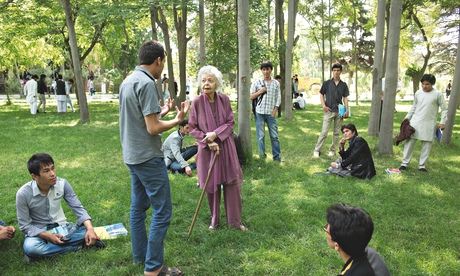
Dupree with science students outside the Afghanistan Centre at Kabul
University: ‘The young have found their voices,’ she says. Photograph:
Joel van Houdt for the Guardian
Few people now move to Afghanistan to start a new life. Visitors
once came for tourism or trade, but these days most arrive for work
postings of a few months or a few years at most, to fight or deliver
aid, take pictures, or flit from meetings in barricaded ministries to
embassy cocktail parties. They do not expect to fall in love with a
country that, in the west, more often makes headlines for its violence,
extremism and corruption.
The past four decades of conflict have driven away millions of
Afghans, and almost all the foreigners who had made a home here. But as
British troops withdraw after a 13-year military occupation, and other
Nato allies send their forces home, a small band of expats has stayed
throughout the turmoil. Some have been seduced by the natural beauty of
the country, the hospitality and extraordinary history – the stupas and
temples, mosques and forts, decaying but still spectacular. Others kept
coming back over the years, and eventually settled – staying for love,
or for work – often seeing another side of Afghanistan. They may be
worried about the future, in a land where the Taliban has stepped up its
fight for both territory and Afghan support, infiltrating stretches of the countryside,
where they control the roads, levy taxes, run schools and dispense
justice. But they are not leaving the country they now call home.
Nancy Hatch Dupree, cultural centre director, Kabul University
Dupree arrived with her husband, a cultural attache, in the 1960s.
They lived in Kabul, where foreigners mingled at parties with the Afghan
elite, then took morning horse rides through grass meadows.
“We met all these beautiful people: sophisticated, elegant, dressed in the latest fashions,” she remembers. “[President Mohammad] Daud Khan
insisted they all brought their wives, because that’s what you did in a
modern nation. The highlight was the Queen’s birthday party at the
British embassy, where we would dance until dawn, then go up to Qargha
lake with our bottles of champagne and watch the sunrise.”
Kabul should have been just the first of many postings as a
diplomatic wife, but her life was upended when she asked anthropologist
Louis Dupree to edit a tourist guidebook she had written, the country’s
first. She walked into his office, and found the love of her life. The
cultural attache became an ex.
“I didn’t have any sense that I was going to stay here for so long,
but when I married Louis I caught the bug with him,” she says.
The couple spent years travelling through the Hindu Kush and the
deserts of the south, seeking traces of prehistoric civilisations and
exploring villages for anthropology research. Those years were a golden
age for the country. “Louis and I would go in one car, and never think
about security.” But in 1978, Daud Khan was toppled in a Soviet-backed coup, Louis was briefly imprisoned, and the Duprees were expelled. They moved to Pakistan, where Nancy worked in refugee camps. Louis died of cancer in 1989,
and when Nancy flew back to Kabul, in 1993, it was to a city battered
by civil war. She helped salvage the national museum’s treasures, and
after the Taliban were toppled, in 2001, she returned for good. Already
in her 70s, she secured the backing to build the Afghanistan Centre at Kabul University, a home for the couple’s collection of historical documents.
Despite the current conflict, her optimism endures. “The young have found their voices,” she says.
Alberto Cairo, physiotherapist
‘To see all
these patients with terrible wounds was quite tough. But strangely, I
have felt since the beginning that I’m in the right place. I realised I
was really useful,’ says Alberto Cairo.Photograph: Joel van Houdt/Guardian
Cairo’s office sits a few paces from a metal workshop, near rooms
full of plaster casts of legs, arms and hands. More than 130,000
disabled Afghans have passed through the simple rehabilitation clinic
over several decades.
Cairo grew up in northern Italy and trained as a lawyer, but
realised, at 30, that he did not want to spend his life in courtrooms
and offices. He went back to college to study physiotherapy, spending
days in a wheelchair to better understand his future patients, then
joined the Red Cross. His first assignment in Afghanistan, in 1990, was
at a hospital for war casualties. Given just three weeks’ notice, he
asked what language the locals spoke and what the weather would be like.
“I did not know anything,” he admits.
He worked 15-hour days for several months to get to grips with his
work. “I was in Africa before, for three years, but it was not a war
situation,” he says. “So to see all these patients coming with terrible
wounds, it was quite tough. But strangely, I have felt since the
beginning that I’m in the right place. I realised that I was really
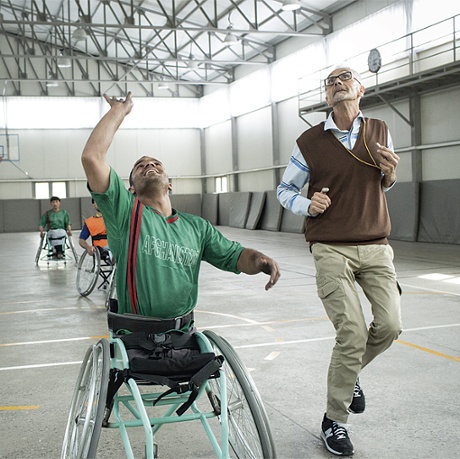
useful.” Alberto Cairo refereeing a game of wheelchair basketball.Photograph: Joel van Houdt/Guardian
Foreign staff were evacuated when a rocket hit the hospital in
August 1992, but less than two months later, Cairo was back, driving
ambulances across frontlines and working at the rehabilitation centre
where he is still based. He has always pushed the Red Cross to be more
ambitious in their efforts to help the country’s disabled. He threw out
old rules and began helping people whose injuries were not caused by the
war. Now, only one in seven people treated at the centre are victims of
conflict; others are maimed in car crashes, industrial accidents, or
difficult home births.
Cairo started the Red Cross’s first rehabilitation projects, offering
education and job training, and he insists that all staff at the centre
are disabled themselves – from the security guards to the teams that
make prosthetic limbs.
“It’s society that makes the life of disabled people impossible,” he
says. “In Afghanistan, the disabled are not rejected, but they are given
pity, not rights. They are not given a chance to restart their lives.
So we have to fight.”
Recently, he introduced wheelchair basketball to the country, after
finding a Chinese firm that makes the special wheelchairs cheaply, and
an American willing to coach.
“Physiotherapy is painful. Prosthetic limbs are not easy. But sport is fun, it’s joyful,” he says.
There is not much about Italy he misses, though he sometimes longs
for theatre or cinema. He taught an Afghan at the centre to make Italian
food, and when he returns from a visit to Italy, his cases are loaded
with parmesan and coffee.
“I will never be an Afghan, but when you ask me where is home, I say Kabul. This is the place where I want to be.”
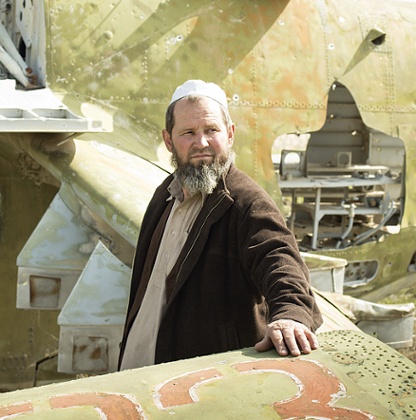
Alexander Levenyets Yurivitch, former Soviet soldier, now a taxi driver
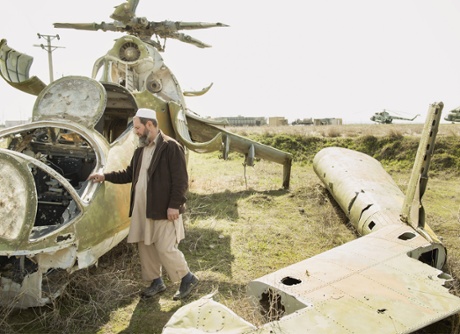
Alexander Levenyets Yurivitch in a field near the airport in Kunduz, where old Soviet military equipment has been left behind.Photograph: Joel van Houdt/Guardian
It was an unpromising introduction to Afghanistan. Alexander
Levenyets Yurivitch’s plane had taken off from a Soviet Union airbase
with no destination given; he and the other conscripts on board were not
warned they were heading into a bloody, protracted war. When he stepped
off the aircraft in windy Kunduz, he recognised the Afghan flag
fluttering beside the Soviet Union’s hammer and sickle.
The young Ukrainian was primed to face squads of ruthless foreign
fighters and hostile locals, but found himself chatting to Afghan
teenagers who peddled hashish to bored soldiers, and he realised the war
was much more complicated than he had expected.
Yurivitch started selling Soviet ammunition to his mujahideen
enemies, but got caught. In detention he was barely supervised, because
the guards thought that the prisoners’ fear of the men waiting outside
the gates of their military base was security enough. And so, one night,
Yurivitch slipped out.
“I wasn’t nervous. I was born in Ukraine but these are my people – I
felt it as soon as I escaped,” he says. “I converted on the first day.” ‘I was born in Ukraine but these are my people – I felt it as soon as I escaped,’ says Alexander.Photograph: Joel van Houdt/Guardian
Alexander became Ahmad, and within a month he spoke fluent Dari, the
only trace of his origins a thick Russian accent that has lasted over
three decades. He sent a letter home to his only relatives, his mother
and brother, after he absconded, telling them he was alive but had
switched sides. His mother, whom he never saw again, replied, “I want
you to be happy. You don’t have to come back – forget your debt to me.”
Yurivitch has left Afghanistan just once, to make the pilgrimage to
Mecca, travelling on an Afghan passport. He spent six years in the
mountains fighting his former comrades, once barely escaping a village
ambush in which the only other convert in the group was killed. But he
found a band of brothers, after growing up desperately poor and
fatherless.
“It wasn’t so tough,” he says. “We had heaters, electricity, everything was well planned; we even had a cook, a baker...”
In 1989, Moscow finally ordered its soldiers home, so he was able to
give up his guerrilla life, move into Kunduz and turn his thoughts to
marriage, a challenge for an outsider in a country where most people’s
partners are chosen by their parents.
“The mujahideen looked for an Afghan woman for me. A radio operator
gave me his daughter,” he says. His wife is a teacher, and they live
with their four daughters in a small village 20 minutes’ drive north of
Kunduz. The land there was left to him by his commander from jihad days.
The legacy is testament to Ahmad’s popularity, bolstered by his
reputation as a devout Muslim.
“I didn’t have any problems with the Taliban because I was one of
them,” says Ahmad, who drove trucks for them in a time he looks back on
as a golden age. “I had a fixed salary then.”
Now a taxi driver, he is ambivalent about the past decade. “Back
then, people were honest, good Muslims. Nowadays, people want democracy
and open society,” he says.
Still, sitting among the rusting wreckage of military transport
planes and helicopters, on the airbase where he first set foot on Afghan
soil, he is hopeful.
“I think things are getting better because the Americans are leaving,
and we are all tired of fighting. This is a holy land, which can’t
accept foreigners. Just like the Russians, they have been forced out.”
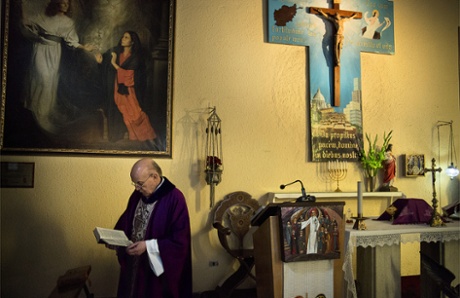
Father Giuseppe Moretti, Catholic priest
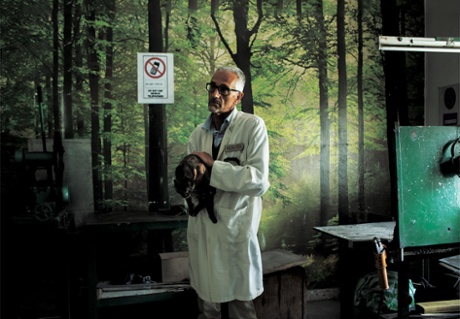
Father Giuseppe Moretti in his church at the Italian embassy.Photograph: Joel van Houdt/Guardian
To Father Moretti’s Afghan friends, the bishop of Kabul is “mullah
sahib”, a token of respect for his status as a man of God, even if his
God is not the one they believe in. Conversion to Christianity still
carries the death penalty in Afghanistan, so Moretti’s diocese is a
single church inside the grounds of the Italian embassy, its
construction authorised nearly a century ago.
Communist secret police, civil war militias, Taliban vice police and
now Nato soldiers have all passed through its gates in the years since
1977, when Father Moretti first flew into the city.
“I realised when I arrived that I could work from the presumption
that I was European and therefore superior, and understand nothing; or I
could open myself completely to this country and love it. And it was
the latter,” he says.
His small house is crammed with mementoes of his life as an Italian
priest in a war zone. When the country spiralled into civil war after
the departure of the Soviet troops, he refused to leave – at first
naive, then stubbornly committed.
“On 28 April 1992, the first night there was fighting, I thought it
was a party with fireworks, beautiful. The second night, I thought the
fireworks were continuing. The third night, our chargé d’affairs said to
me, ‘There are no fireworks, that is fighting.’”
Undaunted, Moretti stayed to minister to the handful of nuns still
doing charity work in the battered city. “We had nothing for our
defence. I remember the boom, boom, boom, so close around.”
Two years later the shells hit his home and he barely escaped alive.
“When I opened my eyes, my dog, Benji, was there in the ruins; he helped
me cross to the ambassador’s residence. When the watchman saw me, he
fainted. I must have been covered with blood.”
Moretti was ordered home to Italy to recover. When security returned
to Kabul it was under the Taliban, and although they left the church and
the nuns who prayed there in peace, there was no priest until the
Taliban fell in 2001. That year, Pope John Paul II sent Moretti a simple
message. “He said, ‘Father, it is time to go back.’”
The two celebrated mass together, and on the journey to Kabul,
Moretti stopped to look around a small shop in eastern Afghanistan. With
a surprise still evident, he found an oil painting of the pontiff
there; it now has pride of place on his wall.
Newly invested with the authority of a bishop, he leads an eclectic
congregation that has at times included ambassadors and Nato commanders.
The only people he has not tried to reach out to are Afghans. “We are
forbidden from proselytising, and I would not say anything about
Christianity to my assistants, even as a joke. But they have respect:
they change the flowers every day, ask me how many people came to the
service.”
At 75, he is due for retirement, but has volunteered to stay on
despite growing security problems. There have been two suicide bombings
just metres from his gate, which have made him a virtual prisoner in his
house. He no longer wanders freely through the city he remembers from
decades ago. “It was not a splendid city, but every day you could see
the mountains. It was a pleasant life. You could walk everywhere
peacefully.”
His main worry is not the violence but his shrinking congregation. He
feels an affinity with the Afghans because they are religious people.
“For the Afghans, it’s impossible to think of a man without God. In the
west, it’s the contrary: impossible to think of a man with God,” he
says. “This is the most difficult thing for me as pastor of the
international community: people are proud of their religious
indifference.”
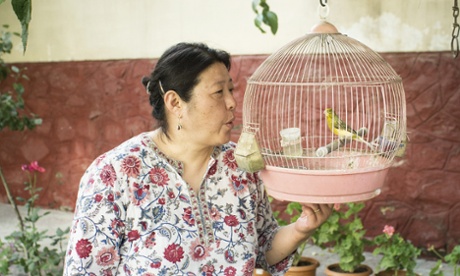
Hiromi Yasui, photojournalist
‘This is my home,’ says Hiromi Yasui.Photograph: Joel van Houdt/Guardian
Yasui’s garden is a shady escape from Kabul’s dusty, frenetic
streets. A fountain sits among fig and mulberry trees, and two giant
guard dogs given to her by nomad families loll on the lawn, longingly
eyeing a small aviary.
“It’s comfortable to have a house of your own,” says Yasui, a
photographer who was first drawn to Afghanistan by its wandering tribes
of livestock herders. She had been captivated by an old book of photos
of the country’s Kuchi nomads,
and in 1993 she hitched a ride on an aid truck to the eastern city of
Jalalabad. After a sheltered childhood in the historic Japanese city of
Kyoto, she was shocked by the violence she found.
“I crossed the border and I was so excited, thinking, ‘This is
Afghanistan.’ I only knew it from the book. I thought there would be
caravans of nomads, and I looked and looked but couldn’t see a single
one. There were just burning trucks and tanks, and then I realised:
there is still a war here. I had never seen war,” she says. “I had to
report these facts to Japan, instead of the Kuchi.”
After two weeks covering a sprawling, squalid refugee camp, Yasui
travelled to Kabul, crossing the frontlines between several warring
factions. Undaunted by her inexperience, or by the horrors she had
already seen, she joined a handful of other journalists in the city’s
dilapidated German Club and became a war correspondent almost overnight.
“It was so surprising, so sad,” she says. “I was crying a little bit at
the beginning… It was not necessary for so many children to die. But I
was not frightened. It looks very dangerous being at the frontline but
the [other soldiers] were a long way away.”
She returned to Afghanistan every year after that first trip,
eventually photographing nomads in the Panjshir valley, and then
befriending one of the war’s most famous commanders, Ahmed Shah Masood, known to his admirers as the Lion of the Panjshir.
“When his bodyguards introduced me, saying, ‘The Japanese female
journalist is here’, he would joke: ‘She’s not a girl, it’s a boy.’ If
you see the pictures, I have very short hair and I’m wearing men’s
clothes for my work.” She laughs.
Masood gave her a Persian name, Mursal, which means rose. “After the
war finished, all the mujahideen came to Kabul, everyone knew me. Every
street, passing by, I’d hear ‘Mursal’ – someone calling to me.”
In 2002, after both her parents passed away, Yasui moved to Kabul
full time. Months later she fell in love with an Afghan colleague, but
dating was a challenge in a city so conservative that many couples don’t
even meet until they are engaged.
“It’s difficult to secretly be boyfriend and girlfriend in this
country, so in the end we decided to get married. We went to Turkey,”
says Yasui, who converted to Islam for the marriage and sometimes
worries that she is a “lazy Muslim”.
A decade later she has become famous in Afghanistan with a new
generation, this time for her cooking and hospitality. Encouraged by an
unconventional Japanese tour firm keen to invest in Afghanistan, she
opened a small but immaculate hotel in the historic Bamiyan valley, looking out over cliffs studded with ancient Buddhist caves.
“At the beginning it was quite difficult, because I’ve no experience
of being a hotelier,” she says. “But I have been a customer, so I try to
put in what I think is comfortable.” That included introducing Japanese
and Chinese food to a once-cosmopolitan valley that had fallen off
international trade routes centuries earlier.
The Hotel Silk Road
became the closest thing Afghanistan has to boutique accommodation,
booked out for government retreats, charity workshops and diplomats’
holidays. Guests told her that, once back in Kabul, they missed her
teriyaki chicken and tempura, so she opened a restaurant in the capital,
and a handicraft business to provide jobs for local women whom the
small hotel could not support.
She still works as a journalist, but her side projects now employ
nearly 100 people. Security worries have already affected her business:
roads into Bamiyan have been periodically cut off to foreigners and most
government officials. But having endured one Afghan war, she is
prepared to ride out another – and is still hopeful she won’t have to.
“I am ready to fight for things to go the right way,” Yasui says.
“Sometimes I’m a little bit tired, but still I want to stay here. This
is my home. We believe the future will be bright.” Thanks to the Guardian for permission to reproduce this article.