A Bizarre SS Expedition to Tibet
In 1938, an SS expedition led by German zoologist Ernst Schäfer
trekked to Tibet, returning with priceless animal specimens. Many
believe they had actually been sent to search for a lost Aryan race,
but a new book argues that the truth is more complicated.
trekked to Tibet, returning with priceless animal specimens. Many
believe they had actually been sent to search for a lost Aryan race,
but a new book argues that the truth is more complicated.
The Berlin Museum of Natural History, even beyond the famous Tyrannosaurus Rex skeleton in its exhibition hall, is well known for its treasured natural artifacts and is considered a world-class collection. It is one that includes some 3,500 mummified birds kept in tall cabinets -- highly valued items that were acquired some 80 years ago by an SS officer on the snow-covered roof of the world.

explains curator Sylke Frahnert. "As a result of the clash between these ecological zones, completely different groups of fauna have intermingled there." Taxonomists and geneticists frequently make the pilgrimage to the Berlin collection, where 10 previously unknown bird species have been discovered over the years.But the artifacts' history is unfortunately a dark one. Shortly before the outbreak of World War II, zoologist Ernst Schäfer traveled to Tibet on behalf of SS leader Heinrich Himmler and despite a government ban, he promptly began killing birds to take back home as samples.

The question as to why the letter never arrived at its destination (and is now at the Bavarian State Library) is as mysterious as the rest of the expedition. Himmler had reportedly ordered the group to search for a "root race" with blond, curly hair -- the original Aryans. The Germans were also interested in finding cold-resistant horse breeds for the war economy.
The British intelligence service, which eyed the German march across British India with suspicion, suspected espionage. Historian Wolfgang Kaufmann, for his part, believes the Nazis wanted to explore the area where the spheres of interest of Japan and Germany, the expected winners of the upcoming war, would collide.
Schäfer was an "excellent marksman" and trapper, obsessed by the loneliness of the wilderness and disgusted by the "soft cushions" of civilization, Meier-Hüsing writes. British colonial officials called him strong, moody and well-educated, but also childishly vain.
A Talented Explorer
He had acquired his talents at an early age. The son of a business executive, Schäfer had hunted deer in the Odenwald region as a teenager before beginning his zoology studies at the age of 19. He later came into contact with American millionaire Brooke Dolan II, who was planning an expedition into relatively unexplored western China and needed an able companion.
In 1931, the two young men dove into the faraway bamboo forests, where the German proved an excellent hunter, such that their trunks were soon filled with rare animal pelts, including goat-like gorals, serows and takins. He also killed a panda -- a first.
The Academy of Natural Sciences in Philadelphia was so enthusiastic about his zoological foray that it made Schäfer a member. Back at home, the young ornithology student wrote a lengthy, best-selling account of his adventures and joined the SS in 1933. But that didn't stop him from once again answering the call of the wild, spending almost two years in the untouched headwaters region of the Yangtze Kiang River with "Yankee" Dolan.
The rising zoology star spent his 26th birthday drinking whiskey and playing golf at the Dolans' luxury ranch. The Americans courted this Indiana Jones of zoology while his German benefactors, including Nazi Party foreign press chief Ernst Hanfstaengl and the German general consul in Shanghai, sought backers in the Third Reich for an expedition Schäfer was planning to Tibet.
At the time, the Dalai Lama's realm seemed like an isolated fortress full of natural secrets. The British had already forcibly opened up Tibet when they invaded the country with 3,000 soldiers in 1903. Using machine guns, they mowed down the local soldiers, who were riding ponies and armed with spears. But the region still remained semi-autonomous, rejecting progress and refusing entry to foreigners.
When Himmler learned of the bold plans for the expedition, he immediately expressed interest, and in spring 1936, he sent a trans-Atlantic cable reading: "Return to Germany requested." Schäfer obeyed.
He later called the alliance with Himmler, who went on to become the architect of the Holocaust, his "biggest mistake." Author Meier-Hüsing, however, describes Schäfer as an opportunist who had a "tremendous craving for recognition."
The young scholar's Faustian bargain with the SS soon brought him into the orbit of Himmler's "Ahnenerbe" Society, whose members championed the "Welteislehre," (world ice theory) which held that there was once a "Nordic-Atlantic original culture" which was destroyed when a moon crashed into the Earth, and that the remnants of this super-race survived only in the Himalayas.
'Nonsensically Mystified'
Karl Maria Wiligut, a former colonel in the Austro-Hungarian army, had dreamed up this nonsense, believing himself to be an incarnation of the German god Thor. When Schäfer visited the charlatan at his villa in the Dahlem district of Berlin, he blurted out his prophecies -- apparently while high on opium.
It is this aspect of the Tibet mission that right-wing esoterics latched onto. In novels and on Nazi websites, the zoologist is still portrayed as a servant of Hitler in search of the Holy Grail.
This nonsense culminated in the so-called "Buddha from space," which surfaced a few years ago. The sculpture is adorned with a reverse swastika, a symbol of luck in the Far East. The sculpture was supposedly 1,000 years old and was part of the spoils of Schäfer's mission. An analysis by the Stuttgart Institute of Planetology even showed that the idol was made from the ferrous Chinga meteorite, which fell to Earth more than 10,000 years ago between Siberia and Mongolia.
It was an astonishing result, but disappointment soon followed: the material is indeed from space, but the Buddha itself was made by a modern-day forger. Apparently an unknown individual had attempted to create a dramatic source legend for the object in order to increase its value.
The expedition was "nonsensically mystified," says Meier-Hüsing. Himmler's drivel about original Aryans meant nothing to the leader of the mission, he insists. The president of the Ahnenerbe Society was at times so irritated with Schäfer that he wanted to back out of the project. Himmler eventually took over the sponsorship and, with the stroke of a pen, turned the entire team into SS officers. But he provided almost no funding.
Nevertheless, the Nazi insignia on the explorers' tropical helmets were enough to alarm the British. When the "Vikings of Science" began their journey in April 1938, they had no entry documents for British India, and the Empire blocked their way.
But the expedition leader applied his charm. After arriving in Calcutta, he took a 36-hour train ride through the country and requested an audience with the Viceroy of India, Lord Linlithgow. He was "so pathetic and subservient," according to a memorandum by the colonial authority, that the British promised their assistance.
The diplomatic carousel was also turning in London. British Admiral Sir Barry Domvile, an anti-Semite and friend of Himmler's, personally intervened with British Prime Minister Neville Chamberlain, who eventually gave the green light to the expedition in the spirit of appeasement.
But the visa that was issued was only valid for the principality of Sikkim, a tiny country high up in the mountains. What could the Germans do? They were stuck in India with tons of equipment.
Entry into Tibet
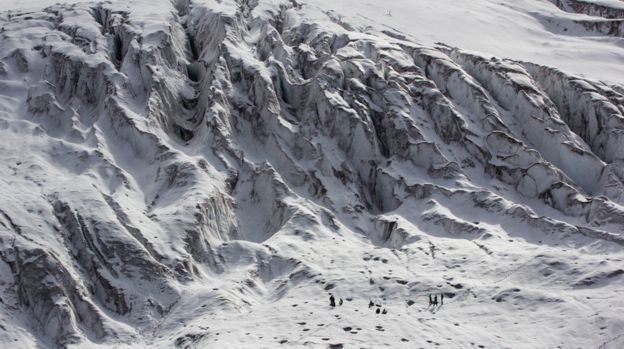
Without waiting for another permit, they set out on their expedition anyway. It was already June when they began their journey in Darjeeling, using ox carts and horses. Heavy clouds from the Bengali plains built up against the Himalayan ridges as the caravan began climbing on muddy paths into the majestic peaks.
The caravan came to a temporary halt at the Kongra La Pass. Tibet, with its mysterious wildlife, was on the other side of the 5,130-meter pass but the SS adventurers had no choice but to set up a base camp near the border.
In the evenings, the melancholy Schäfer would sit in his tent reading Goethe's "Faust." His wife had been killed prior to the expedition in November 1937, having been hit in the head by a stray bullet during a duck hunt.
The dance music coming from a short-wave radio they had secretly brought from Berlin was not enough to lift his mood, nor was the monotonous food, which consisted of "noodles, nothing but noodles."
But then an opportunity arose. A Tibetan administrator from across the border paid a visit to the Germans' wind-blown camp and Schäfer flattered the man, serving him tea and pastries and giving him rubber boots, Bahlsen cookies and an air mattress. In return, the man used his powers of persuasion to request a visa for Lhasa.
He was successful. After weeks of waiting, Tibet's council of ministers permitted the "master of a hundred sciences" to visit the closed off capital of Tibetan Buddhism, but without scientific equipment. He was also not permitted "to kill birds or mammals," the permit read.
On Dec. 22, 1938, the SS men entered the forbidden plateau and two days later, they decorated a Christmas tree with home-made tinsel. After New Year's Eve, the temperature dropped to -35°C and they burned yak dung as fuel.
Despite the ban, the team had brought along their technical equipment. They trekked for 400 kilometers through snow-covered steppes, through ice and hail storms. When they reached Lhasa, the Germans looked like vagrants. "They had blonde hair, blue eyes and dirty, unkempt beards," one Tibetan noted.
There were 25,000 people living in the holy city at the time and roughly the same number of red-robed Buddhist monks lived in the three government monasteries in the surrounding area. The massive Potala, the seat of government, stood in the center of Lhasa.
Unlike the showy and stiff British officials in Lhasa, the Germans remained casually dressed and relaxed, even after their first bath. Their fondness for drink quickly became the talk of the city: They invited Tibet's notables to numerous parties, where the Chang Beer flowed freely and German songs were played on the gramophone.
Despite being the sent by "the Aryan master race" to search "for forgotten cousins in the East," writes Meier-Hüsing, the team did not put on airs.
Anthropologist Bruno Berger's behavior was particularly egregious. He used a compass, skull tongs and a device for the lower jaw to measure the bodies of local residents. He also smeared a material called Negocoll onto the faces of test subjects to make skull impressions.In their dossiers, the British accused the Germans of loutish behavior, describing Schäfer as a "priest of Nazism," but their assessment also contained a hint of jealousy.
Despite the British criticism, Schäfer rose more and more into favor. As a master of what Meier-Hüsing calls "flattering declamations," he even convinced the state's ruler, Radreng Rinpoche, to extend the group's permit for another six months. According to an SS memo from late 1939, Schäfer also secretly offered weapons to the regent, although it is unclear today whether anything came of it.
The mission -- a strange mixture of espionage, drunken revelry and a zoological foray -- ended three weeks before World War II began. In addition to the more than 3,000 bird carcasses, the group took home 2,000 eggs, 400 skulls and pelts of mammals, as well as reptiles, amphibians, several thousand butterflies, grasshoppers, 2,000 ethnological objects, minerals, topographic maps and 40,000 black-and-white photographs.
Many of these treasures are still tucked away in the archives today, frowned upon because of their association with the Nazis. Schäfer fell into similar obscurity. If he had moved to the United States in time, he would probably have risen into the pantheon of great discoverers. But in postwar Germany, he was tainted with Nazism and only barely acquitted in his denazification trial. Ultimately, he ended up writing for a German hunting magazine.
Translated from the German by Christopher SultanDespite the British criticism, Schäfer rose more and more into favor. As a master of what Meier-Hüsing calls "flattering declamations," he even convinced the state's ruler, Radreng Rinpoche, to extend the group's permit for another six months. According to an SS memo from late 1939, Schäfer also secretly offered weapons to the regent, although it is unclear today whether anything came of it.

Many of these treasures are still tucked away in the archives today, frowned upon because of their association with the Nazis. Schäfer fell into similar obscurity. If he had moved to the United States in time, he would probably have risen into the pantheon of great discoverers. But in postwar Germany, he was tainted with Nazism and only barely acquitted in his denazification trial. Ultimately, he ended up writing for a German hunting magazine.