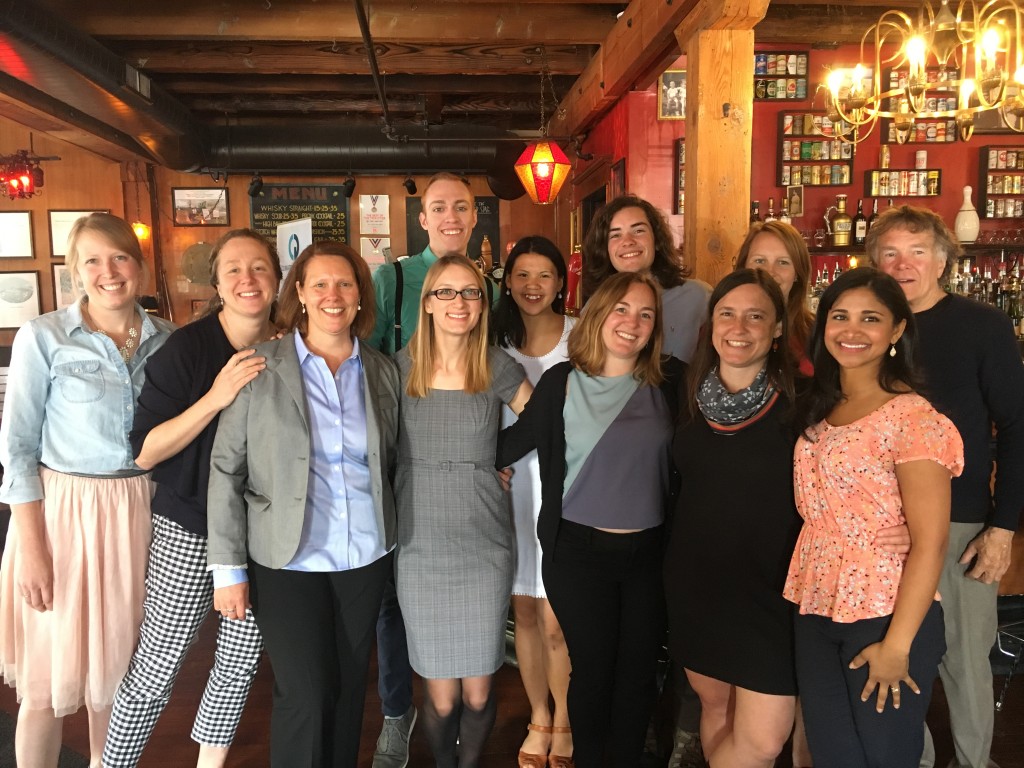
I rediscovered this interview in 2011 when the eight of us from our successful 1986 North Pole Expedition where each of us spoke about the impact of climate change in the world's we individually work in, or have worked in.


Letter from the Executive Director
 This month kicked off with our annual donor appreciation breakfast at Red Stag, where supporters learned through storytelling how our work has been influenced by the Paris climate agreement. Our staff’s stories brought COP21 to life again, while connecting the experience of the UN conference with our climate change programming moving forward
Together with the Minneapolis Film Society, MN350 and Food & Water Watch, we joined film director Jon Bowermaster for a screening and panel discussion of his new film Dear President Obama, featuring stories of individuals impacted by the fracking industry and the clean energy revolution that is happening now across the US.
On Saturday, May 7th, we were thrilled to have over 20 allies and supporters join us as we began the process of mapping a new strategic plan for our organization. The feedback, thoughtful insights, and energy that filled the room were truly inspiring! On behalf of our whole staff, I want to extend a heartfelt thanks to everyone who took the time to be there or filled out our survey for input.
Throughout this spring, our high school youth involved in YEA! MN are wrapping up their action projects before the end of the school year, and planning for their year-end retreat at the Steger Wilderness Center. At the same time, our education team is pulling together a robust agenda for our 11th annual Summer Institute for Climate Change Education at Macalester College, happening June 21-24.
Looking ahead to summer, we hope to see you at our Institute in June or at the Northern Spark festival on June 11, where the theme is Climate Chaos – Climate Rising. We are proud to be working with a team of architects and artists who are creating an interactive look at climate data and climate impacts through ice!
Thanks you for engaging in, sustaining and supporting our work in the ways that you can!
Sincerely,
Nicole Rom, Executive Director
Education
Past Summer Institute testimonials highlight what you can expect this year!
 Attendees at last year’s 10th Annual Summer Institute for Climate Change Education had a lot to say about this powerful and much-needed professional development experience. You can add your testimonial to the growing ranks of Summer Institute alumni by registering and attending this year’s Institute, which is right around the corner! Here’s what past educators have had to say:
Fabulous speakers, staff, workshops, and presenters plus tasty, fresh food in a great setting – what an awesome combination!
Since I have been a teacher, there are two institutes/trainings that have made more than a lasting impression on me. This is definitely one of them. I wish the three days weren’t up, or that we could have at least one more day! This was so awesome. Thank you so much for an insightful and resource-filled week. Kudos to ALL of you who are a part of Climate Generation!
Carrying the stories of COP21 forward
It honestly wasn’t until April 22, the day the Paris Agreement was signed, that I truly felt I had returned from Paris and COP21. On Earth Day, 174 nations and the EU signed the Paris Agreement, the largest number of signatures to an international agreement in one day, ever. It was both a privilege and an honor to not only be present at COP21, where the Paris Agreement was developed and finalized, but to be present with ten education ambassadors committed to climate change education. In the past few weeks, I finally took time to look back and reflect on all the moments that made our time there memorable and transformational. There are many stories I could tell, but I think this is the one that best captures how COP21 transformed all of us who were able to attend: Kristen’s Climate Story – Landing from Paris.
Katharine Hayhoe talks changing minds on climate
During Earth Week, some of the staff attended a talk by atmospheric scientist Katharine Hayhoe, who is an associate professor at Texas Tech University, director of their Climate Science Center, and a personal climate hero for many of us. Her research focuses on how we should communicate about climate change, and how to use that dialogue to then inspire action on solutions. In her talk, she emphasized that we don’t need to share ever more facts and figures to bring people around; rather, we should respectfully connect with the other person through shared values that motivate our concern about climate change. We need to connect what we know to be true in the head to what the heart is feeling. Her talk affirmed our model of place-based climate storytelling that we used during our Climate Minnesota convenings last year. Share your climate story with us at stories@climategen.org and we’ll add it to our online collection!
Emerging Leaders
Relational organizing at work in the YEA! MN program
 Relationships are at the heart of movement building. In order to win long-term change, we need to cultivate sustaining relationships to support the long-haul work that will get us there. We need one another to weather the storms of our world and move forward our visions for our communities. This year, YEA! MN student leaders Addie Welch, Kendra Roedl and Liam DelMain have come together to intentionally navigate their relationship with the East Phillips neighborhood. The growing relationship between YEA! MN student leaders and Tamales y Bicicletas brings us to exciting work ahead of us: we’re creating momentum for environmental justice in East Phillips and more broadly among young people around the Twin Cities. Join us for two upcoming opportunities to build relationships in our local community – on Wednesday, May 18 we’re partnering with Tamales Y Bicicletas for a Toxic Tour Bike Ride of East Phillips, and on Tuesday, May 24 we will be holding an environmental justice listening session in the community. Reach out to yeamn@climategen.org with any questions.
Former YEA! MN student Becca Krasky selected as 2016 Fossil Free Fellow
 Have you wondered where YEA! MN students go after they graduate and leave our program? Becca Krasky joined YEA! MN as a junior at Minneapolis South High School, where she helped launch a compost competition between rival high schools and a campaign to reduce plastic bottle waste through the installation of hydration stations on campus. She traveled with us to Power Shift 2013, a national youth climate summit in Pittsburgh, PA, and upon graduation, went on to Macalester College, where she joined the student divestment group Fossil Free Macalester. This spring, Becca was accepted as a 2016 Fossil Free Fellow with 350.org. Chosen from hundreds of applicants, she will join a diverse group of 24 fossil fuel divestment campaigners from across the U.S. for 10 weeks this summer. Fellows gain hands-on experience in climate and justice-based organizing by working on projects across the U.S. with 350.org and partner organizations. Congratulations Becca!
#ActOnClimate
 Catch MN Stories in a Changing Climate in Duluth, or schedule your own screening!
On Tuesday, June 7th, join Climate Generation at Zeitgeist Arts Cafe in Duluth for an evening of film and live storytelling! We’ll be showing the Twin Cities PBS Minnesota Stories in a Changing Climate film, followed by a storytelling panel of Duluth residents sharing their climate stories, and a reception with beer donated by Bent Paddle. If you’d like to bring Minnesota Stories in a Changing Climate to your community, neighborhood group, or office, schedule a screening here.
In the News
Renowned polar explorer tackles NWO wilderness
 At the end of April, our founder Will Steger returned from his annual solo expedition, where he traveled from north of the Quetico down to his homestead in Ely. He left earlier this year in hopes of catching the mid-winter cold, but travel conditions in a changing climate have become a “wild card.”
Photo of the Month