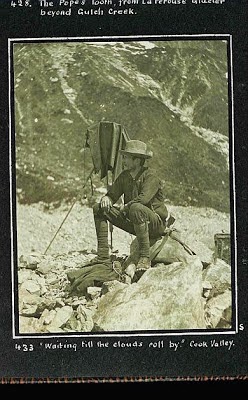
TEICHELMANN, Ebenezer
Evening Post, Volume CXXVI, Issue 149, 21 December 1938, Page 14
Noted Mountaineer
Dr. E. Teichelmann
Death At Hokitika
New
Zealand has lost one of her noted mountaineers through the death of Dr.
Ebenezer Teichelmann, F.R.C.S., M.R.C.S. (Eng.), L.R.C.P. (Ireland).
Associate of Mason's Science College (Birmingham). He died at Hokitika
yesterday.
Dr. Teichelmann was surgeon superintendent of the
Westland Hospital for about twenty years, but retired eighteen years
ago. He was widely known in New Zealand because of his mountaineering
work and was in Wellington for the last annual dinner of the New Zealand
Alpine Club.
Dr. Teichelmann was born in South Australia in
1859. He was educated at Hahndorf College, at Adelaide University, and
at Queen's and Mason's Colleges, Birmingham, England. He also studied at
St Bartholomew's Hospital, London, and at hospitals in Dublin. Ireland.
For a time he acted as demonstrator of physiology at Mason's College,
was assistant physician and resident pathologist at the General
Hospital, Birmingham, assistant surgeon at the Jaffray Suburban
Hospital, resident medical officer of the Birmingham Workhouse, and
later spent two years in private practice in England. Upon returning to
Australia he was health' officer at Port Adelaide for two years. He came
to New Zealand in 1897 to accept the position of superintendent of the
Westland Hospital.
At the outbreak of war in 1914 Dr.
Teichelmann, although he had difficulty in obtaining a position with the
Forces because of his German ancestry on his father's side, secured a
commission in the New Zealand Medical Corps with the rank of captain. He
served overseas from 1914 until 1917, and was one of the survivors of
the troopship Marquette which was torpedoed in the Aegean Sea.
Exploring and Climbing.
Many
contributions to mountaineering in New Zealand were made by Dr.
Teichelmann. He first became interested in climbing through engaging in
prospecting for gold up the Kellery River, but as soon as he v commenced
mountaineering he followed what was to be his lifelong hobby with
enthusiasm. Although he was a small, spare man, he proved a capable
climber and was nominated and elected a member of the Alpine Club
(London) in 1903.
He came into prominence through carrying out
some noted exploration work in the headwaters of the Wanganui, where he
climbed a number of peaks. He also did a good deal of exploring at the
head of the Cook River, but the pioneering work had been done there
before his time. From the time he was elected to the Alpine Club until
he went overseas with the New Zealand Expeditionary Forces he made many
ascents, several being first ascents, and a monument to the part he
played in New Zealand mountaineering will always remain in Mount
Teichelmann (10,370 ft) in the Southern Alps, which was named after him.
Dr. Teichelmann was the first to climb some of the peaks at the
head of the Cook River from the westward. and he was the first to cross
the Harper Saddle from the west, making the crossing some years after
Mr. A. P. Harper, Karori, Wellington, had given the saddle its name.
Dr.
Teichelmann also crossed Baker's Saddle from the Hooker Glacier to the
Copeland River, and made the' first crossing (in 1904) of Pioneer Pass
from the Fox Glacier to the Tasman Glacier. Others of his notable
climbing feats included the ascents of Mount Cook, Douglas Peak, Mount
Spencer. Mount Green, and La Perouse Call 10,000 ft or over). His
principal climbing companions were the Rev. H E. Newton (A.C.) and Mr.
Alex Graham (guide).
Dr. Teichelmann was a member of the New
Zealand Alpine Club for many years, and was a valued member of the
executive. He was president of the club in 1936 and 1937.
Evening Post, Volume CXXVI, Issue 149, 21 December 1938, Page 14
I was so happy to discovery this obituary today so long after writing his biography. Here is a to my web site on Dr. Ebenezer Teichelmann.
A typical Teichelmann photograph taken from the Fritz Range looking
over the Franz Josef Glacier and the main divide with Mt. Elie de
Beaumont to the left and The Minerets and de la Beche to the right. What
light, composition and texture. Bob McKerrow collection. Christchurch.