Forty three years has passed so quickly, but while that old thief of a clock may have stolen some years, the memories and photographs remain vivid as yesterday. Virtually to this day, in 1968, a bunch of young and enthuisiastic New Zealand mountaineers arrived at the foot of many unclimbed Andean summits in Peru, the mountain range was the Cordillera Vilcabamba. See the location on the map below..

We were seven young New Zealanders and one Englishman who had mortgaged our souls and hearts to have a last chance at a beavy of unclimbed mountains. I recall our leader Ken McNatty telling me " With nearly all major mountains in the world having been climbed, you'll never get another chance in history to climb so many peaks for the first time." I sold everything I had and took a loan for a thousand new Zealand dollars, half a year's salary in those days.
 The peaks of Pumasillo and Sacsarayoc in the Cordillera Vilcabamba taken from Paccha.
I was 19 when I left New Zealand,
(Read posting on departing NZ and travel to Peru)and 20 when I stood on my first virgin Andean summit, 43 years ago. Here is the extract from my diary of the first two climbs we did in the Andes.
Wednesday 5 June 2008
Paul Green, Ken McNatty and I left our base camp (situated at 4200 m) early morning with bulging 40 kg mountain mules packs and headed down valley and forked sou’west into the valley that we believe leads to the unclimbed peak, Cupola. 5200 m. We were hoping to do the first ascent by the south ridge. We had yet to set foot on an Andean Glacier, or snow yet, so were we being too optimistic ? We made hard work of the heavy loads and at 4 pm, we camped on the smow-line . Above, the twisted icefall streaked longitudinally with avalanche debris, and the skyline ridge dotted with bulges resembling Athenic helmets, were taking on the soft red and purple shades as the sun set. We erected our tent and put on down jackets, drank tea, as we looked for a route.
Thursday 6 June 2008
Slept in patches. We awoke at 5am and crawled out of the tent. A clear sky and the stars were dancing heel and toe. It would soon dawn a glorious day. Wolfed down breakfast and started the climb at 6am.. We threaded our way through a steepish icefall which led us out onto a glacier. We then had to negotiate an ice face that led onto a rocky buttress which tested our rusty climbing skills to the utmost Once on top of the buttress, a knife edge snow arête led to the summit. I couldn’t contain my joy. In twenty minutes or so and we would be on top of out first Andean summit, an unclimbed summit at that. The ridge was exposed and dropped away with alrming abruptness. We moved carefully, but surely, belaying all the way with three on the rope. Ken McNatty and Paul Green are solid climbers and a joy to be with. Sonn we stepped on thye summit. We had climbed 2000 feet in four hours. The view from the top was breathtaking. Similtaneously we saw a huge needle in front of us and we all started talking at once. "Does it have a name and can we climb it ?" We consulted the map and it was an unnamed and unclimbed peak between us and Nevado Blanco, the next named peak on the map. This was exciting stuff discovering an unnamed peak. We agreed that we would attempt to climb it tomorrow and if successful, we would call it La Aguja, "the Needle" because of its pointed spire. We were at 5,200 metres and La Aguja we estimated it to be at least 150 m higher.
 Looking from the summit of Cupola to La Aguja
Our descent was uneventful and we got back to our camp at mid afternoon for a rest and preparation for tomorrow for La Aguja. It was an exciting day and my thoughts were on La Aguja. Would we be able to find a route up and how safe would that tottering ridge be ? These thoughts swirled like mist round and round in my head as I fell asleep.
Friday 7 June 1968
I stirred about 4 a.m and peeked out the tent door. A star-studded sky greeted me. The climb was on. We were well prepared. We had heated milk the night before and put it in a Thermos Flask. So breakfast was Wheetbix with hot milk and some biscuits washed down with tea. We were away by 6 a.m. We found a good route through the glacier to the snow field beneath the towering Needle, We looked at the possible routes. We decided to attempt the south ridge which is on the right-hand side of the photo posted above. We had to negotiate the tricky mushrooms on the ridge which took time to negotiate. With three on one rope, you move slowly. As I belayed I would look around the whole massif and take in the view. At one stage Paul shouted out,” Watch me and your belay, not the mountains,” as he caught me being a tourist and not a mountaineer. We had a series of fragile mushrooms to negotiate and with the hot sun beating down, the tops were beginning to melt and break. We needed to move more quickly. The summit seemed hours away.

Negotiating the tricky mushrooms on the south ridge of La Aguja.
After negotiating the mushroom flecked ridge, we came to to final 100 metre pinnacle, a mixture of rock and snow. Paul Green, who had recently done one of the few ascents of the Coxcomb ridge of Mt. Aspiring in New Zealand,, eagerly volunteered to lead the final summit push. He climbed his way up a narrow gap between rock and ice, using both to get the required purchase as he steadily climbed towards the summit. This super piece of climbing took an hour. We quickly joined him and then it was a further hour of climbing to the summit. We all stood atop this precarious summit, which was threatening to topple at any moment
 Bob McKerrow leading out along the ridge of La Aguja with Ken McNatty roped to him. Paul took the photo. Paul did the lead to the summit between the snow and rock on the left side of the Needle
A second first ascent in two days and the honour fell to us to name it,
'La Aguja', the needle. Our vantage afforded an amazing view of the Pumasillo and Panta Massif. Looking about at the mass of peaks, many unclimbed summits, faces and ridges, we were in for another three months of exciting climbing. On the descent we encountered white-out conditions but we picked up our morning’s footprints and we gingerly picked our way back to base without incident Providence had been with us so far. Two first ascents in two days.
Saturday 8 June 1968
At 5 am it was snowing. We decided to wait the day out sleeping, reading a brewing tea. The next morning it was still snowing so we decided to go back to base camp to let the snow settle, consolidate and freeze as it is very avalanche prone on the high mountains for days after heavy snow falls.
 A camp, high on La Aguja. The success of the expedition was due to the fact we put in high camps, and started early before the snow got soft and started avalamching.
Ourr fast improving Spanish was going to be of little help as we hit the alto plano, where descendents of the Incas, the Quetchua Indians lived and spoke only Quetchua. As the weeks rolled by, we spent a lot of time with the two Quetchua families in the valley, headed by
Juan and Simien digging a potato field below.
 Juan Pablo and his daughter Nellie.
 Four of the eight of us on the walk in. Bob McKerrow, Pete Goodwin, Mac Riding and Paul Green.
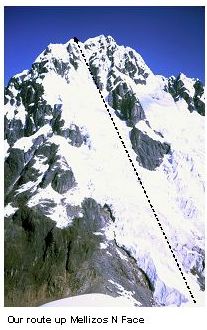
The most difficult climb I did in the Andes with John E.S Lawrence an English climber who did many major climbs in Europe, Himalayas, Antarctica and New Zealand before I teamed up with him. I found it strange that the other six people in the expedition either were overawed by John's reputation or just didn't want to climb with him. Being the youngest member of the expedition, I jumped at the opportunity to climb with John when he asked me. We did a few warm up climbs on peaks at a little over 5000 metres to get to know each other and develop good rope handling and belay techniques. Recently John Lawrence reminded me of this difficult climb:
"...do you remember that tense descent on Mellizos north face where on the way down we dodged streaming, chunky gulley avalanches by hopping sideways onto the comforting rockface, and sitting pegged to the granite for hours, huddled, hummingbird antics beside us, meanwhile nestling the image between our feet of welcoming red tents on the ledge way, way, way down below us... as I recall it, we set a little `roulette', or standard.... something like ten minutes with no big stuff, and five minutes with no stuff at all before we felt it safe to resume our descent down the steep couloir..."
 Bob McKerrow on the summit of Mellizos after the first ascent with John E. E. S. Lawrence of the North Face.
Bob McKerrow leading through a rock band, which gave access to the icy summit: Photo: J.E.S Lawrence
Bob McKerrow on the summit of Mellizos after the first ascent with John E. E. S. Lawrence of the North Face.
Bob McKerrow leading through a rock band, which gave access to the icy summit: Photo: J.E.S Lawrence
John take on the descent is very accurate. After the ascent of Mellizos we did the second ascent of Torayoc (climbed for the first time a week earlier by our team) and then went on to try the unclimbed north ridge of Pumasillo.
John writes about this climb:
"furthermore, on that epic ascent up onto Pumasillo's N ridge (phew!)... my memory was of those awesome, apocolyptic faces beneath us on both sides of our tiny stances on that tottering crap of a ridge with no belays at all to speak of... and geez, no wonder they all said it would never be climbed... and to my knowledge still hasn't!! I would truly welcome your own take on your memories....”
 Putting in a high camp from where we John Lawrence and I attempted the unclimbed north ridge of Pumasillo:
So forty-three years ago the dream of a young man came true spending four months climbing hitherto, so many unclimbed mountains, and learning what big expeditions entailed.
Putting in a high camp from where we John Lawrence and I attempted the unclimbed north ridge of Pumasillo:
So forty-three years ago the dream of a young man came true spending four months climbing hitherto, so many unclimbed mountains, and learning what big expeditions entailed.
Why were we one of the most successful expeditions in the Andes? No big names, no egos, and most of us had started in the dense bush before graduating to the high mountains. We knew the art of carrying bags of cement to build huts, ran club trips, some were chief guides of tramping (bushwalking) clubs and above all, we believed that team work would see us through.
We also realised quickly that in the winter in Peru, avalanches are rare in the morning but by early afternoon the snow slopes become unstable. So our approach was to put in high camps like the one above which we climbed Torayoc and the Nu Nu from. These high camps enabled us to get on the summits early and off the mountain before the avalanches started. Also when the weather was good, we could stay high and climb two or three neighbouring mountains from the same high camp. Leadership and organisation was another key factor. Ken McNatty, on reflection, was a man with vision and sound judgement, who quietly led bunch of strong individuals. Today he is one of New Zealand;s leading scientist and a marathon runner at 60 +. And Paul Green and his Wellingtonian clubmates from the Wellington Tramping and Mountaineering club. Al Higgins, Pete Goodwin and Mac Riding, were strong organisers. They packed 2 tonne of equipment and food that came with us by boat.
In addition, we all had crash courses in Spanish, enhanced by courting beautiful young lasses on the boat from Panama, to Columbia, Equador and through the Boulevards of Lima, as we waited for our mountaineering equipment to arrive.