I climbed with John E.S. Lawrence for two months in the Cordillera Vilcabamba in the Peruvian Andes and among many first ascents we did, the climb of the north Face of Mellizos stands out. Here is John's story.

Wake-up
was leisurely the next morning, and breakfast somewhat protracted. We had our
eyes set on the North Face of Mellizos towering directly above us, and through
blowing mist, we started up to diagnose what had looked from below like a safe
ledge for Camp III. We cramponed
steeply through huge crevasses on much better snow. Our rhythm
was established, and we were climbing well together, although the whirling,
sporadic mist made route finding difficult. When we got to where we thought the
ledge was we had seen from Camp II, it was just the lip of another enormous
crevasse, offering some protection form avalanche, but not much room for tents.
We pressed on, and found a sizable ledge, and marked it so we could find it
again with loads the next day. Camp II looked great down at the foot of the
face, and we yodeled to the others. It took us only 1 1/2 hours to get back
down. Tomorrow we would carry loads up to Camp III and go for the summit the next
day given decent weather.
We
looked up in the twilight to see what looked like the best route, around 3500'
to the top from this north side. The mountain had already been climbed from the
east by Americans on 29 July 1956. Since the Vilcabamba to our knowledge had
never been surveyed, the heights of all the peaks were an approximation, but we
thought ourselves to be in the six thousand meter area. The North Ridge looked
like all these Andean ridges, tottery and time-consuming, with little
protection, like a fruit cake with creamy toppings. More practical, and quicker
if somewhat unstable on the north-facing side of this beautiful mountain, was
to pick the cleanest-looking couloir going straight up onto the North ridge
close to the summit. The devil or the
deep blue sea. The shorter the couloir,
the more climbing remained on that
candyfloss ridge. And at the top of the couloirs are those magnificent
cornices, curled like ornamental awnings, menacingly out over the face. We
could watch, in the afternoon sun, the gulleys erode visibly, plunging
selective chunks of rock and ice down the face. The only answer was to move in
the coldest parts of the day. After a hard frost, the face would take front
pointing and fast progress seemed possible. Photo below shows Bob McKerrow leading to the summit couloir. Photo: John E.S. Lawrence
 Bob
seemed OK with his chest, was climbing strongly, and besides very sore lips, I
felt fine. We had a good chance to get our wind carrying loads up to Camp III
at over 17,000'. We estimated the summit to be another 2000'+, so we would be
carrying tents, personal gear and 4 days food, plus a couple ropes and all the
climbing gear. We would be roped all the way of course, and one ice pitch
(where I had left a sling and peg) would probably require sack hauling. We
gratefully accepted the backup assistance from Dick and Alan who we knew were
anxious to do their own climb on Nevado Blanco, but who generously agreed to
haul loads with us up to Camp III. These
kiwis are something special. So glad I was able to join them. Plus the kiwis
had come up with a new kind of ice screw since import regulations made european
gear harder to come by. It was an ordinary standard 8 inch coach bolt with a
chainlink welded onto its head, and the pitch of the thread lathed out more
deeply to give extra bite in the ice. Though they were sometimes hard to start,
I found them better than any other ice screw I had used, from quite wide array
of British and European climbing
equipment.
Bob
seemed OK with his chest, was climbing strongly, and besides very sore lips, I
felt fine. We had a good chance to get our wind carrying loads up to Camp III
at over 17,000'. We estimated the summit to be another 2000'+, so we would be
carrying tents, personal gear and 4 days food, plus a couple ropes and all the
climbing gear. We would be roped all the way of course, and one ice pitch
(where I had left a sling and peg) would probably require sack hauling. We
gratefully accepted the backup assistance from Dick and Alan who we knew were
anxious to do their own climb on Nevado Blanco, but who generously agreed to
haul loads with us up to Camp III. These
kiwis are something special. So glad I was able to join them. Plus the kiwis
had come up with a new kind of ice screw since import regulations made european
gear harder to come by. It was an ordinary standard 8 inch coach bolt with a
chainlink welded onto its head, and the pitch of the thread lathed out more
deeply to give extra bite in the ice. Though they were sometimes hard to start,
I found them better than any other ice screw I had used, from quite wide array
of British and European climbing
equipment.
My
next log entry says `We are camped safely, ensconced under a huge ice cliff on
the N face of Mellizos.. primus going well, snow melting in the pot, and Bob
getting into his pit… we've had an eventful few hours'…
All
four of us started out rather late morning (1015 hrs) with the usual gruesomely
heavy loads, with the hot sun and now wet snow making going very difficult. Bob and I were well ahead, though both
carrying tents, and got up to the difficult ice pitch, where we stopped and had
some `ki', ginger biscuits, chocolate
and cheese, wondering why the others didn’t appear. Finally we decided
to push on with the ice pitch, leaving the pegs in for the others. It was very difficult with packs on.
Yesterday's peg had melted out, and the ice was flaky. Fixed ropes and pegs
were of little use in these sun-drenched mountains, and traditional ice screws
went floppy in an hour. Coach bolts were the only answer. I was halfway up when
Dick's head showed up below us, and he emerged on his own, saying Allan was
`crook' and he'd have to go back. I came back down from another ice screw to
where I could see down to Allan collapsed in the snow. We made our way down to him, and he was in
bad shape, half-sobbing for breath, and clearly there was no alternative but to
get him down quickly. We had oxygen at base camp, but I didn’t think he needed it,
he was likely to recover quickly after descending with appropriate rest, food,
and drink, although he complained of shortness of breath and leg cramps. The
sun and the heavy packs and wet snow were too much for any of us, and Allan had
had a bout of dysentery already. Although we offered to accompany both of them
back down, he insisted that only Dick need come with him. So we kicked out a
ledge, opened packs and reconstituted loads. We worked out a plan whereby Bob
and I would go on up with as much as we could carry to Camp III, and we'd leave
the rest of the gear attached to the icewall peg, and Dick would either bring it up to Camp III
tomorrow, or if we could manage without it, we'd go ahead and climb the next
day. We worked out yodelling signals, and the face was steep enough so almost
all of it could be seen from a short distance back from Camp II.
I
took us five hours to complete the load carry up to Camp III, and it was the
hardest day yet. We both moved very
slowly. The strap broke on Bob's crash hat and it flipped down into a deep slot.
We let it go, to our cost. We felt we
had enough food, shelter and equipment for at least a recce of the upper part
of the face, if not to go all the way without any extra stuff or help. We encircled
our tents with a rope strung between our ices axes as protection against a
sleepy nocturnal stumble that could convert a mere necessity into a fatality.
The sunset at Camp III was spectacular. Photo: John E.S. Lawrence
We went to sleep with the sun and set our alarm for 0400 hours, determined to
get onto that ice tomorrow long before the sun hit it.
We
almost didn’t hear the alarm, muffled under duvets and sleeping bags. Bob had heated up the milk the night before
and we hauled out the thermos , poured it on the weetbix, and we heated up some
hot lemon. We should have left by 0500, but it was very cold and we thawed our
boots over the primus for half an hour.
A nippy wind was blowing down the face, though the visibility was
perfectly clear, and we finally got roped up and off by 0600.
We
skirted through steep crevasses that guarded our camp, and hesitated a while
deciding which of the couloirs to aim for.
We picked the one that let straight up out of sight into the ice towers
and cornices of the North Ridge. We moved together for about 500', until the
slope steepened to where we would lead through for the rest of the way. As we
approached the bottom of the gulley, we found we had to cross the schrund
between ice and the rock walls of the gulley, but there seemed no satisfactory
start beyond that. As we got higher, the rock walls obstructed us, and the
couloir went blind. A short pitch up the wall yielded sight of a much larger
chute going up the left side of a massive rock rib, and branching at the top
into three options, the middle one of which gained the ridge close to where we
had seen the summit from the other side.
The
traverse into this big couloir proved extremely hairy, over very shaky ice,
with fifteen hundred feet of face yawning below. By now I had learned, Bob's
muttered curses were, like David Witham's low whistling with me on some of
Australia' s and New Zealand's hardest rock and ice climbs, a sign of profound,
if profane respect for our overall situation on the mountain. I was encouraged by my faith in the rock pegs
I had brought with me clinking round my neck through all the airports, because
I knew they would hold as either runners or belay/rappel anchors. The last crawl under a bulge into a small
schrund-cup and up to where we hoped to find the start of the couloir revealed
a frantic vertical wall of rotten ice for about 50'. It was on Bob's lead, and
he did it muttering all the way, thoughtfully leaving in two ice screws for me.
I followed and saw why he had had so much trouble, but getting over that step
made all the difference.
Once
we gained the couloir proper, the good
hard snow and occasional ice and rock rib meant much faster (and better
protected) ascent. We moved up in long takeover leads, 120' at a
time, with runners as we felt like it, but knowing speed was safety, we mostly
just climbed. At the top, the angle
eased as we rounded a rock corner, and the couloir branched again. Taking the
most direct line up, another 3 pitches and gingerly through the cornice, we
were on the ridge, not much more than half a ropes length to the prize. We had
climbed the North Face clear to the summit. It was hard to believe our luck..
we looked straight down the face to Camp
II amost 4000' below. We thought we could
also make out the other team's brightly colored tents on Torayoc, since there
was no one else remotely close in the entire Vilcabamba Range, we probably were
correct. My yodel raised a faint COEEE from Camp II, much better than a bloody
radio!
What
was really staggering was to look down the other approaches. The ridges were
horrifying (as we were to learn later). The face dropping down the other side
towards Mitre was just an abyss. I had seen pretty awesome scenics on the South
face of Annapurna IV, and gazing down the Caroline face of Mt Cook, but there
is something quite unique about the architecture of those improbably sculpted
Andean spines. Nothing seems reasonable!
Across to our left was the second peak of Mellizos, about the same height, a
rounded bulge surrounded by broken cornices. We debated, not for very long,
whether to make the traverse to the second summit, since it was only 1015 hrs, so we had made good
time. But a recce of the S facing ridge
yielded thigh deep snow, and with the memory of our last climb fresh in our
minds, we wiped the idea. Bob took his feet out of his boots and put them into
my armpits to relieve frostnip in his toes.

Bob McKerrow on the summit pointing to the north ridge we had hoped to descend.
We
could see plainly in all directions, all the way to Salcantay on which Fritz
Kasparek (of Eigerwand fame) had died falling through a cornice near the
summit. I have noted I my log that Cesar Morales Arno, Head of the Peruvian
Department of Andeanism, who had welcomed the others on the expedition when
they arrived at a reception in LIma,
shook Bob's hand and told him to `beware
of the cornices'.
The
classic Andes brown dominated the
landscape far below that I had seen so much of from the plane, just the icy
pinnacles, ridges showing like teeth across the smiling panorama, quite unlike
the monstrous white arc of the Himalayas. When I wrote about this in my tent
later, I mused on the vista, and the entropic forces against our venturing into
such extreme country. Death, I thought, would be unlikely to come
instanteously. My almost 200' fall in an ice gulley in Antarctica had
introduced me to the drama of what is now called a `near death experience'.
Bouncing precipitously into the air after a slip descending a steep cut on Mt Anakiwa,
I was saved only by the belay of my
climbing partner, the redoubtable senior geologist Graham Hancox. We had
practised so many times, and he was an experienced alpine climber, subsequently
joining Ed Hillary's expedition to Mt Herschel.
But as I flew through the air with a high-def awareness of my
predicament, slamming momentarily against the ice, only to ricochet back into
spinning aerial helplessness, I knew I
had somehow to stop, otherwise I would be the death of both of us. I resolved
to grab something next time I hit…Bang… bounce…back out into space…then suddenly
an elastic bungy-jumping finale as Graham's belay held. I had completely
forgotten about the rope, but as it squeezed around my waist and I came back onto the slope grabbing ice
like a scared cockroach, Hank's shout
from above brought me back to something like ordinary life. (Thanks again
Hank!).
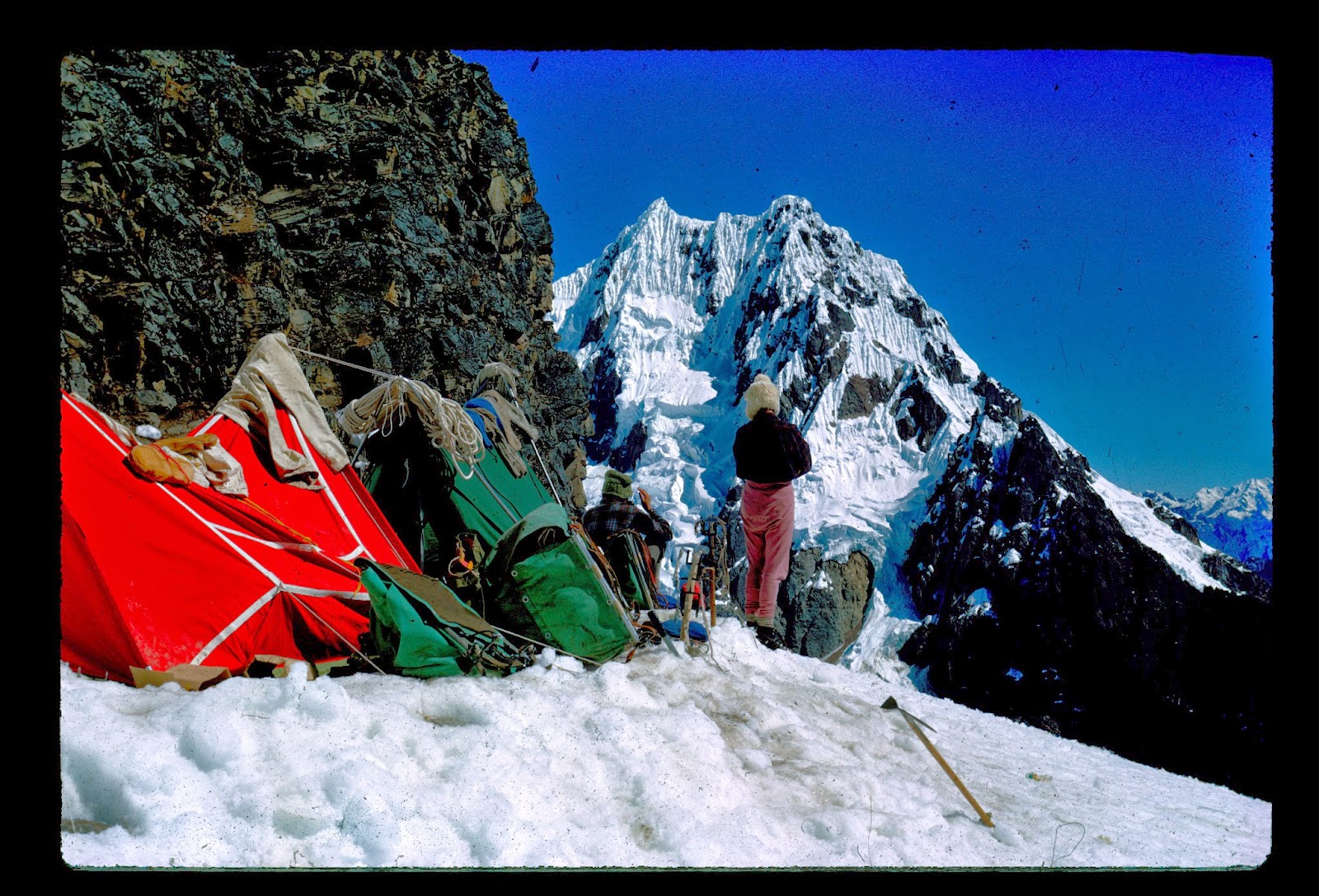
The north face of Mellizos just to the left of Pete Goodwin's head. Photo: Bob McKerrow
My
feelings are that death seldom comes unexpected in the mountains. Some seek it,
like Guy Waterman, whom I met once in the Gunks, and whose son I helped rescue
off Alaska's Mt McKinley,
but who wished to die in the arms of Mt Lafayette, and did. I venture to think rather it comes in the big
mountains after a long fall, several impacts, ending up rolling into a crevasse
like Joe Simpson, but unlike him, unmarked, unfound, perhaps to wake again
briefly, for some lonely, agonizing, shivering moments, and then finally, to
fade out. Not to be thought about? Why not?.
Bob McKerrow coming through the last gulley to the summit of Mellizos. Photo: John E.S. Lawrence.
It
seemed we climbed Mellizos on a particularly cold day, which was very
fortunate. I noted later that others said the creek at Base Camp was dry,
because the frost clamped down higher up during that week. Leaving the summit was easy. We roped up and
started our descent around 1200. My usual concerns about the funneling function
of our route seemed assuaged by our quick progress down the first parts of the
couloir, including the rock steps without having to leave any pegs behind.
However, as more branches joined the
main artery, we were subjected to a constant stream of tiny avalanches with
growing chunk-size. Most distressing was that Bob would increasingly lean into
the wall with gloved hands over his head to compensate for his lost crash-hat,
whereas I stood up and out so I could have a chance to dodge the incomings.

They loomed at disastrous speed, and it was clear that the increasing whirring
sound spelled nothing but trouble. When Bob was almost buried in a mini-cascade as he clung to the ice, we decided that we
had to get out of the gulley. As luck would have it, there was a safe ledge
under an overhang in the rock rib running down our flank, and we sought
immediate refuge. We had biscuits and cheese, and drank from the water drip
from the roof, celebrating our salvation.
The
hiss was changing now to a thunk and crash, as big stuff began to clean out our
gully. The vertical sastrugi are so
steep in the flutings that the sun acts like a sort of razor. When the ice
blocks flew by, we would stop munching, and look at each other, and Bob would
begin to mutter. We could see our red tiny tents clearly between our feet as we
sat, in a kind of mockery. I thought it reminded me of being on a ship unable
to make port, moored in the roads outside when you have a date and you can see
the lights onshore and you wonder what she's doing.
We
sat on the ledge for hours, listening to the mountain shivering, watching the
detritus rolling out down the face below. At some point a humming bird flew
close on the face beside us, beak into tiny flowers, in a brilliant display of miniscule aerobatics, then gone in
a flash as if it was never there. If only we had had those wings. We began
timing the space between the chunks of ice.
As the sun recedes from the face, you can almost hear the ice
re-gelling, as the sound volume gets turned down. I was prepared to spend the
night on the ledge if necessary… we had good gear and were in good shape. But
after counting two or three 3-minute silences, and no big stuff for an hour, we
decided to chance it. We descended as fast as we dared, on belay, ensuring our
belay stances were always out of the direct fall line. I don’t think either of
us have ever moved so fast over ice, and I count it among the more purely lucky
episodes in my climbing experience, but despite both of our mutual remonitions
as to caution, we simply shot down, only bumped by the odd shot from above. Bob
got hit by one sizeable chunk, but no lasting damage. Once over the two big
slots at the bottom, we could breathe again, and in less than an hour were
grateful to be back at Camp III. Two figures below at Camp II, presumably Dick
and Allan were watching our descent. Only when we were finally at the tent did
I yodel, and they waved, and retired from their vigil. I'm sure they could see
and hear the crap coming down too.
Few
feelings can equal those upon safe return from danger. Bob's warm handshake at
the tent was immensely welcome. We had been lucky, but we had also been
skilful, and had come out alright from a significant effort. We both ate too
much. Our over -stressed bodies needed more liquid than we could take, and the
result was very heavy stomachs, leading to a more or less sleepless night, and
some great midnight photos.
I
woke at dawn feeling very crook indeed, and record staggering out of the tent
and having a very large and very painful crap which was thoughtfully committed to the crevasse depths
behind our little camp. I felt so weak I took one of our gastro pills, and felt
almost instantly better. We could intermittently see others ascending the lower part of the face but were
not sure who it was. They seemed to take a long time getting up, to us over the
ice step, and shouts failed to raise any response. Perhaps they were just collecting the gear we had left there. We relaxed,
and Bob read me hilarious excerpts from
his log about the mob that had seen them all off from Wellington on board the
Rangitane, something about throwing the
minister's daughters into the swimming pool, and entering a Fancy Dress competition as Snow's wife and the Seven Wharfies.

The final voyage of the M.V. Rangitane with a ticker-tape farewell from Auckland. For us, 8 young male mountaineers, it was more like a maiden voyage, being outnumbered by 3:1 by pretty young women on the voyage to Tahiti, then Panama.
Apparently they behaved so badly that they
were occasionally mistaken for the crew, getting ordered to their quarters by
the captain. Another big Kiwi advantage was that at some point on their outward
journey, a Kiwi cent worked as a dime in slot machines, gaining a certain
mercantile advantage in various schemes. Many other tales emerged to our great
mutual amusement, but we were interrupted by shouts from below and Allan's
cheery face appearing at the foot of our little nevé, closely followed by Dick.
They were relieved to see out tent was still up since they had traveled very
light, relying on all our kit to sustain their ascent up the face the next day.
We
made it down to Camp II in one hour and a quarter, using the fixed rope they
had left on the ice step, including cleaning up and carrying down all the
remaining gear. We learned later that
our sojourn on the ledge had given them some pause since they had heard our
yodel from the summit at 10.30, then nothing… until they saw us scuttle at high
speed down the bottom of the couloir. They were relieved, but surprised at the
soundlessness of the yodeller who waited until actually at the tent before signalling success!

I
recorded a great sense of achievement and pleasure following that climb. We
basked in the kaleidoscopic show above as mist acted like a slowed film shutter
across the face. Turrets and ridges appeared and disappeared randomly as the
marvelous light shifted from place to place. Sometimes we could see the tiny
figures like flies on a wall. We watched them until they were out of sight in
the gut of the couloir. We knew they would make it, and they did. We suddenly
heard a `cooee', and they were there in our sights, but too far away to
communicate verbally. I was disturbed by the icecliffs that marked the bottom
of the route especially at that time in the afternoon, knowing what they must
have already gone through. Yet they wasted no time, even abseiling the last bit
free (out from the face) . We watched the whole thing, and what a pity Mac
wasn't there with his telefoto lens. Alan described the final rappel as the
hairiest part. He said Dick went over like a piece of rubbish, then skated out
of the way at the bottom, while Allan contemplated the descent, then dropped
like a reluctant stone. He said afterwards that he could see nothing but
icicles threatening his impalement. So we all shot back down, to base and a
blizzard of tales and comparisons of hardest parts of the climb. Amazing double
shift on a hard assignment.
We
woke to a satisfying view of the Mellizos face from base, what a beautiful,
impressive face it is, and all the more since we had learned to know it
intimately. We shared, touched in the
memory of its embrace. At about 6.0 am two Andean shepherds arrived up with
spuds slung across their backs. One was wearing a Tibetan-style hat, and we produced the milk tins they were
seeking. One would have sufficed, but Dick apparently owed them one additional
tin, so we fessed up.
We
had a big breakfast, and I had four coffee brews without feeling bloated, lay
on my Lilo and dispassionately ate porridge and eggs in the sun, and read a
little while catching up on my log. All of a sudden, Mac rolled up from the
other party, looking for some baccy.
He'd walked around from the North Col in shorts (as usual) and we were glad to see him and get an
update. He said they had successfully climbed, and filmed, Torayoc, and he outlined the route for us,
with major difficulties confined as he said, to the last 500'. We had now climbed
all the peaks that the Everest Foundation required for their grant (Cupola, the
High Unnamed, and Torayoc as subsequently recorded ),
and were thus in new territory.
A further article of mine climbing in Peru.


