Showing posts with label New Zealand Mountaineering. Show all posts

Friday, 10 April 2015

The pioneering anarchist mountaineer tends to his garden


John Glasgow became the first to climb Mt Cook/Aoraki's Caroline Face in November 1970. Glasgow successfully summitted with friend Peter Gough.
Alden Williams/Fairfax NZ
John Glasgow became the first to climb Mt Cook/Aoraki's Caroline Face in November 1970. Glasgow successfully summitted with friend Peter Gough.
I lived at Aoraki Mount Cook village from 1971 to 1973. During the winter of 1972, I got to know John Glasgow quite well. We did a few skiing trips together to Round Hill at Lake Tekapo, and to the Lake Ohau ski field. A kind and caring soul, John marched to a different drummer.

When John Glasgow was young he was a walker. He walked Nelson Lakes, through the Tableand and the Cobb Range tracks. Whenever he did he was always a day late getting back to civilisation. His mother would wait for him at the other end and when he didn't arrive she would simply return next day.
"She was slightly concerned but she trusted us."
It was a different era back then. In the 1960s there weren't personal locator beacons. There was only you and the wilderness. He liked the vastness of the outdoors. There were no rules. Just you and the wilderness. If you made a mistake, you owned it. Even back then, as a teenager, Glasgow thought that was the way it should be.
Nelson was Glasgow's playground. He was a skier. Then he became a climber. He climbed Mt Hopeless and Mt Travers. And when you get to the top of them you see Arthur's Pass. When you climb Arthur's Pass you see Mt Rolleston and the Arrowsmith Range. Glasgow just kept going further south - each time the mountains getting bigger. Then he arrived in Twizel in South Canterbury.

The Caroline Face of Aoraki Mount Cook Photo: Bob McKerrow

He was a geology student there. That was going to be his career. He enjoyed the outdoors and understanding how it came to be. But one day a friend George Harris said he needed a climbing partner. It would be Glasgow's very first foray into Mt Cook National Park. So he clamped on some crampons and some boots. The trip set several things in motion.
Glasgow always liked being in the mountains. He liked being on the side of them and watching the space drift into nothingness below him while above it towered over him. Some people climb to summit. Glasgow climbed to climb. Whether it was a 3000 metre peak in New Zealand or a 6000 metre one in Peru, seeing the peak from below was always a humbling experience.
In 1970 Glasgow and his friend Peter Gough were joined by Harris and Graeme Dingle.
They agreed to try something that had not been achieved before. By then they had headed up Aoraki several times. On this occasion, however, they would climb Mt Cook's Caroline Face.
It had never been achieved before. It remained a colossus in the climbing world. It has the longest vertical lift of any climb in New Zealand. It is the country's highest at 2000m. It is dangerous.
"When a powder avalanche comes it wipes the whole face clean," Glasgow says now from the comfort of his home in Ngatimoti.On this day Glasgow has been in his vast garden tidying up his vegetable patches. He heads inside and takes a seat on his couch. Then he tells the story about he and Gough came to set the climbing world alight. How their pictures, with sunglasses, beards and bandannas came to grace newspapers across the country.

On that attempt in early 1970 the group only got half way up before weather forced them back down. It closed in fast and there was no way they were going to make it to the top. They had to clamber down gullies and jump down waterfalls in the dark. By the time they got back Glasgow says they would have slept in their sodden clothes if it had not been for Gough's wife helping them to bed. The Face had beaten them. In their stupor they vowed to give up climbing. That, however, did not last long. Instead, another vow surfaced - the following season, if the weather was good, they would go and try one more time.
Glasgow and Gough arrived at the Hermitage Hotel in Mt Cook on November 7, 1970. The pair were in their twenties. They looked up to the range. The weather was good. They knew more about the climb this time. They knew how to ascend. So they went. Parts of the climb which previously took them three hours only took 10 minutes. They climbed with straight ice picks - climbing in balance the whole way as they crept up the ice cracks in the face.
Below them was a 1000 metre vertical drop.
"It just goes on and on," Glasgow recalls
The safest route was up a sharp, rocky ridge. That night they stayed - setting up a bivouac on that ridge. It was then that a small river of an avalanche rolled by. The snow was wet and it flowed smoothly.

"We could put our hand out and touch it."
They just hoped another larger one wasn't behind it. That night was a meal of tins of stew, chocolate, biscuits, and hot drinks. The following day would be the most challenging part of the climb - a sheer ice climb. The entire face had little cracks you could nick the upper points of your crampons on to. Carefully they threaded their way across the hard ice. Back down in the Hermitage a crowd had gathered with binoculars, checking their movements as they emerged on the ice fields along the ridge of the mountain.
Crossing the field was "like a roof", Glasgow said - ice sheets dropping away on either side with nothing of the mountain visible beneath. Eventually they got to the ridge but bypassed the nearby summit as that had already been accomplished long ago. Then they dropped down the west face, an easier descent.
Glasgow looked up and saw the sky had turned grey and purple. There were huge curtains of it.
"I'm thinking I must be really tired," Glasgow says. "
But Gough was seeing it too. It was the Aurora Australis.
"I had never seen it there before. It was shimmering."
When they returned to the Hermitage Hotel an excited crowd was there to greet them. The story was splashed across the front pages of newspapers around New Zealand. Glasgow declared the summit "a victory for hippies". The climb was hailed as the greatest of the millennium by the New Zealand Alpine Council. It also changed Glasgow's life. Before the summit he was likely heading to a geology job in Western Australia. Instead he was offered a job alpine guiding in the national park.
He ended up climbing Mt Cook 11 times. But he never did the Caroline Face again. However, as he kept climbing there was an feeling that increasingly came over him.
It was there when he was doing a practice run with a client who wanted to summit Aoraki. The pair went up a rocky ridge with small steps. Glasgow was tied to his client and was pulling himself up on to a shelf when his client slipped. Glasgow was luckily tied on a short rope. If he had not been it might have been fatal.
"I was more alert to the fact that when you are on your own you can make a mistake, but when professionally guiding you can't and your climber can make one any old time."
Glasgow says he wasn't hard enough mentally to carry on putting himself in dangerous situations. Some people had it. Others got frightened more quickly. Glasgow says he was one of the latter. When he was on the mountain he was all right. It was after and before that his mind played tricks on him. He stopped climbing almost altogether.
Soon after he left the area and returned to the Nelson region. A group bought a piece of land and helped set up a commune.
"I'm an anarchist and I was fed up with all these rules. I always followed the movement. When it works it is the best form of government."
However, after many years he realised that like all other forms of rule, self interest will always win out.
"Any 'isms' work when people curtail self interest."
Glasgow landed a job as an Abel Tasman guide though he sees the role more as a safety officer and an interpreter - fauna, flora and natural history. Then he bought his own piece of land in Ngatimoti and set about tending it for himself. His garden is blooming and hands dirty when we meet him. His memorabilia - his ice axe and boots have gone to his children to enjoy. In a back room there are albums filled with photographs of his earlier days. He is there staring back out of black and white images with long flowing hair. He looks back at those images now.
"I still think about climbing sometimes," he says.
Then the anarchist mountaineer goes back to his garden.
 - Stuff

Tuesday, 8 April 2014

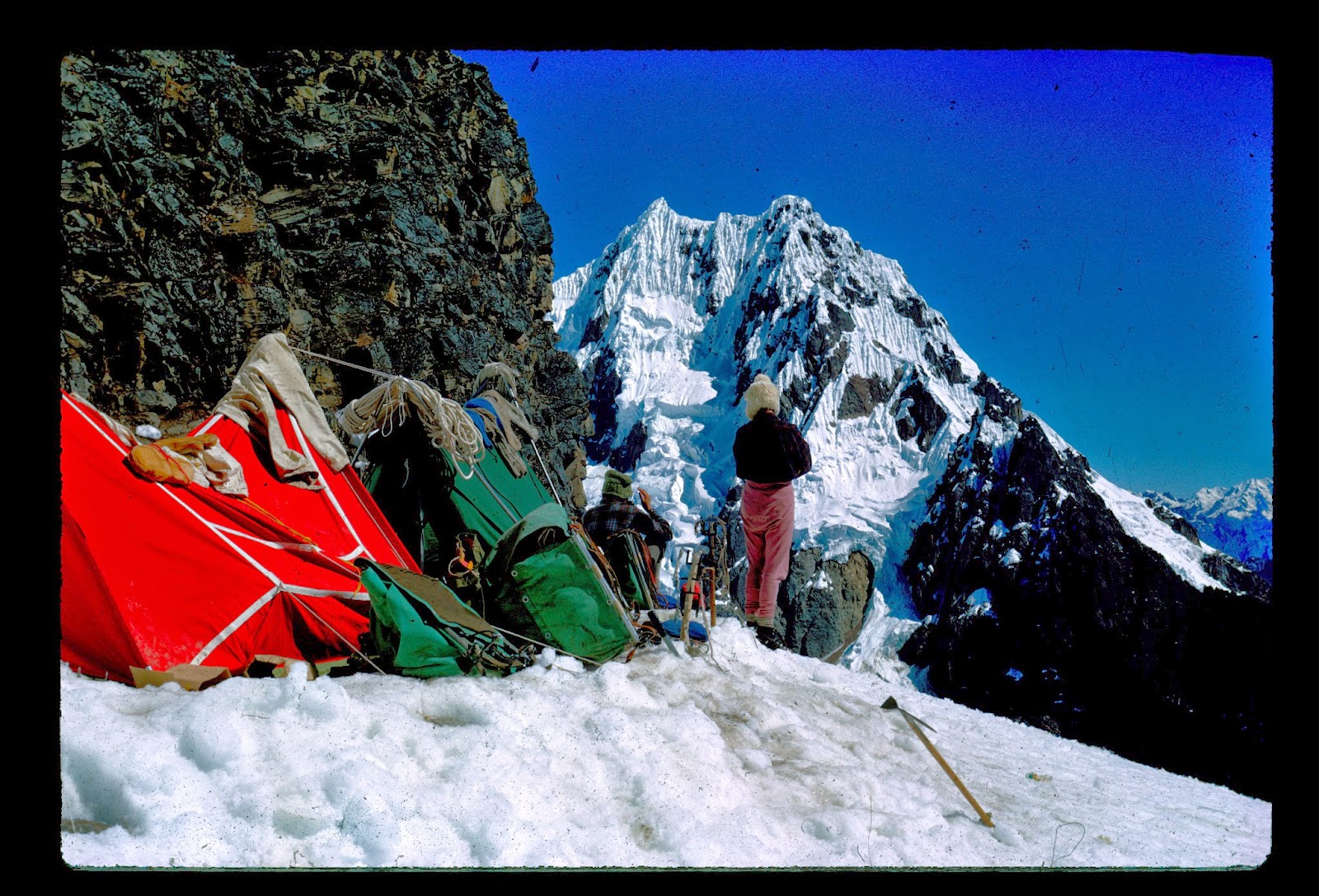
First ascent of Mellizos by its North Face. Cordillera Vilcabamba


I climbed with John E.S. Lawrence for two months in the Cordillera Vilcabamba in the Peruvian Andes and among many first ascents we did, the climb of the north Face of Mellizos stands out. Here is John's story.

Wake-up was leisurely the next morning, and breakfast somewhat protracted. We had our eyes set on the North Face of Mellizos towering directly above us, and through blowing mist, we started up to diagnose what had looked from below like a safe ledge for Camp III.  We cramponed steeply  through  huge crevasses on much better snow. Our rhythm was established, and we were climbing well together, although the whirling, sporadic mist made route finding difficult. When we got to where we thought the ledge was we had seen from Camp II, it was just the lip of another enormous crevasse, offering some protection form avalanche, but not much room for tents. We pressed on, and found a sizable ledge, and marked it so we could find it again with loads the next day. Camp II looked great down at the foot of the face, and we yodeled to the others. It took us only 1 1/2 hours to get back down. Tomorrow we would carry loads up to Camp III and go for the summit the next day given decent weather.
We looked up in the twilight to see what looked like the best route, around 3500' to the top from this north side. The mountain had already been climbed from the east by Americans on 29 July 1956. Since the Vilcabamba to our knowledge had never been surveyed, the heights of all the peaks were an approximation, but we thought ourselves to be in the six thousand meter area. The North Ridge looked like all these Andean ridges, tottery and time-consuming, with little protection, like a fruit cake with creamy toppings. More practical, and quicker if somewhat unstable on the north-facing side of this beautiful mountain, was to pick the cleanest-looking couloir going straight up onto the North ridge close to the summit.  The devil or the deep blue sea.  The shorter the couloir, the more climbing remained  on that candyfloss ridge. And at the top of the couloirs are those magnificent cornices, curled like ornamental awnings, menacingly out over the face. We could watch, in the afternoon sun, the gulleys erode visibly, plunging selective chunks of rock and ice down the face. The only answer was to move in the coldest parts of the day. After a hard frost, the face would take front pointing and fast progress seemed possible.  Photo below shows Bob McKerrow leading to the summit couloir. Photo: John E.S. Lawrence


 Bob seemed OK with his chest, was climbing strongly, and besides very sore lips, I felt fine. We had a good chance to get our wind carrying loads up to Camp III at over 17,000'. We estimated the summit to be another 2000'+, so we would be carrying tents, personal gear and 4 days food, plus a couple ropes and all the climbing gear. We would be roped all the way of course, and one ice pitch (where I had left a sling and peg) would probably require sack hauling. We gratefully accepted the backup assistance from Dick and Alan who we knew were anxious to do their own climb on Nevado Blanco, but who generously agreed to haul loads with us up to Camp III.  These kiwis are something special. So glad I was able to join them. Plus the kiwis had come up with a new kind of ice screw since import regulations made european gear harder to come by. It was an ordinary standard 8 inch coach bolt with a chainlink welded onto its head, and the pitch of the thread lathed out more deeply to give extra bite in the ice. Though they were sometimes hard to start, I found them better than any other ice screw I had used, from quite wide array of British and European  climbing equipment.
My next log entry says `We are camped safely, ensconced under a huge ice cliff on the N face of Mellizos.. primus going well, snow melting in the pot, and Bob getting into his pit… we've had an eventful few hours'…

All four of us started out rather late morning (1015 hrs) with the usual gruesomely heavy loads, with the hot sun and now wet snow making going very difficult.  Bob and I were well ahead, though both carrying tents, and got up to the difficult ice pitch, where we stopped and had some `ki', ginger biscuits, chocolate  and cheese, wondering why the others didn’t appear. Finally we decided to push on with the ice pitch, leaving the pegs in for the others.  It was very difficult with packs on. Yesterday's peg had melted out, and the ice was flaky. Fixed ropes and pegs were of little use in these sun-drenched mountains, and traditional ice screws went floppy in an hour. Coach bolts were the only answer. I was halfway up when Dick's head showed up below us, and he emerged on his own, saying Allan was `crook' and he'd have to go back. I came back down from another ice screw to where I could see down to Allan collapsed in the snow.  We made our way down to him, and he was in bad shape, half-sobbing for breath, and clearly there was no alternative but to get him down quickly. We had oxygen at base camp, but I didn’t think he needed it, he was likely to recover quickly after descending with appropriate rest, food, and drink, although he complained of shortness of breath and leg cramps. The sun and the heavy packs and wet snow were too much for any of us, and Allan had had a bout of dysentery already. Although we offered to accompany both of them back down, he insisted that only Dick need come with him. So we kicked out a ledge, opened packs and reconstituted loads. We worked out a plan whereby Bob and I would go on up with as much as we could carry to Camp III, and we'd leave the rest of the gear attached to the icewall peg,  and Dick would either bring it up to Camp III tomorrow, or if we could manage without it, we'd go ahead and climb the next day. We worked out yodelling signals, and the face was steep enough so almost all of it could be seen from a short distance back from Camp II.
I took us five hours to complete the load carry up to Camp III, and it was the hardest day yet.  We both moved very slowly. The strap broke on Bob's crash hat and it flipped down into a deep slot. We let it go, to our cost.  We felt we had enough food, shelter and equipment for at least a recce of the upper part of the face, if not to go all the way without any extra stuff or help. We encircled our tents with a rope strung between our ices axes as protection against a sleepy nocturnal stumble that could convert a mere necessity into a fatality. 


 The sunset at Camp III was spectacular. Photo: John E.S. Lawrence

We went to sleep with the sun and set our alarm for 0400 hours, determined to get onto that ice tomorrow long before the sun hit it.
We almost didn’t hear the alarm, muffled under duvets and sleeping bags.  Bob had heated up the milk the night before and we hauled out the thermos , poured it on the weetbix, and we heated up some hot lemon. We should have left by 0500, but it was very cold and we thawed our boots over the primus for half an hour.  A nippy wind was blowing down the face, though the visibility was perfectly clear, and we finally got roped up and off by 0600.


We skirted through steep crevasses that guarded our camp, and hesitated a while deciding which of the couloirs to aim for.  We picked the one that let straight up out of sight into the ice towers and cornices of the North Ridge. We moved together for about 500', until the slope steepened to where we would lead through for the rest of the way. As we approached the bottom of the gulley, we found we had to cross the schrund between ice and the rock walls of the gulley, but there seemed no satisfactory start beyond that. As we got higher, the rock walls obstructed us, and the couloir went blind. A short pitch up the wall yielded sight of a much larger chute going up the left side  of  a massive rock rib, and branching at the top into three options, the middle one of which gained the ridge close to where we had seen the summit  from the other side. 
The traverse into this big couloir proved extremely hairy, over very shaky ice, with fifteen hundred feet of face yawning below. By now I had learned, Bob's muttered curses were, like David Witham's low whistling with me on some of Australia' s and New Zealand's hardest rock and ice climbs, a sign of profound, if profane respect for our overall situation on the mountain.  I was encouraged by my faith in the rock pegs I had brought with me clinking round my neck through all the airports, because I knew they would hold as either runners or belay/rappel anchors.  The last crawl under a bulge into a small schrund-cup and up to where we hoped to find the start of the couloir revealed a frantic vertical wall of rotten ice for about 50'. It was on Bob's lead, and he did it muttering all the way, thoughtfully leaving in two ice screws for me. I followed and saw why he had had so much trouble, but getting over that step made all the difference.
Once we gained the  couloir proper, the good hard snow and occasional ice and rock rib meant much faster (and better protected)  ascent.   We moved up in long takeover leads, 120' at a time, with runners as we felt like it, but knowing speed was safety, we mostly just climbed.  At the top, the angle eased as we rounded a rock corner, and the couloir branched again. Taking the most direct line up, another 3 pitches and gingerly through the cornice, we were on the ridge, not much more than half a ropes length to the prize. We had climbed the North Face clear to the summit. It was hard to believe our luck.. we looked straight  down the face to Camp II amost  4000' below. We thought we could also make out the other team's brightly colored tents on Torayoc, since there was no one else remotely close in the entire Vilcabamba Range, we probably were correct. My yodel raised a faint COEEE from Camp II, much better than a bloody radio!
What was really staggering was to look down the other approaches. The ridges were horrifying (as we were to learn later). The face dropping down the other side towards Mitre was just an abyss. I had seen pretty awesome scenics on the South face of Annapurna IV, and gazing down the Caroline face of Mt Cook, but there is something quite unique about the architecture of those improbably sculpted Andean  spines. Nothing seems reasonable! Across to our left was the second peak of Mellizos, about the same height, a rounded bulge surrounded by broken cornices. We debated, not for very long, whether to make the traverse to the second summit, since  it was only 1015 hrs, so we had made good time.  But a recce of the S facing ridge yielded thigh deep snow, and with the memory of our last climb fresh in our minds, we wiped the idea. Bob took his feet out of his boots and put them into my armpits to relieve frostnip in his toes.
 Bob McKerrow on the summit pointing to the north ridge we had hoped to descend.

We could see plainly in all directions, all the way to Salcantay on which Fritz Kasparek (of Eigerwand fame) had died falling through a cornice near the summit. I have noted I my log that Cesar Morales Arno, Head of the Peruvian Department of Andeanism, who had welcomed the others on the expedition when they arrived at a reception  in LIma, shook Bob's hand and told him to  `beware of the cornices'.
The classic Andes brown dominated the landscape far below that I had seen so much of from the plane, just the icy pinnacles, ridges showing like teeth across the smiling panorama, quite unlike the monstrous white arc of the Himalayas. When I wrote about this in my tent later, I mused on the vista, and the entropic forces against our venturing into such extreme country. Death, I thought, would be unlikely to come instanteously. My almost 200' fall in an ice gulley in Antarctica had introduced me to the drama of what is now called a `near death experience'. Bouncing precipitously into the air after a slip descending a steep cut on Mt Anakiwa, I was saved only by  the belay of my climbing partner, the redoubtable senior geologist Graham Hancox. We had practised so many times, and he was an experienced alpine climber, subsequently joining Ed Hillary's expedition to Mt Herschel.  But as I flew through the air with a high-def awareness of my predicament, slamming momentarily against the ice, only to ricochet back into spinning aerial helplessness,  I knew I had somehow to stop, otherwise I would be the death of both of us. I resolved to grab something next time I hit…Bang… bounce…back out into space…then suddenly an elastic bungy-jumping finale as Graham's belay held. I had completely forgotten about the rope, but as it squeezed around my waist  and I came back onto the slope grabbing ice like a scared cockroach,  Hank's shout from above brought me back to something like ordinary life. (Thanks again Hank!).
 The north face of Mellizos just to the left of Pete Goodwin's head. Photo: Bob McKerrow

My feelings are that death seldom comes unexpected in the mountains. Some seek it, like Guy Waterman, whom I met once in the Gunks, and whose son I helped rescue off Alaska's  Mt  McKinley,  but who wished to die in the arms of Mt Lafayette, and did.  I venture to think rather it comes in the big mountains after a long fall, several impacts, ending up rolling into a crevasse like Joe Simpson, but unlike him, unmarked, unfound, perhaps to wake again briefly, for some lonely, agonizing, shivering moments, and then finally, to fade out. Not to be thought about? Why not?.

 Bob McKerrow coming through the last gulley to the summit of Mellizos. Photo: John E.S. Lawrence.

It seemed we climbed Mellizos on a particularly cold day, which was very fortunate. I noted later that others said the creek at Base Camp was dry, because the frost clamped down higher up during that week.  Leaving the summit was easy. We roped up and started our descent around 1200. My usual concerns about the funneling function of our route seemed assuaged by our quick progress down the first parts of the couloir, including the rock steps without having to leave any pegs behind. However, as more branches  joined the main artery, we were subjected to a constant stream of tiny avalanches with growing chunk-size. Most distressing was that Bob would increasingly lean into the wall with gloved hands over his head to compensate for his lost crash-hat, whereas I stood up and out so I could have a chance to dodge the incomings. 

 They loomed at disastrous speed, and it was clear that the increasing whirring sound spelled nothing but trouble. When Bob was almost buried in a mini-cascade  as he clung to the ice, we decided that we had to get out of the gulley. As luck would have it, there was a safe ledge under an overhang in the rock rib running down our flank, and we sought immediate refuge. We had biscuits and cheese, and drank from the water drip from the roof, celebrating our salvation.
The hiss was changing now to a thunk and crash, as big stuff began to clean out our gully. The vertical sastrugi  are so steep in the flutings that the sun acts like a sort of razor. When the ice blocks flew by, we would stop munching, and look at each other, and Bob would begin to mutter. We could see our red tiny tents clearly between our feet as we sat, in a kind of mockery. I thought it reminded me of being on a ship unable to make port, moored in the roads outside when you have a date and you can see the lights onshore and you wonder what she's doing.
We sat on the ledge for hours, listening to the mountain shivering, watching the detritus rolling out down the face below. At some point a humming bird flew close on the face beside us, beak into tiny flowers, in a brilliant  display of miniscule aerobatics, then gone in a flash as if it was never there. If only we had had those wings. We began timing the space between the chunks of ice.  As the sun recedes from the face, you can almost hear the ice re-gelling, as the sound volume gets turned down. I was prepared to spend the night on the ledge if necessary… we had good gear and were in good shape. But after counting two or three 3-minute silences, and no big stuff for an hour, we decided to chance it. We descended as fast as we dared, on belay, ensuring our belay stances were always out of the direct fall line. I don’t think either of us have ever moved so fast over ice, and I count it among the more purely lucky episodes in my climbing experience, but despite both of our mutual remonitions as to caution, we simply shot down, only bumped by the odd shot from above. Bob got hit by one sizeable chunk, but no lasting damage. Once over the two big slots at the bottom, we could breathe again, and in less than an hour were grateful to be back at Camp III. Two figures below at Camp II, presumably Dick and Allan were watching our descent. Only when we were finally at the tent did I yodel, and they waved, and retired from their vigil. I'm sure they could see and hear the crap coming down too.
Few feelings can equal those upon safe return from danger. Bob's warm handshake at the tent was immensely welcome. We had been lucky, but we had also been skilful, and had come out alright from a significant effort. We both ate too much. Our over -stressed bodies needed more liquid than we could take, and the result was very heavy stomachs, leading to a more or less sleepless night, and some great midnight photos.
I woke at dawn feeling very crook indeed, and record staggering out of the tent and having a very large and very painful crap which was  thoughtfully committed to the crevasse depths behind our little camp. I felt so weak I took one of our gastro pills, and felt almost instantly better. We could intermittently see others  ascending the lower part of the face but were not sure who it was. They seemed to take a long time getting up, to us over the ice step, and shouts failed to raise any response. Perhaps they were just collecting  the gear we had left there. We relaxed, and  Bob read me hilarious excerpts from his log about the mob that had seen them all off from Wellington on board the Rangitane,  something about throwing the minister's daughters into the swimming pool, and  entering a Fancy Dress competition as  Snow's wife and the Seven Wharfies.   


The final voyage of the M.V. Rangitane with a ticker-tape farewell from Auckland. For us, 8 young male mountaineers, it was more like a maiden voyage, being outnumbered by 3:1 by pretty young women on the voyage to Tahiti, then Panama.

Apparently they behaved so badly that they were occasionally mistaken for the crew, getting ordered to their quarters by the captain. Another big Kiwi advantage was that at some point on their outward journey, a Kiwi cent worked as a dime in slot machines, gaining a certain mercantile advantage in various schemes. Many other tales emerged to our great mutual amusement, but we were interrupted by shouts from below and Allan's cheery face appearing at the foot of our little nevé, closely followed by Dick. They were relieved to see out tent was still up since they had traveled very light, relying on all our kit to sustain their ascent up the face the next day.
We made it down to Camp II in one hour and a quarter, using the fixed rope they had left on the ice step, including cleaning up and carrying down all the remaining gear.  We learned later that our sojourn on the ledge had given them some pause since they had heard our yodel from the summit at 10.30, then nothing… until they saw us scuttle at high speed down the bottom of the couloir. They were relieved, but surprised at the soundlessness of the yodeller who waited until actually at the tent  before signalling success!


I recorded a great sense of achievement and pleasure following that climb. We basked in the kaleidoscopic show above as mist acted like a slowed film shutter across the face. Turrets and ridges appeared and disappeared randomly as the marvelous light shifted from place to place. Sometimes we could see the tiny figures like flies on a wall. We watched them until they were out of sight in the gut of the couloir. We knew they would make it, and they did. We suddenly heard a `cooee', and they were there in our sights, but too far away to communicate verbally. I was disturbed by the icecliffs that marked the bottom of the route especially at that time in the afternoon, knowing what they must have already gone through. Yet they wasted no time, even abseiling the last bit free (out from the face) . We watched the whole thing, and what a pity Mac wasn't there with his telefoto lens. Alan described the final rappel as the hairiest part. He said Dick went over like a piece of rubbish, then skated out of the way at the bottom, while Allan contemplated the descent, then dropped like a reluctant stone. He said afterwards that he could see nothing but icicles threatening  his impalement.  So we all shot back down, to base and a blizzard of tales and comparisons of hardest parts of the climb. Amazing double shift on a hard assignment.
We woke to a satisfying view of the Mellizos face from base, what a beautiful, impressive face it is, and all the more since we had learned to know it intimately. We shared, touched in  the memory of its embrace. At about 6.0 am two Andean shepherds arrived up with spuds slung across their backs. One was wearing a Tibetan-style hat,  and we produced the milk tins they were seeking. One would have sufficed, but Dick apparently owed them one additional tin, so we fessed up.
We had a big breakfast, and I had four coffee brews without feeling bloated, lay on my Lilo and dispassionately ate porridge and eggs in the sun, and read a little while catching up on my log. All of a sudden, Mac rolled up from the other party,  looking for some baccy. He'd walked around from the North Col in shorts (as usual)  and we were glad to see him and get an update. He said they had successfully climbed, and filmed,  Torayoc, and he outlined the route for us, with major difficulties confined as he said, to the last 500'. We had now climbed all the peaks that the Everest Foundation required for their grant (Cupola, the High Unnamed, and Torayoc as subsequently recorded )[1], and were thus in new territory.
A further article of mine climbing in Peru.


[1] see Evelio Echevarria `A Survey of Andean Ascents 1961-70' American Alpine Journal Supplement 1973.

Wednesday, 30 October 2013

Misery on a Taranaki mountainside

Hiroki and Nicole
Nicole Sutton and Hiroki Ogawa died tragically in a snow cave on Mt Taranaki over the weekend.
Taranaki Alpine Cliff Rescue member Mike Johns
ROBERT CHARLES/Taranaki Daily News
TOUGH DECISION: Taranaki Alpine Cliff Rescue member Mike Johns was part of the search and rescue mission on Mt Taranaki last weekend.
      
I want to put this article on my blog in the hope that climbers and trampers of the future will learn from this and not repeat the mistakes made here. I have worked in mountain rescue teams in Otago and at Aoraki/ Mount Cook and have seen too many climbers die or badly injured due to either poor decisions and or not learning from others.
Here is an excellent summary of events written by Helen Harvey
 In the early hours of Sunday morning Taranaki Alpine Cliff Rescue member Mike Johns got to within 200 metres of two climbers stuck on Mt Taranaki - only to be forced back by the weather.
Yesterday morning he was winched down onto the mountain, from an air force helicopter, and helped recover the bodies of Nicole Sutton, 29, and Hiroki Ogawa, 31, who died after they spent two nights in a snow cave. The recovery operation took place in near perfect conditions.
It was "a beautiful morning up there, not a breath of wind", Johns said.
But it was a different situation when he and his team started out just after 1am on Sunday - into driving wind, horizontal sleet and rain.
Massive gusts made walking difficult, he said. They got to nearly 2200 metres. The climbers were at about 2400 metres.
"We were the next valley over, but getting close to that altitude. They had given us a rough coordinate that was pretty close."
The rescue team was getting pounded by sleet, he said.
"So one side of your face was going numb. By that stage we were so covered in ice everything was starting to freeze up. It wasn't particularly pleasant conditions."
It got so bad that just after 3.30am they made the gut-wrenching decision to turn around and go back down.
"It weighed on everyone's mind. We discussed it as a team, but our safety came first and we all agreed we were at the point it was starting to get dangerous."
The team, who were carrying 20kg packs, were hoping the two climbers had dug in and were well secured in their spot, Johns said.
"They were probably in a better position than we were when we turned around.
"We discussed digging a snow cave as well and staying up there, but we thought, ‘What are we going to achieve?' We are going to be cold and wet and miserable and no good to anybody. We'd be better off coming back and regrouping and trying again."
There was a wind chill factor of -15 so it was "pretty cold".
Johns got back to the base at 6am. Teams were still assembling and the fourth team to go up made it to the climbers who were dug in just below the rim of the crater.
Normally it is possible to get right inside a snow cave and get out of the weather, he said.
"But they had just managed to dig a slot in the snow and get into it.

Johns spent Monday with the crew of an air force helicopter trying to get on the mountain, but it was too windy. The wind was still howling when the rescue team found the missing climbers about 7.30am Monday.
"Considering how hard it would have been up there - the ice gets really hard especially that high - it would have been a big effort for them to do what they did. So they did really well."
"That's why they made the decision to leave them behind and get out of there."
The search teams will be "going through a bit of victim support, especially the guys who found [the climbers]."
The police also provide support and there will be a formal debrief, he said.
"The guys don't like talking about it. But it was a big operation, especially with people getting so close and having to turn back. There are some people out there with mixed emotions - if they'd managed to get on a bit further . . .
"But at the end of the day all the teams made the right decision. No searchers got lost or injured."
The search involved more than 30 volunteers and Mr Johns estimated they would have spent 2000 hours during the rescue attempt.
"The incident management team ran all the time. We don't usually do that. Often we shut down overnight, but because teams were still going up at all hours, we had to man it the whole time.
"If there were no volunteers there would be no search and rescue in New Zealand."
Taranaki police Senior Sergeant Thomas McIntyre, who was part of the incident management team, said the volunteers had given up their Labour Weekend to help.
The 20 search and rescue people from the Ruapehu Alpine Rescue Organisation had driven over from National Park.
"Without [the volunteers] we don't have a search and rescue capability. We rely on them to get the job done."
LandSAR helped with administration and was following the tracks of the climbers who walked out around noon on Sunday.
"Arec [Amateur Radio Emergency Communications] came in and operated all our search and rescue radio. And the Taranaki rescue chopper provided invaluable support."
The air force and the police were also involved in the rescue, McIntyre said.
"It was a big operation. There was a lot of people to manage and mitigate the risk to them, as well as rescue the people who are in trouble."
AGONISING QUESTIONS HAUNT THE EXPERTS
The tragic deaths of two climbers on Mt Taranaki last weekend has left experienced mountaineers with lots of questions.
How did two people who were well-prepared, well-briefed, with good skills die on the mountain, outdoor specialist Rob Needs was asking.
"Why did they choose to stay the night when the weather forecast was for the weather to deteriorate? Eight people went up there, six got back. Why did two choose to stay? That's what's perplexing those who know the mountain."
Every 100 metres down the mountain the conditions ease a little bit, said Needs, who owns the New Plymouth Kiwi Outdoors shop.
"If they had got down to 2200 metres or 2100 metres the rescue teams would have got to them or they would have got to better conditions and made it lower."
At the moment there are so many more questions, he said.
"They'd done a huge day. They took 12 hours on a trip that should have taken five. Why did it take so long?"
And why did they choose to stay up there?
The couple sheltered in a snow cave, but it wouldn't have been something cosy like the one climbers Mark Inglis and Philip Doole spent 13 days in on Aoraki/Mt Cook in 1982.
There is no snow up on Mt Taranaki at the moment, just ice, he said.
Taranaki Mt Egmont: A Guide for Climbers author and mountain guide Ross Eden agrees.
It would have been like trying to dig a hole in soft rock, Eden said.
"It'll be enough to sit in and keep your head out of the wind if you hunker down."
But they would have needed something to insulate themselves from the weather and they wouldn't have taken a sleeping bag.
"I'm trying to understand why two people could walk down on Sunday morning. Why the other two didn't walk down? Why didn't they attempt to walk down?"
Eden, who has climbed Mt Taranaki more than 350 times, said he wouldn't spend a night on the mountain.
"It's just not an option in my view."
The eight Auckland trampers had taken the East Ridge, which is the hardest way to climb the mountain.
"It's not a place that you take novices and you certainly wouldn't want to be exposed out there in bad weather. It's the least hospitable place on mountain."
The climbers made really slow progress to get to the summit at 7pm, which is too late to get there, he said. He usually calls time about 3pm.
"But it's not that easy to back off East Ridge, to be fair. And if you're unfamiliar with it and haven't got visibility, there doesn't look like there's an option to go back down.
"So I can understand why you would persevere with heading upward. There is easier ground on other side once you get there. The travel time coming down from the summit by the normal descent route is three times faster than coming down east ridge."
The clear message is know the limitations of the climbing party and watch the weather.
"Juggle those two things together and make decisions based on that."
He always tells his clients: "The mountain is not going anywhere. You can always come back."
New Zealand Alpine Club general manager Sam Newton said climbers were making decisions all the time based on an extraordinary variety of circumstances, some of which could be quite individual around what equipment or what injuries they had, how much food or what clothing they had.
Then there was the individual interpretation of the weather and the varying type of terrain.
"It's very hard to second-guess decision making. There is such a wide variety of circumstances that are individual to everyone." 
Thanks to Fairfax NZ News for permission to run this article.

Thursday, 22 August 2013

90 years of one of the greatest mountaineering and tramping clubs in New Zealand

Tonight,  23 August 2013, climbers and trampers (trekkers) are gathering in Dunedin to celebrate  90 years of the Otago Tramping and Mountaineering Club with its long tradition of exploration, tramping (trekking) rock climbing and mountaineering.  Here is my take on how it became a climber's nursery and how many of us learned skills that took us to remote mountain ranges of the world, the Amazon forests and to the Antarctic and Arctic  

The jewel in Otago's crown, Mount Aspiring. Most climbers in the OT&MC aspired to climb to these heights. Many did, and went on to greater heights: Photo by Colin Monteath

So many competent New Zealand climbers came out of Otago, and it is interesting to look back at the origins of mountaineering in Otago, and wider afield to see why ? Here is a bit of a history of the club up until 1974, with special emphasis on why the club produced many outstanding mountaineers.

The N.Z. Alpine Club, formed in 1891, was the first organised mountain club in New Zealand. Several more were formed early last century, particularly after the First World War--the Tararua Tramping Club in 1919, The Otago Tramping & Mountaineering Club in 1923 and the Auckland Tramping Club in 1925. In Canterbury, a Christchurch Tramping & Mountaineering Club was formed in 1925. Later its male members formed the Canterbury Mountaineering Club.

With the Southern Alps well traversed regularly by Maori in search of Greenstone, food and for the general draw of what lays over the ridge, early New Zealand mountaineers and trampers generally ignored a lot of information available in Maori records and folklore. Here is an extract from my article on Maori mountaineers of South Westland. 

http://bobmckerrow.blogspot.com/2008/03/maori-mountaineers-of-south-westland.html

The mana and beauty of the Pounamu was an added attraction to cross the Divide again and again, all the while gathering further alpine experience. Their pre-European glossary of snow and ice, whilst not as comprehensive as the Innuit (Eskimo), certainly proved that they had rubbed their paraerae (sandals) on the high mountain passes. Whenuahuka described the permanent snow on the high peaks and hukapapa was the name for the huge snowfields. The snow slides from the high peaks were hukamania, and as they grew and took on avalanche proportions, they became hukahoro. The glaciers that drained the snowfields were called hukapo, the glacial sediment waiparahoaka and the snow-fed water, waihuka. Kipakanui, or ice, was seen in the shady valleys in winter, and the thick ice which never saw the sun was named waiuka, meaning solid water.

Early runholders and goldminers in Otago often crossed passes in the late 1850s and early 1860 and set a path for later European climbers who followed. My great grandfather James McKerrow surveyor /explorer a true-blue Otago mountain man, surveyed many parts of remote Otago, Southland and Fiordland frequently climbing peaks, not only once but sometimes four times before he got the right weather to take a bearing. So many of us young mountaineers in Otago had a lineage from explorers, shepherds, runholders, goldminers, sheep stealers and surveyors and with our tough outdoor upbringing, we took to the hills of Otago, like ducks to water.

James McKerrow (pictured left) was the first person to climb Mount Pisgah in Fiordland in 1863. McKerrow noted that 'from its summit, the mouth of Caswell Sound and the ocean beyond, were seen on 3 January 1863. At that time there was a strong desire to find an overland route to the West Coast. 'The sighting of the West Coast from the interior for the first time, so far as I know, brought to my mind the sighting of "The promised land" by Moses from Pisgah, hence the adoption of the name."

One hundred and thirty years later, Southland mountaineer Stan Mulvaney wrote of how this was a very difficult task.  More on James McKerrow
So with this background of rugged Maori travelers  surveyors, runholders, goldminers and explorers, the spirit of the hills started a new era with Malcolm Ross of Dunedin heading for Mt Earnslaw in 1885 on an expedition which was characteristic of the 'pluck and daring', colonial ingenuity and self-reliance which typified the early exploits of New Zealand's homebred mountaineers (Ross 1892). Ice axes were improvised from manuka saplings and the blades of sheep shears, while horseshoe nails provided extra friction for his boots (Gilkison 1957: 32). Ross's expedition triggered a number of attempts on Mount Earnslaw, which was finally climbed in 1890 by one of the original expedition members, a young local shepherd and tourist guide called Harry Birley.

By erecting a cairn on the summit, he left not only proof of his ascent, but also marked the advance of man further into this remote wilderness.

Between the first and second World Wars, in the context of social dislocation and economic hardship, young men and women in Otago were drawn to mountain environments for an experience which diverted them from, and in a sense gave meaning to, the world and time that they were living through. It was also a time increasingly characterized by the 'more rigid structures, impersonal forces, and sprawling cities' of the historical momentum of rationalization and bureaucracy (Olssen 1981: 278). explore 'their' mountains and that therein they discovered a sense of self.

From its inception, the Otago Tramping and Mountaineering Club ran trips to remote parts of Otago and Southland and members quickly gained bush, river, snow and ice techniques. Photo: OTMC archives.

So the formation of the Otago Tramping Club club was not an isolated event. Dunedin had been the home of a good many noted trampers and mountaineers such as Malcolm Ross, Kenneth Ross, H.F. Wright, J.K. Inglis, E. Miller and E. A. Duncan. In the earliest post-war years groups of Otago University students - G. M. Moir, R. S. M. Sinclair, D.R. Jennings and many others - had been exploring and track-cutting in the Hollyford and Cleddau Valleys. And both the hills around Dunedin and the Routeburn, Greenstone and Hollyford areas saw an ever increasing number of visitors. Amongst these the idea of forming a Club had been discussed informally, and the idea was quick to gain acceptance.


In 1923 the new Club immediately started with a flourish, and forthwith set out to walk. There was an immediate rush of new members, and at the end of the first year the roll was 157. The first tramp was planned for Saturday afternoon, September 1. About 50 members assembled at Ross Creek reservoir and set off up the Pineapple Track to Flagstaff - a clear sunny day, with a cold south-westerly wind, the kind we know so well. The following Saturday some 60 persons gathered at the Gardens corner for a climb of Signal Hill and down the other side to Burkes; and this was followed the next day by a trip to Whare Flat, where various parties converged on a pleasant river-bank below McQuilkan's (long since washed out by floods and ruined by the invading gorse).


Ben Rudd at his hut with Otago Tramping Club visitors 1923.

A fortnight later while one group climbed Mt. Cargill, two others set off for Whare Flat - one of which made the journey successfully, but the other was stopped and warned off by Ben Rudd, the old hermit whose property was long afterwards purchased by the Club. Scott Gilkinson was one of those cut-off and still remembers the feelings of alarm as they encountered the stocky, bearded little man with the shot-gun. As a result of this, the Club arranged with Ben Rudd that he would cut a track through the manuka scrub, thus providing a route to Whare Flat while keeping members well away from Ben's property. For this he was paid the princely sum of £5, and the track was under very

By 1930 then, the Club was well established as a force in the community. Whereas previously trampers had been looked on almost as cranks, or at best as rare curiosities, their activities were now accepted as rational and respectable. The 'thirties, and the onset of the Depression, saw the Club ready to play its part.


At 4350 feet (1325 m) above sea level Big Hut. In 1946 the Otago Ski Club opened this spacious 70-bunk ski lodge near the summit of the Rock and Pillar Range. The Otago University Tramping Club, then the Otago Tramping and Mountaineering Club, took over the hut in the 1980s and did repairs that kept the elements out.

On the local scene there was extensive development of active interest in the mountains. For seven years the Otago Tramping Club had been building up its activities. The Otago University Tramping Club was functioning—very actively in some years, more modestly in others. Under the influence of Ellis, Miller, Boddy, Aitken and others, Otago men had been taking an active interest in the higher mountains in North-west Otago. At the end of 1930 the Otago Section of the N.Z. Alpine Club was formed in Dunedin, this being the start of a long period of friendly co-operation between trampers and mountaineers. In 1932, as a result of five weeks of continuous ski-able snow on Flagstaff, the Otago Ski Club was formed; the Tramping Club " learned with interest of its formation and extended to it its good wishes for a successful future ". The three clubs operating in their respective fields worked in well together, with some members common to all, and with members of one of the clubs not infrequently becoming interested in the others.

My hero, my guru, Vern Leader, a great Otago cricketer, mountaineer and tramper, was alienating himself from New Zealand's traditional Alpine fraternity in the late 1930s by carrying on the Mount Earnslaw tradition  set by a young local shepherd and tourist guide called Harry Birley who soloed Mt. Earnslaw in 1890. Birley, Leader and Denz, all revolutionaries had something in common which I wrote on my website.

Bill Denz on  one ocassion  took a large coffee jar from the house I lived in at Mount cook in 1972 which he used as a water bottle on his new route on Mt. Cook. Some weeks later when I did a Grand Traverse with Aat Vervoorn, when we guided 64 year old Vern Leader, we discovered the infamous coffee jar on the ridge. You had to admire Bill for the sheer audacity and guts of this young emerging mountaineer.

Vern Leader, 44 years older than Bill at the time, probably identified with Bill Denz better than most, despite the age gap. Vern who did a number of large first ascent solo climbs in the Earnslaw group, had written up his climbs in the NZAJ, and was publicly criticised in NZAC publications for dangerous practices. So when we found Bill Denz's abandoned coffee jar, Vern understood better than most, what solo climbing was about, and the flak you get for being bold.

Right: The trusty 'Mountain Mule' pack carried the loads for over four decades, perhaps longer. From lugging 90lb bags of cement and 4 x2s on the frame, huts were built. On Christmas trips 90 lb packs were not uncommon. Photo: Bob McKerrow

Interest in organised Christmas trips reached a peak in 1947 when no less than three expeditions were planned Rockburn - Olivine, Hopkins and Ahuriri, with 50 to 60 members involved. Gordon McLaren and Murray Douglas climbed Mt Ward (third ascent) - the first major ascent to be made by the climbing enthusiasts. A high standard of safety was maintained on all these trips and no incident of any sort occurred, despite the numbers in the field.

Christmas 1948 saw another Club camp in the Wilkin Valley. Pack horses took half a ton of stores to Jumboland Base Camp and their owner charged £97 for the privilege. Every part of the Wilkin and its tributaries were visited, and several good climbs made, including the first ascent of the inaccessible Pickelhaube in the South Wilkin. Jack Hoskins and Scott Gilkison made a first crossing from the West Coast via the Waiatoto, Pearson Saddle and South Wilkin. The Rees, Dart, Matukituki, Rockburn, Hollyford and Ahuriri were also visited by other parties. Aspiring was climbed by Gordon McLaren and party, and Murray Douglas climbed Mt Cook - the Club's first major post-war ascents.

John Armstrong. One of the strong and visionary Presidents the club had in its long history. John was behind the Freedom March that broke the Government's THC stranglehold on the Milford Track in 1965.

It is interesting to note just how advanced the Club had become by the end of '63, with parties as far afield as Cook, Homer, Harrison, Tutoko, Matukituki, Dart and Rees. A considerable number of peaks were climbed in these areas, and while this may be commonplace today, it was then regarded as another milestone in the Club's history. In November 1963, the Club moved into its (then) present premises in Lower Dowling Street. By 1964 the Club was under the capable control of President Gerry Kampjes who initiated skiing within the Club, and expressed a desire for the Club to build a hut at Coronet Peak. Models, plans and specifications were prepared, but even up until 1968 " red tape foiled all plans to go ahead with this.

John Armstrong carried on the tradition of capable and innovative Presidents with entrepurnurial skills, a sense of adventure, and an even bigger sense of humour.


Women always played a leading role in the Otago Tramping and Mountaineering Club. Robyn Norton (now Armstrong)  went on a number of  big, remote journeys such as this one in Forgotten River, the Ollivine Ice Plateau and climbing peaks at the head of the Rockburn before coming down the Rockburn in 1967 with future husband John Armstrong and a young Bob McKerrow.

On January 8th and 9th, 1966, six Club members climbed Mt Cook - M. Jones, G. Kampjes, J. Armstrong, G. Hasler, I. Meyer and H. Laing. Although Club members had climbed Cook before, and have since climbed far more formidable peaks, this does serve to give some idea of the standards reached during this period.

Murray Jones right with Sherpa friends on a trip over the Lumding La In Nepal where we had an attempt on Kwandge. in 1975. Photo: Bob McKerrow

A change in attitudes was noticed in 1966, and is evidenced in the following report which is worth a place in history:

At a lively extraordinary general meeting held on October 26, 1966, the grandiose plans of the committee, led by radical President John Armstrong, were amended. Chief Guide James consented to remain in the cabinet, as tramping is still an 'approved' sport.

The following motion was passed after hours of discussion and much amendment. "This Club should continue to encourage tramping, climbing, ski mountaineering and ski-ing without detriment to the Club's prime aim of tramping."

Bob Cunninghame: " There has been a considerable change in the last five years. There was next to no climbing up until that time."

Gerry Kampjes: " Five or six years ago there was little ambition in the Club and less than half the number of people."

Graeme Hasler: "Safety is of paramount importance. We must have a balanced club"

Laurie Kennedy: "Something must suffer if we run a climbing course"

Jim Freeman: " People now have more money and are able to spread out into areas and sports not previously possible. Now less scope for tramping. Climbing is the natural outcome of tramping"

Alan Thomson: "Need to support tramping"

Arthur James: " Far better to have a small specialist club where you know most of the people rather than a large social ski-ing and climbing organisation."

Jim Cowie: " If the O.T.C. does not run an instruction course in climbing there is little incentive for the likes of me to remain in the Club."

Roger Conroy: " Let's change the name to the Otago Tramping and Mountaineering Club"

Ross Adamson: "Too much advertising on ski-ing by word of mouth and publications"


Photo below: Bob McKerrow (l) Graeme Lockett and Keith McIvor on the summit of Mt. Huxley, Easter 1967. photo: Jim Cowie

Easter '67 still saw climbing being carried out with Bruce and Ken Mason, Heather and Stu. Thorne, Logan McGhie and Dick Brasier climbing Mt McKenzie. Mt Strauchon was climbed by Stu. Thorne, Logan McGhie and Dick Brasier, and Mt Huxley by Bob McKerrow, Graeme Lockett, Jim Cowie and Keith McIvor.

Christmas 1967-68 saw Club trips led by John Armstrong and Bruce Mason to the North Routeburn, North Col and Rockburn, other's going on to Fohn Saddle and the Beansburn. Parties led by John Fitzgerald went to Martins Bay, Big Bay, Pyke, Alabaster Pass, Olivines, Cox Saddle, Hidden Falls, Park Pass and Rockkburn. Trevor Pullar looked after a party from the Arawata River to Mlilford Heads, Laurie Kennedy's party went into the Olivines whilst Jim Cowie, Keith McIvor and Bob McKerrow spent 10 days in the Cook region and 10 days at Aspiring. Graeme Hasler also ,was back in the Cook area. All in all, a fantastic amount of tramping and climbing was achieved during this season - on a scale which was to continue until the end of the '60's.

Keith McIvor right and Bob McKerrow left, on the summit of Malte brun in 1967.


Club member Boh McKerrow was a member of the 1968 Andean Expedition, and in return for some assistance from the Club, provided interesting accounts of his exploits.

The number of Club members who went south to the Antarctic during the '60s included Ken Gousmett, Keith McIvor, Bob McKerrow and Frank Graveson. A large number of members have tramped and toured overseas, with some distinguishing themselves on the climbing scene. Two names that spring to mind readily are Bob McKerrow and Murray Jones.

Bill Denz  (right) went on to be one of, or if not the greatest, New Zealand mountaineer,  started in the Otago Tramping Club. While I was climbing in Peru in 1968, Bill Denz at the AGM August 1968, was elected onto the club committee. As his biographer Paul Maxim writes, “through the OTC, Denz and his friends met some of the seasoned local climbers Bob Cunningham and John Armstrong, overseeing his first climbs at Long Beach. Perhaps that is a good place to stop as Bill went on to be not only New Zealand’s greatest mountaineer, but one of the best in the world. We owe so much to the Otago Tramping and Mountaineering Club, and the mighty mountains of Otago.


Calum Hudson carries on the OT&MC tradition of rock climbing at Long Beach with the first ascent of "Sticky Fingers" in 1973.


A recent bulletin of the OT&MC shows a very active club with membership rising and the nursery alive and well.

I was not entirely happy with the above history up until the early 70s, so I wrote to Calum Hudson asking if he could fill the gaps.

Dear Calum
I know you are a busy man, but believe you can fill a huge gap in my Otago mountaineering history. You are from Dunedin, and I
believe Murray Judge and Phil Herron are too ? Correct? After a few years
working at Mount Cook, I left in mid 1973 for Vietnam and spent the next 8
years overseas so I missed out on a lot of top climbing. From reading the Bill
Denz book, Murray and Phil come on the scene in 1973 and do the 1st ascent
Marian Nth Face and then NW face of Sabre. Any information you can provide will
be much appreciated. Thanks, Bob

Calum wrote a very comprehensive reply.

Hi Bob,
Please forgive me my tardiness in responding to your request.

First of all Murray Judge is from Wellington and had climbed at Titahi Bay, and
came to Dunedin in the early 70's to study medicine. He was a brilliant
technical climber right from when we first met in about 1972 and was climbing
much harder than anyone else around! Phil Herron was from Dunedin, his father
Jack was the rector at Bayfield High School and was a pretty tough character! I
believe he had been awarded a DFC in WW2 but I have tried verifying this on the
Internet to no avail. As far as I know there was no connection with the David
Herron you mention.


Murray Jones from the OT&MC together with Graeme Dingle showed that New Zealand climbers could match it with the best in the world when they were the first mountaineers in the world to climb all the six great North Faces in the European alps in one season in 1969. In New Zealand, Calum Hudson together with Phil Heron from the OT&MC took our reputation into the 1970s with some gutsy climbs. In the 80s Calum was at the cutting edge of new routes such as this photo on "Maori Alphabet", Double Cone, Remarkables; during the first ascent with Kim Logan and Rob Turner in Jan.1986.

Despite what Paul Maxim says in his Bill Denz Bio, Phil did not "learn the
ropes" from me! He and I climbed Mt Ollivier together at labour Weekend
1970 (both aged 14) on an OTC trip to MT Cook. We were accompanied by Judy
Knewstubb, Pauline Robilliard and Rod McKenzie and the following day were taken
aside by Gordon Hasell and taught the invaluable art of step cutting which I am
eternally grateful for!

Phillip went to Mt Cook with John Broad and Trevor Glossop at the end of 1971,
a trip that I was to go on as well until Judy Knewstubb phoned my mother and
suggested that I should not be allowed! I was heart broken of course and to
make matters worse Henry Stoddart refused my participation in the OTC Xmas trip
to the Olivines as he deemed me too small to carry the necessary food and
equipment! So I went to Fiordland with my father and made a double crossing of
the Routeburn via the Pass beneath Emily Peak in atrocious conditions and then
went to Homer where l climbed Barrier with a chap from Tasmania.

I had priorly made my first trip to the Darrans at Labour Weekend of 71 on an
OTC trip where I ventured to Moraine Creek and climbed a small unnamed peak
between Apirana and Revelation with Colin Strang, Eugenie Ombler and Heather
Craw.

Later in the Summer of 71/72 I returned to the Darrans twice more. In January
72 whilst at Long Beach I overheard the Big Boys discussing their plans to
climb a new route and asked if I could go! So the following weekend with Alan
Smith, Bruce Clark, Ken Calder and Pete Glasson I made my first new route on
the Sth Ridge of Apirana. A couple of weeks later I was invited to join a
Venturer Scout climbing course at Homer Hut. Along with Peter McKellar and
Murray Kokich from the OTC, we filled in a vacancy on what was to be a very
beneficial week of learning in my climbing career. Under the experienced and
colourful tutelage of Harold Jacobs, Austin Brookes and Don Morrison we got
stuck in to a fantastic week of climbing which culminated in an East/West
traverse of Sabre. I was well and truly hooked on the Darrans by this stage!!

Anyway, back to Phil. Sometime in 1972 I realized I had not seen him for some
months and rang him up to ask why he'd not been climbing. About that time, we
had decided to investigate why the crag at Mihiwaka had not been climbed on and
if there was any basis to the rumours that "the rock was loose" and
"the crag was so steep one would need a ladder to get started"! So
the rush was on, and one day I led Phillip and Eugenie Ombler up what was the
second route at Mihiwaka, "Living in the Past" , the climbing went on
and on, none of us had climbed anything as high before. But from that day on,
Phillip never looked back and was into climbing like a man possessed!!

At the end of 1972 Phillip and I carried our brand new Galibier RD's to Malte
Brun Hut (to preserve the new rubber soles) and proceeded to Tasman Saddle the
following day where we mucked around and climbed Aylmer. Then after a spell at
the Mt Cook Village where we had the privilege of a meeting with Max Dörfliger
who visited us whilst we were camping in the picnic shelter, we headed in and
up Haast Ridge for a couple of days and climbed Silberhorn. Then we were off to
the Darrans in early Jan 73 with Rob Turner and Colin Strang for an ascent of
the Notch route on Talbot and the West Ridge of Sabre.

After this it seemed Phil was determined to head onto the front line so to
speak and by the following Summer he was in the thick of it with Bill and
Murray. I meanwhile took a gentler approach making do with first ascents on the
Nth and Sth faces of Belle, the 4th ascent of the Nth Buttress of Sabre and a
solo ascent of the Jones/Campbell Route on the Summit Pyramid of Talbot before
heading in July 74 off to Europe and Yosemite Valley for 2 years sadly never to
see Phil again!

Phil was nicknamed the "Kamikaze Kid" because he was apparently
Fearless and it did not seem to phase him at all to find his runners
disappearing below his feet as he climbed. He was in my memory not particularly
talented technically as a rock climber, just incredibly cool and brave! He also
had amazing stamina due to his penchant for cross country running. Phil was in
fact 19 when he died being 2 months short of his birthday.

I have a couple of incredibly funny stories about Phil, and of course there are
a few regarding my time with Bill as well, who was very good to me as I grew as
a climber. However I will save them for some time when we can meet in person!

We must have crossed paths or come near enough during those early years Bob.
But my only real recollection of you was at an OSONZAC dinner at the new
Northern Oaks Union Rugby Club in Great King Street when you were making a
speech and a fellow named Johnny ?? had some disagreement with you and there
was a bit of a Fracas ensued!!

Calum Hudson on the first ascent of "Aqualung" at Mihiwaka in 1973.

Kim Logan and I met at Homer Hut in the early 80's and in December 1981 we
walked up the Hooker to Empress, not together mind and the following day I made
a solo ascent of the Sheila Face of Cook and Kim made an ascent of Earles
Route. I sat on the summit smoking for an hour before Kim arrived with bare hands
and bleeding knuckles, and on asking where were his mittens he replied, "I
stuck them down my Bush-shirt and they fell out!" We worked together for
the Park at Mt Cook the following year when the infamous rescue of Mark Inglis
and Phil Doole occurred and we were both in the Iroquois helicopter when it
crashed on the Empress Shelf!! I ended up staying in Queenstown with Kim and
his then wife Sharon in the mid 80's and that is when Kim and I with my old
friend Rob Turner from Bradford in Yorkshire made the first big rock climb on
Double Cone on the Remarkables in Jan 1986 with our ascent of "Maori
Alphabet" a route which for some reason has been erroneously misreported
in everything that has been published to date!! Hopefully the next edition Guidebook
to the area which is currently underway will have the True Story which is also
a rather funny tale I will relate to you at some time! Kim and I did one other
shorter and harder rock route above Lake Alta that Summer which thus far has
failed to make print at all! I have not seen a hell of a lot of Kim for quite
some time, we seem to move in different circles these days and it appears on
the few times I have dropped in to see him in Cromwell he has m not been at
home. However, I have very fond memories of the times we hung out and climbed
together.

Kim Logan without shirt 2nd from left with Peter Hillary to his right and Matt Comesky to his left in Islamabad after their fatal K2 expedition in August 1995 when Bruce Grant of Queenstown and Jeff Lakes from Canada died. I met them in Islamabad before they went and helped with transport and met the the survivors on arrival. For further information, read this. 

Well Bob I really have got carried away here and written something of a small
Essay! But I hope it fills a few gaps in your history of Otago Mountaineering.
I am more than happy to dredge my mental archive for anything else it may hold
that would interest you!

Until then I wish you all the best in your work and further adventures, and I
look forward to catching up with you in person in the not too distant future!

Cheers, Calum.
Keith McIvor with Vicky Thompson at Sefton Bivvy in 1969. Photo: Bob McKerrow

PS: I did read your Blog on Keith McIvor too which I found very moving. I met
Keith at the OTC in 1972 and went on an OTC trip to Ball Hut that Winter where
we spent the weekend ice climbing on the Tasman white ice. Keith was very good
to me as well and such a delightful person to be around. Bill Denz was on that
trip too and the three of us ended up returning to Dunedin in Keith's old
Austin A40. I saw him once again at the Alpine Club after that and will never
forget the day at OBHS when I learned of his death on the Caroline. I was
devastated as you can imagine. The day I learned that my friends could die in
the mountains! And that sombre day following with a Memorial Service at the
Church in James St in NE Valley. Wow!

Thanks to Lee Davidson for permission to use extracts from her publication:

The Spirit of the Hills: Mountaineering in Northwest Otago, New Zealand, 1882-1940.

Special thanks to Calum Hudson for providing an excellent history of his era.


Tonight