Nicolas Bouvier, a Swiss writer and artist wrote, “ My belief is that one must have passed through fire oneself....to be able to sort out...the contents of those storehouses of sorrow, where fortunately we can also find, more often than we might have dared to expect...enough small miracles to motivate and encourage those in the field who are so often compelled, to quote a mediaeval Japanese poem, ‘to bear the unbearable and tolerate the intolerable.”
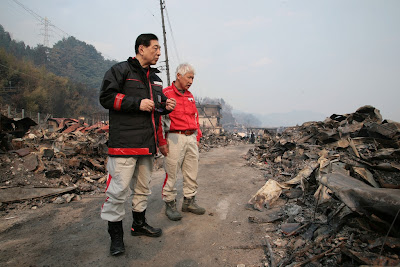
 Today when I accidently discovered this photograph of Tadateru Konoe and Naoki Kokawa (above) giving support and encouragement to rescue workers who were searching through rubble in a residential area of tsunami-hit Otsuchi, my heart lept.
Konoe said after his visit "After my long career in the Red Cross where I have seen many disasters and catastrophes, this is the worst I have ever seen. Otsuchi reminds me of Osaka and Tokyo after the Second World War when everything was destroyed and flattened. Konoe who is President of the International Federation of Red Cross and Red Crescent Tadateru Konoe and the Japanese red Cross has a huge burden on his shoulders,
The affected people feel incredible pain and bewilderment, and families who have lost loved-ones in the earthquake and tsunami will grieve interminably. It is a truly undescribeable tragedy.
But I know our President, Tadateru Konoes, who was born in 1939 before the 2nd World War started, suffered the hardships of as a child of a country reeling from aerial bombing and the explosion of two nuclear bombs, and having to grow up in temporary shelter and on rationed food - has passed through fire himself....to be able to sort out...the contents of those storehouses of sorrow, where fortunately we can also find, more often than we might have dared to expect...enough small miracles to motivate and encourage those in the field who are so often compelled, to quote a mediaeval Japanese poem, ‘to bear the unbearable and tolerate the intolerable.”
Konoe, who I have known since we worked in Bangladesh at the conclusion of the Indian-Pakistan war in early 1972, and have worked not only in Geneva, but in disasters in India, Bangladesh, Indonesia and Sri Lanka. Kokawa and I have worked closely for more than 15 years in earthquakes and tsunami in India, Pakistan, Sri Lanka and Indonesia. So I know the calibre of these men. Outwardly men of compassion with constitutions of steel and I know they will deliver.
With leadership like our President and able lieutentants such as Kokawa, Tanaka, Nagazumi, Oiwa, Dr. Mikishima, Sugai, Saito, Hori, Hiroshi Higashuira and many others who I apologise if I have forgetten you, I know this is an organisation that will provide the highest quality of rescue, relief and all round medical care, including pyscho social support. for thousands of traumatised people.
With a number of the above I have shared life-threatening moments. In Kabul in 1995 when the Taliban's were killing at least 120 people a day by rockets and mortars as they closed in on the capital, Hori and I had to share a bunker. We survived the heaviest bombardment of the year. When I came to Tokyo some years later, he gave my wife and I a beautiful gift. These are our friends in the Japanese Red Cross.
 Soldiers and a rescue worker carry a body through Kesennuma City on March 15, 2011.
This afternoon, Matthias Schmale, Under Secretary General, Programme Services Division send us this very sincere note
"There have been numerous expressions of concern and support from many of you, and we know that the whole network stands with the Japanese Red Cross in the Spirit of Togetherness inspired by Mr Tadateru Konoé, who is President of the National Society and also of our IFRC.
As we now all know, this is an unprecedented disaster, which has caused tremendous damage and loss of life. Friday’s earthquake, which measured 9.0 on the Richter scale, triggered a ten metre high tsunami that has ravaged the northeast coast of the country, surging a quarter of a mile inland and destroying everything in its path.
To date, more than 3,000 people have been rescued, but the death toll currently stands at 1,600 and is expected to rise. The most affected area is a town called Minami-Sanriku-cho in the northern part of Miyagi Prefecture. The entire village has washed away and there are grave concerns for 10,000 residents – half the town’s population.
Around 380,000 people evacuated from the tsunami and earthquake affected areas are being sheltered in 2,050 evacuation centres. Another 210,000 people living within a 20 km radius around the Fukushima nuclear power plants have also been evacuated.
The Japanese Red Cross, in its role as auxiliary to the government, has mobilized its full emergency response capacity in response to the disaster. More than 60 response teams are in operation, and 178 disaster medical teams have been deployed with another 111 teams on the way. However, the response is being hampered by continuous aftershocks, tsunami alerts and fires, and many affected areas remain inaccessible.
Earlier today I had an opportunity to briefly talk to President Konoé. The Japanese Red Cross is expressing its sincere thanks for the messages of sympathy and offers of support it has received from sister National Societies around the world. At present, the Japanese society is not launching a national or international appeal, but expressions of solidarity in the form of un-earmarked financial contributions would be gratefully received.

My old mate Patrick Fuller has been traveling with Mr. Konoe and Kokawa and last night slept in a tent and Patrick reported it was - 6 o C. As I have said previously, Patrick is one of the best humanitarian communicators in the game and his reports on most of the world's media have been outstanding.
But like the Fire Services, Police, Ambulance drivers, armed forces, para-medics, social workers, rescue workers, government administrators, who are in the frontline, and sometimes unsure about the safety of their own families and friends: Red Cross and other humanitrian workers face similar challenges of lack of sleep, hunger, cold, toxic fumes, lack of clean water, insecurities that are exacerbated as the days drag on, and the successes few. But to be President of the IFRC and the Japanese Red Cross at the same time, and to be directing and motivating two huge organisations within one movement, is an almost impossible task. But Tadateru Konoe is a talent spotter, and over the years has recruited, nurtured and coached staff and volunteers of the highest calibre, and led an International Federation of 187 Red Cross and Red Crescent Societies who are staunchly behind him. The power of humaity will triumph in this disaster.
To close this post I will let Patrick Fuller have the last words.
Many of the wounded are burn victims whose homes caught fire when the diesel from sinking fishing boats ignited the mass of debris being carried inland by the tidal surge. In one area, local residents are now too afraid to stay in their homes at night because of the frequent aftershocks and the fear of a repeat tsunami. Instead, they sleep in their cars on the second storey of a car park.
Some of the seriously injured taken to the hospital are people who were swept up in the tsunami. They’re being stretchered in with internal injuries and severe wounds. Others are at risk from pneumonia having inhaled large quantities of contaminated sea water.
Hundreds of Red Cross medical staff have come in to work at the hospital on four-day rotation from other hospitals across Japan. Whilst morale is high, medical supplies are running low, and with no electricity and problems finding fuel to run the hospital generator, conditions are difficult.
In the coming days, search and rescue efforts will turn towards the retrieval of dead bodies, which litter the devastated coastline. The hospital is setting up a special tent to store the bodies and help with the identification process.
As well as providing basic relief items such as blankets to evacuees, the Japanese Red Cross has deployed over 80 medical teams, which are based in hospitals receiving the sick and injured. The teams operate mobile clinics to provide care for the thousands of people displaced by the earthquake and tsunami.

Konoe said after his visit "After my long career in the Red Cross where I have seen many disasters and catastrophes, this is the worst I have ever seen. Otsuchi reminds me of Osaka and Tokyo after the Second World War when everything was destroyed and flattened. Konoe who is President of the International Federation of Red Cross and Red Crescent Tadateru Konoe and the Japanese red Cross has a huge burden on his shoulders,
The affected people feel incredible pain and bewilderment, and families who have lost loved-ones in the earthquake and tsunami will grieve interminably. It is a truly undescribeable tragedy.
But I know our President, Tadateru Konoes, who was born in 1939 before the 2nd World War started, suffered the hardships of as a child of a country reeling from aerial bombing and the explosion of two nuclear bombs, and having to grow up in temporary shelter and on rationed food - has passed through fire himself....to be able to sort out...the contents of those storehouses of sorrow, where fortunately we can also find, more often than we might have dared to expect...enough small miracles to motivate and encourage those in the field who are so often compelled, to quote a mediaeval Japanese poem, ‘to bear the unbearable and tolerate the intolerable.”

Konoe, who I have known since we worked in Bangladesh at the conclusion of the Indian-Pakistan war in early 1972, and have worked not only in Geneva, but in disasters in India, Bangladesh, Indonesia and Sri Lanka. Kokawa and I have worked closely for more than 15 years in earthquakes and tsunami in India, Pakistan, Sri Lanka and Indonesia. So I know the calibre of these men. Outwardly men of compassion with constitutions of steel and I know they will deliver.
With leadership like our President and able lieutentants such as Kokawa, Tanaka, Nagazumi, Oiwa, Dr. Mikishima, Sugai, Saito, Hori, Hiroshi Higashuira and many others who I apologise if I have forgetten you, I know this is an organisation that will provide the highest quality of rescue, relief and all round medical care, including pyscho social support. for thousands of traumatised people.
With a number of the above I have shared life-threatening moments. In Kabul in 1995 when the Taliban's were killing at least 120 people a day by rockets and mortars as they closed in on the capital, Hori and I had to share a bunker. We survived the heaviest bombardment of the year. When I came to Tokyo some years later, he gave my wife and I a beautiful gift. These are our friends in the Japanese Red Cross.

This afternoon, Matthias Schmale, Under Secretary General, Programme Services Division send us this very sincere note
"There have been numerous expressions of concern and support from many of you, and we know that the whole network stands with the Japanese Red Cross in the Spirit of Togetherness inspired by Mr Tadateru Konoé, who is President of the National Society and also of our IFRC.
As we now all know, this is an unprecedented disaster, which has caused tremendous damage and loss of life. Friday’s earthquake, which measured 9.0 on the Richter scale, triggered a ten metre high tsunami that has ravaged the northeast coast of the country, surging a quarter of a mile inland and destroying everything in its path.
To date, more than 3,000 people have been rescued, but the death toll currently stands at 1,600 and is expected to rise. The most affected area is a town called Minami-Sanriku-cho in the northern part of Miyagi Prefecture. The entire village has washed away and there are grave concerns for 10,000 residents – half the town’s population.
Around 380,000 people evacuated from the tsunami and earthquake affected areas are being sheltered in 2,050 evacuation centres. Another 210,000 people living within a 20 km radius around the Fukushima nuclear power plants have also been evacuated.
The Japanese Red Cross, in its role as auxiliary to the government, has mobilized its full emergency response capacity in response to the disaster. More than 60 response teams are in operation, and 178 disaster medical teams have been deployed with another 111 teams on the way. However, the response is being hampered by continuous aftershocks, tsunami alerts and fires, and many affected areas remain inaccessible.
Earlier today I had an opportunity to briefly talk to President Konoé. The Japanese Red Cross is expressing its sincere thanks for the messages of sympathy and offers of support it has received from sister National Societies around the world. At present, the Japanese society is not launching a national or international appeal, but expressions of solidarity in the form of un-earmarked financial contributions would be gratefully received.

In happier times in Tokyo. In 2002 IFRC head of regions in Asia Pacific dining with, on the left side of the table, Tanaka, Tadateru Konoe and Kokawa. We came to discuss disaster preparedness and the setting up of a regional Disaster Management Unit in the region, the brain-child of Mr. Konoe. Photo: Bob McKerrow
My old mate Patrick Fuller has been traveling with Mr. Konoe and Kokawa and last night slept in a tent and Patrick reported it was - 6 o C. As I have said previously, Patrick is one of the best humanitarian communicators in the game and his reports on most of the world's media have been outstanding.
But like the Fire Services, Police, Ambulance drivers, armed forces, para-medics, social workers, rescue workers, government administrators, who are in the frontline, and sometimes unsure about the safety of their own families and friends: Red Cross and other humanitrian workers face similar challenges of lack of sleep, hunger, cold, toxic fumes, lack of clean water, insecurities that are exacerbated as the days drag on, and the successes few. But to be President of the IFRC and the Japanese Red Cross at the same time, and to be directing and motivating two huge organisations within one movement, is an almost impossible task. But Tadateru Konoe is a talent spotter, and over the years has recruited, nurtured and coached staff and volunteers of the highest calibre, and led an International Federation of 187 Red Cross and Red Crescent Societies who are staunchly behind him. The power of humaity will triumph in this disaster.
To close this post I will let Patrick Fuller have the last words.
Many of the wounded are burn victims whose homes caught fire when the diesel from sinking fishing boats ignited the mass of debris being carried inland by the tidal surge. In one area, local residents are now too afraid to stay in their homes at night because of the frequent aftershocks and the fear of a repeat tsunami. Instead, they sleep in their cars on the second storey of a car park.
Some of the seriously injured taken to the hospital are people who were swept up in the tsunami. They’re being stretchered in with internal injuries and severe wounds. Others are at risk from pneumonia having inhaled large quantities of contaminated sea water.
Hundreds of Red Cross medical staff have come in to work at the hospital on four-day rotation from other hospitals across Japan. Whilst morale is high, medical supplies are running low, and with no electricity and problems finding fuel to run the hospital generator, conditions are difficult.
In the coming days, search and rescue efforts will turn towards the retrieval of dead bodies, which litter the devastated coastline. The hospital is setting up a special tent to store the bodies and help with the identification process.
As well as providing basic relief items such as blankets to evacuees, the Japanese Red Cross has deployed over 80 medical teams, which are based in hospitals receiving the sick and injured. The teams operate mobile clinics to provide care for the thousands of people displaced by the earthquake and tsunami.


